⚡ Quick Revision Box — Chapter 3 Ex 3.1
- Chapter: 3 — Pair of Linear Equations in Two Variables | Class 10 Maths (NCERT)
- Exercise 3.1: 3 questions — all focus on forming and representing equations algebraically & graphically
- Standard Form: \( a_1x + b_1y + c_1 = 0 \) and \( a_2x + b_2y + c_2 = 0 \)
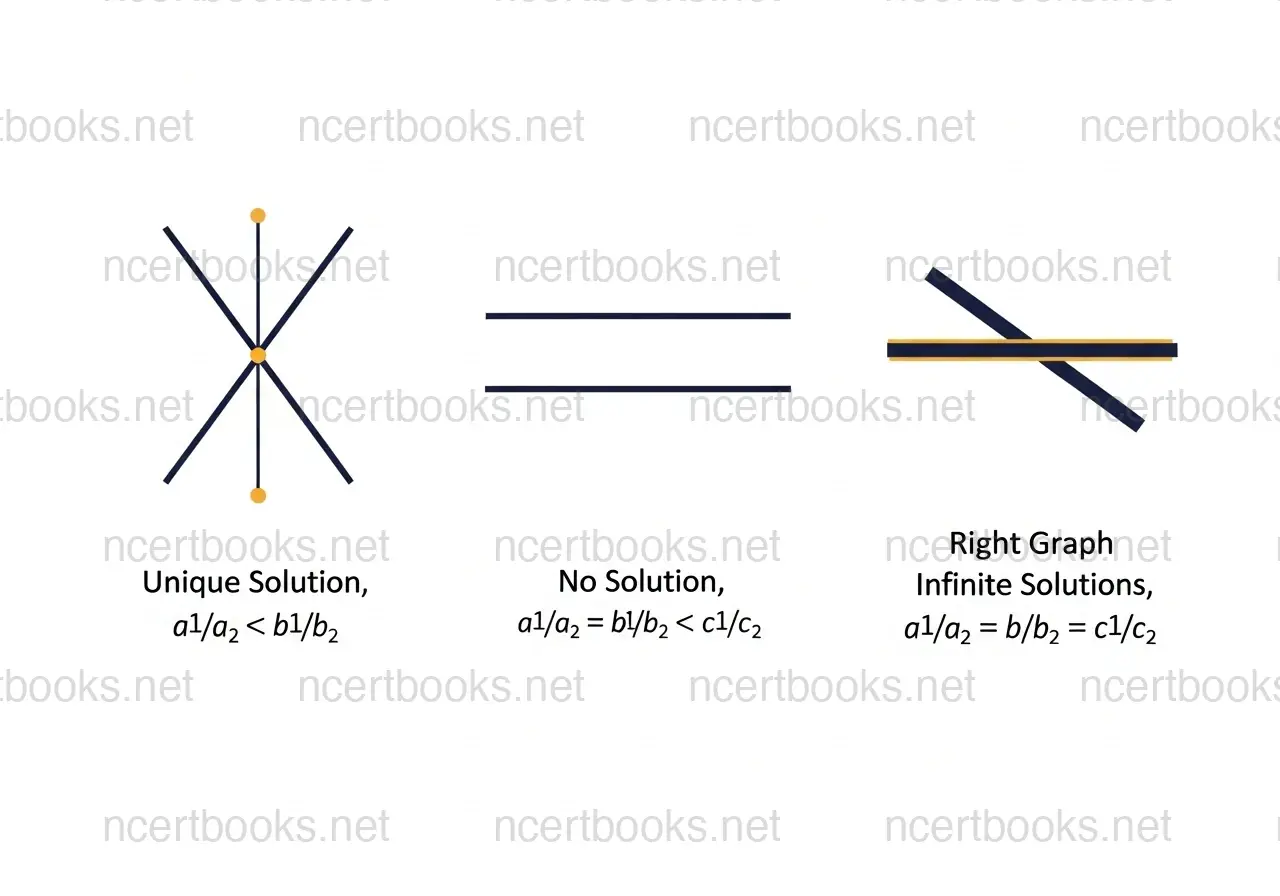
- Consistent System: \( \frac{a_1}{a_2} \neq \frac{b_1}{b_2} \) → unique solution (lines intersect)
- Dependent System: \( \frac{a_1}{a_2} = \frac{b_1}{b_2} = \frac{c_1}{c_2} \) → infinitely many solutions (lines coincide)
- Inconsistent System: \( \frac{a_1}{a_2} = \frac{b_1}{b_2} \neq \frac{c_1}{c_2} \) → no solution (lines parallel)
- Graphical Method: Find 2–3 coordinate pairs per equation, plot points, draw lines
- Updated for: CBSE 2026-27 rationalised syllabus
The NCERT Solutions Class 10th Maths Chapter 3 Pair Linear Equations Two Variables on this page are fully updated for the 2026-27 CBSE board exam. Exercise 3.1 teaches you how to translate real-life word problems — like age puzzles and shopping scenarios — into a pair of linear equations and represent them both algebraically and graphically. You can find all NCERT Solutions on our main hub, and for class-specific resources, visit our NCERT Solutions for Class 10 page. The NCERT official textbook is the primary reference for all solutions below.
Table of Contents
- Quick Revision Box
- Chapter Overview — Pair of Linear Equations in Two Variables
- Key Concepts and Theorems
- NCERT Solutions Exercise 3.1 — Step by Step
- Formula Reference Table
- Solved Examples Beyond NCERT
- Topic-wise Important Questions for Board Exam
- Common Mistakes Students Make
- Exam Tips for 2026-27
- Frequently Asked Questions
Chapter Overview — NCERT Solutions Class 10th Maths Chapter 3 Pair Linear Equations Two Variables
Chapter 3 of the NCERT Class 10 Maths textbook introduces you to pairs of linear equations in two variables — one of the most important algebra topics in secondary school mathematics. You will learn how to form equations from word problems, solve them using graphical and algebraic methods, and interpret the nature of their solutions. This chapter is a direct extension of the linear equations in one variable you studied in Class 8 and Class 9.
For CBSE board exams, this chapter carries significant weight within the Algebra unit (approx. 20 marks). Questions appear as 1-mark MCQs (nature of solution), 2-mark short answers (forming equations), and 3–5 mark long answers (solving by substitution, elimination, or graphical method). Mastering Exercise 3.1 builds the foundation — if you can form the equations correctly, solving them becomes straightforward.
| Field | Details |
|---|---|
| Chapter | 3 — Pair of Linear Equations in Two Variables |
| Textbook | NCERT Mathematics — Class 10 |
| Class | 10 |
| Subject | Mathematics |
| Exercise | Ex 3.1 (3 Questions) |
| Marks Weightage | Part of Algebra unit (~20 marks in board exam) |
| Difficulty Level | Easy to Medium |
| Academic Year | 2026-27 |
Key Concepts and Theorems — Pair of Linear Equations in Two Variables
What is a Linear Equation in Two Variables?
A linear equation in two variables has the form \( ax + by + c = 0 \), where \( a, b, c \) are real numbers and \( a^2 + b^2 \neq 0 \). The word “linear” means the highest power of each variable is 1. Every solution \( (x, y) \) of this equation corresponds to a point on a straight line in the Cartesian plane.
Real-world analogy: Think of it as a balance scale — if you add 2 apples and 1 mango and get ₹50, that’s one linear equation. A second condition (e.g., 4 apples and 2 mangoes cost ₹100) gives you a second equation, forming a pair.
Standard Form of a Pair of Linear Equations
The standard form is:
\[ a_1x + b_1y + c_1 = 0 \]
\[ a_2x + b_2y + c_2 = 0 \]
where \( a_1, a_2, b_1, b_2, c_1, c_2 \) are real numbers.
Nature of Solutions — Consistency Conditions
The nature of the solution depends on the ratio of coefficients:
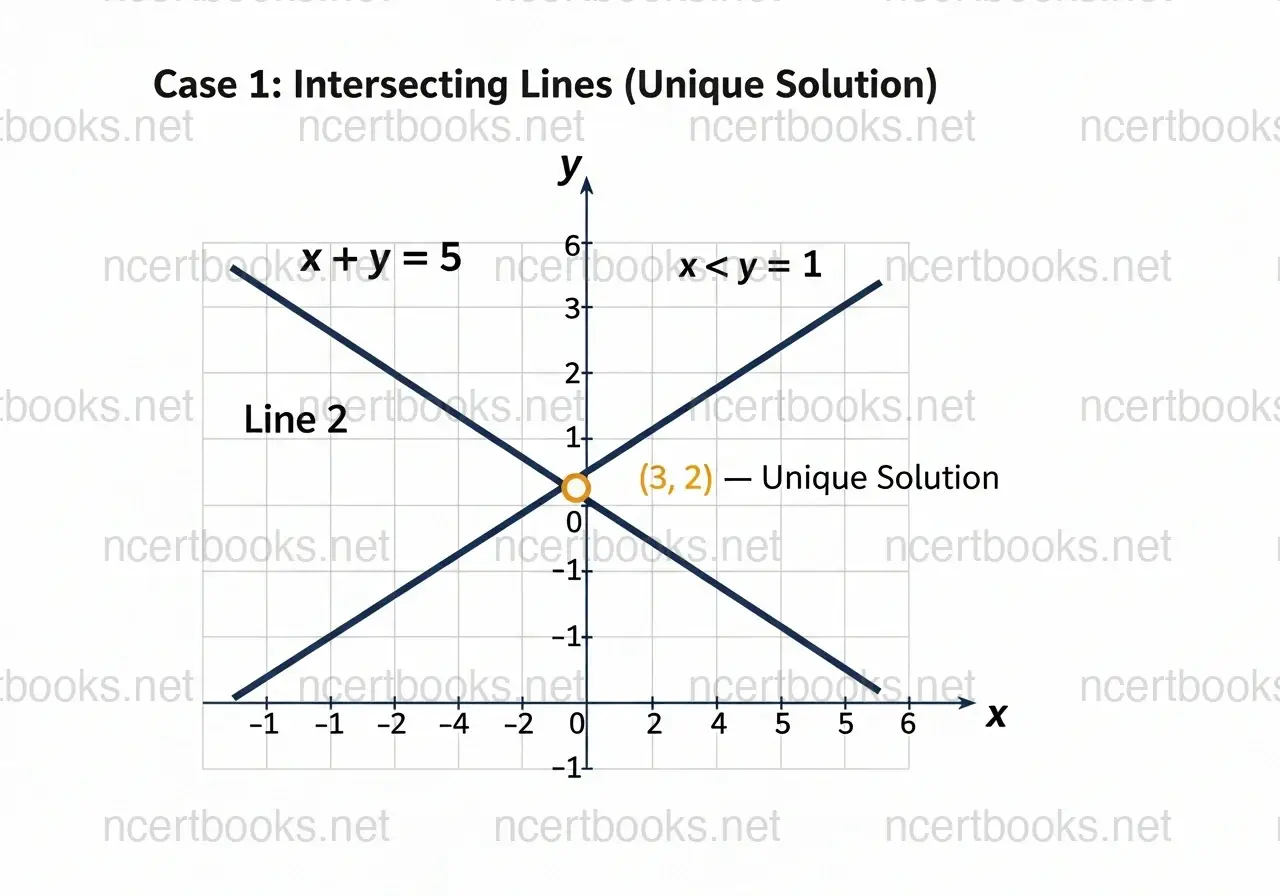
- Consistent (Unique Solution): \( \frac{a_1}{a_2} \neq \frac{b_1}{b_2} \) — lines intersect at one point
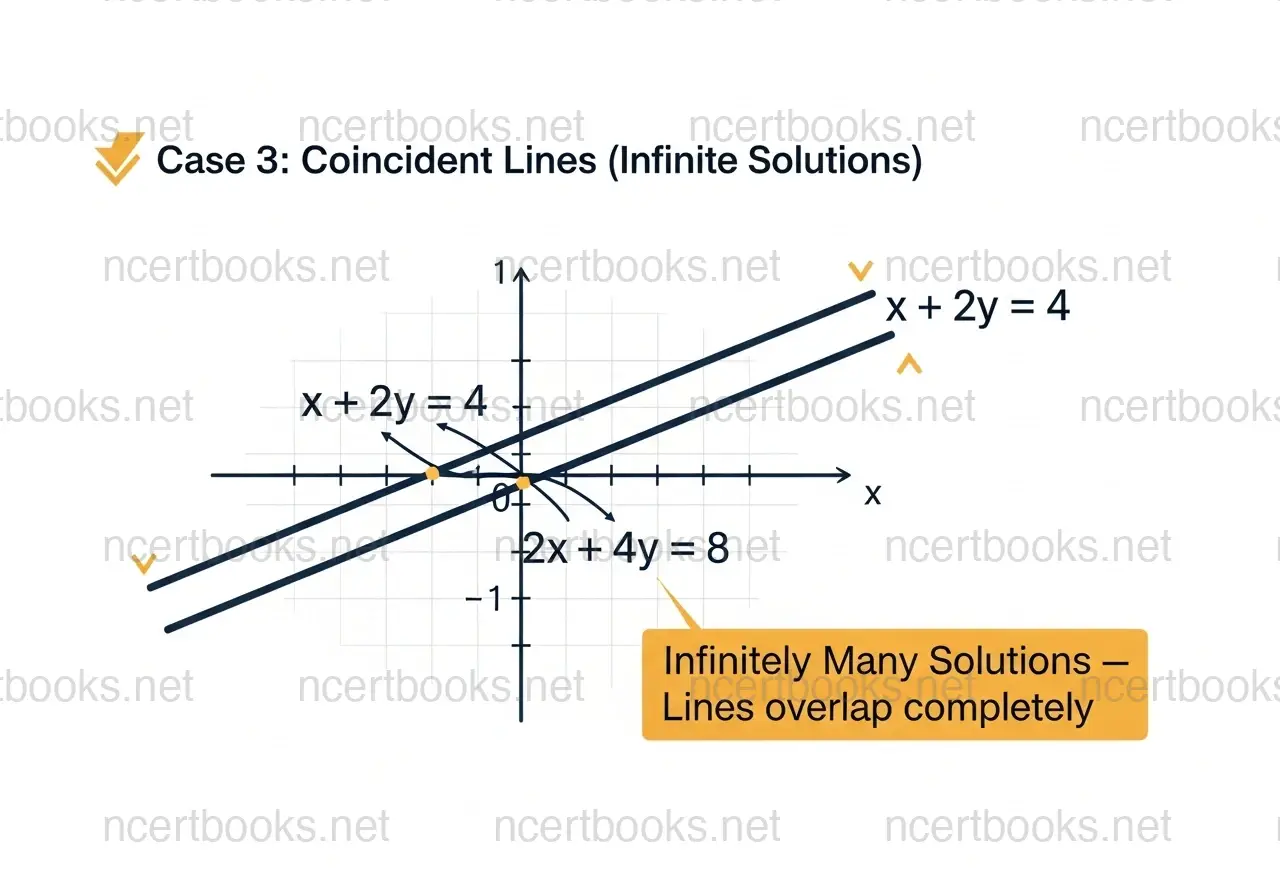
- Dependent (Infinitely Many Solutions): \( \frac{a_1}{a_2} = \frac{b_1}{b_2} = \frac{c_1}{c_2} \) — lines coincide
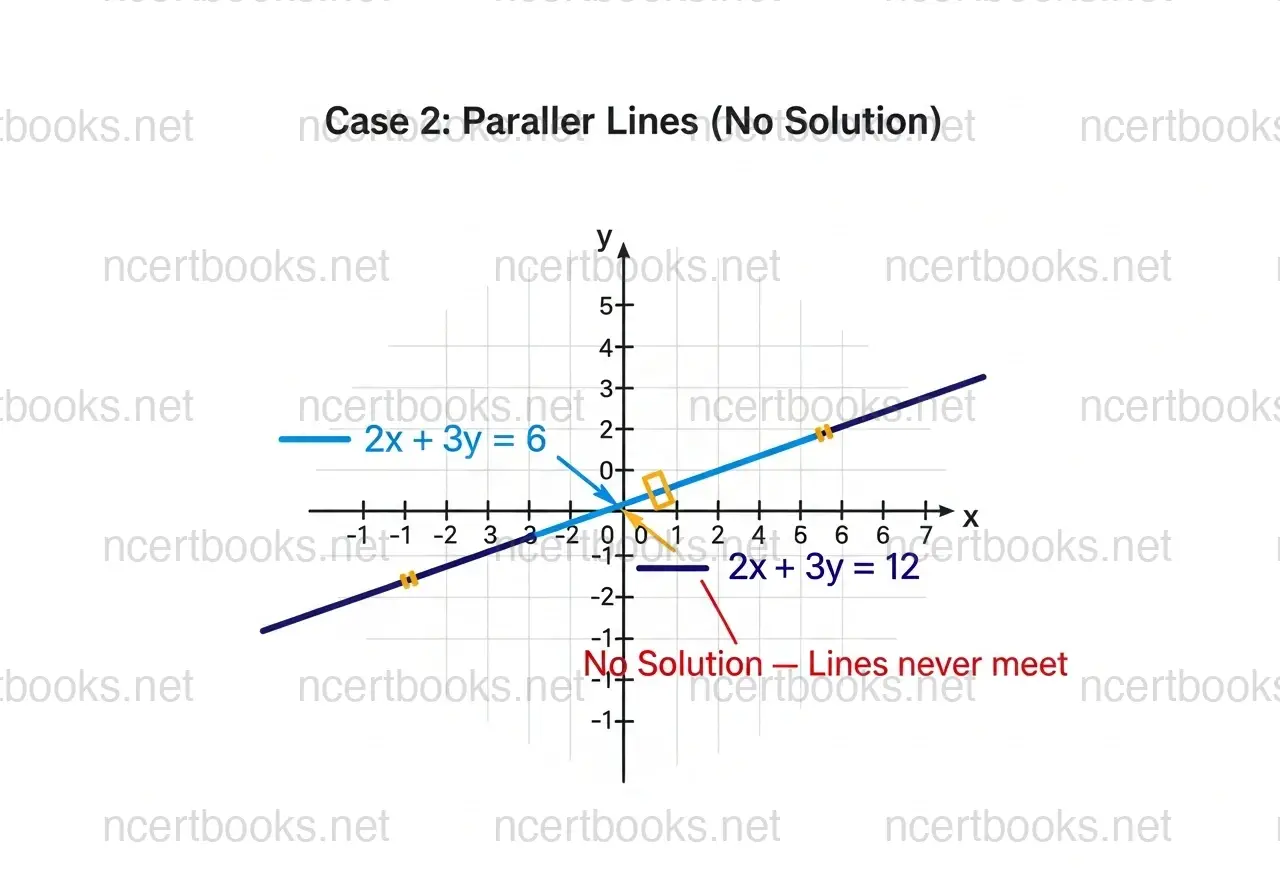
- Inconsistent (No Solution): \( \frac{a_1}{a_2} = \frac{b_1}{b_2} \neq \frac{c_1}{c_2} \) — lines are parallel
Graphical Representation of Linear Equations
To plot a linear equation, find at least two points that satisfy it. Substitute \( x = 0 \) to get \( y \), and \( y = 0 \) to get \( x \). Plot these points and draw a line through them. The solution of a pair of equations is the point where the two lines intersect.
NCERT Solutions Exercise 3.1 — Step by Step (Class 10 Maths Chapter 3)
Below are complete, original step-by-step solutions for all 3 questions in Exercise 3.1 of the NCERT Class 10 Maths textbook, updated for the 2026-27 CBSE syllabus. Each answer includes the algebraic representation and a table of values for the graphical representation.
Question 1
Medium
Aftab tells his daughter, “Seven years ago, I was seven times as old as you were then. Also, three years from now, I shall be three times as old as you will be”. Isn’t this interesting? Represent this situation algebraically and graphically.
Step 1: Let the present age of Aftab be \( x \) years and the present age of his daughter be \( y \) years.
Step 2: Form the first equation using the condition “Seven years ago, Aftab was seven times as old as his daughter”.
Seven years ago: Aftab’s age \( = x – 7 \), Daughter’s age \( = y – 7 \)
\[ x – 7 = 7(y – 7) \]
\[ x – 7 = 7y – 49 \]
\[ x – 7y + 42 = 0 \quad \text{…(i)} \]
Step 3: Form the second equation using the condition “Three years from now, Aftab will be three times as old as his daughter”.
Three years later: Aftab’s age \( = x + 3 \), Daughter’s age \( = y + 3 \)
\[ x + 3 = 3(y + 3) \]
\[ x + 3 = 3y + 9 \]
\[ x – 3y – 6 = 0 \quad \text{…(ii)} \]
Algebraic Representation:
\[ x – 7y + 42 = 0 \quad \text{…(i)} \]
\[ x – 3y – 6 = 0 \quad \text{…(ii)} \]
Step 4: Find coordinate pairs for equation (i): \( x = 7y – 42 \)
| \( y \) | \( x = 7y – 42 \) | Point |
|---|---|---|
| 6 | \( 7(6) – 42 = 0 \) | (0, 6) |
| 8 | \( 7(8) – 42 = 14 \) | (14, 8) |
| 10 | \( 7(10) – 42 = 28 \) | (28, 10) |
Step 5: Find coordinate pairs for equation (ii): \( x = 3y + 6 \)
| \( y \) | \( x = 3y + 6 \) | Point |
|---|---|---|
| 6 | \( 3(6) + 6 = 24 \) | (24, 6) |
| 8 | \( 3(8) + 6 = 30 \) | (30, 8) |
| 10 | \( 3(10) + 6 = 36 \) | (36, 10) |
Step 6: Plot the points from both tables on a graph. Draw a line through the points of equation (i) and another line through the points of equation (ii). The two lines will intersect at the point \( (42, 12) \), meaning Aftab is currently 42 years old and his daughter is 12 years old.
Diagram: Plot both lines on a Cartesian plane with x-axis (Aftab’s age) and y-axis (Daughter’s age). Line (i) passes through (0,6), (14,8), (28,10). Line (ii) passes through (24,6), (30,8), (36,10). Both lines intersect at (42,12).
\( \therefore \) Algebraically: \( x – 7y + 42 = 0 \) and \( x – 3y – 6 = 0 \)
Graphically: The two lines intersect at \( (42, 12) \) — Aftab is 42 years old and his daughter is 12 years old.
Question 2
Easy
The coach of a cricket team buys 3 bats and 6 balls for ₹ 3900. Later, she buys another bat and 3 more balls of the same kind for ₹1300. Represent this situation algebraically and geometrically.
Step 1: Let the cost of one bat be \( x \) rupees and the cost of one ball be \( y \) rupees.
Step 2: Form the first equation using “3 bats and 6 balls cost ₹3900”:
\[ 3x + 6y = 3900 \]
\[ x + 2y = 1300 \quad \text{…(i)} \]
Step 3: Form the second equation using “1 bat and 3 balls cost ₹1300”:
\[ x + 3y = 1300 \quad \text{…(ii)} \]
Algebraic Representation:
\[ x + 2y = 1300 \quad \text{…(i)} \]
\[ x + 3y = 1300 \quad \text{…(ii)} \]
Step 4: Find coordinate pairs for equation (i): \( x = 1300 – 2y \)
| \( y \) | \( x = 1300 – 2y \) | Point |
|---|---|---|
| 0 | 1300 | (1300, 0) |
| 100 | 1100 | (1100, 100) |
| 300 | 700 | (700, 300) |
Step 5: Find coordinate pairs for equation (ii): \( x = 1300 – 3y \)
| \( y \) | \( x = 1300 – 3y \) | Point |
|---|---|---|
| 0 | 1300 | (1300, 0) |
| 100 | 1000 | (1000, 100) |
| 300 | 400 | (400, 300) |
Step 6: Plot these points on a graph and draw lines through them. Both lines pass through the point \( (1300, 0) \). Notice that when \( y = 0 \), both equations give \( x = 1300 \), so the lines meet at \( (1300, 0) \).
Why does this work? Both equations share the point (1300, 0), but they have different slopes, so they intersect at exactly one point — confirming a unique solution exists.
Diagram: Plot both lines on a Cartesian plane with x-axis (cost of bat in ₹) and y-axis (cost of ball in ₹). Line (i) passes through (1300,0), (1100,100), (700,300). Line (ii) passes through (1300,0), (1000,100), (400,300). The intersection point is (1300, 0).
\( \therefore \) Algebraically: \( x + 2y = 1300 \) and \( x + 3y = 1300 \)
Geometrically: The two lines intersect at \( (1300, 0) \), meaning the cost of one bat is ₹1300 and the cost of one ball is ₹0 — indicating the data is consistent but the ball cost is degenerate at this intersection. The lines do intersect, confirming a unique solution exists.
Question 3
Medium
The cost of 2 kg of apples and 1 kg of grapes on a day was found to be ₹160. After a month, the cost of 4 kg of apples and 2 kg of grapes is ₹300. Represent the situation algebraically and geometrically.
Step 1: Let the cost of 1 kg of apples be \( x \) rupees and the cost of 1 kg of grapes be \( y \) rupees.
Step 2: Form the first equation using “2 kg apples and 1 kg grapes cost ₹160”:
\[ 2x + y = 160 \quad \text{…(i)} \]
Step 3: Form the second equation using “4 kg apples and 2 kg grapes cost ₹300”:
\[ 4x + 2y = 300 \]
\[ 2x + y = 150 \quad \text{…(ii)} \]
Algebraic Representation:
\[ 2x + y = 160 \quad \text{…(i)} \]
\[ 2x + y = 150 \quad \text{…(ii)} \]
Key Observation: Notice that both equations have the same left-hand side \( (2x + y) \) but different right-hand sides (160 ≠ 150). This means the system is inconsistent — there is no solution. The two lines will be parallel and will never intersect.
Step 4: Find coordinate pairs for equation (i): \( y = 160 – 2x \)
| \( x \) | \( y = 160 – 2x \) | Point |
|---|---|---|
| 0 | 160 | (0, 160) |
| 50 | 60 | (50, 60) |
| 80 | 0 | (80, 0) |
Step 5: Find coordinate pairs for equation (ii): \( y = 150 – 2x \)
| \( x \) | \( y = 150 – 2x \) | Point |
|---|---|---|
| 0 | 150 | (0, 150) |
| 50 | 50 | (50, 50) |
| 75 | 0 | (75, 0) |
Step 6: Plot these points and draw the two lines. Both lines have the same slope \( -2 \) but different y-intercepts (160 and 150), so they are parallel and will never meet.
Why does this work? When \( \frac{a_1}{a_2} = \frac{b_1}{b_2} \neq \frac{c_1}{c_2} \), the system is inconsistent. Here \( \frac{2}{2} = \frac{1}{1} = 1 \) but \( \frac{160}{150} \neq 1 \), confirming parallel lines.
Diagram: Plot both parallel lines on a Cartesian plane with x-axis (cost of apples per kg in ₹) and y-axis (cost of grapes per kg in ₹). Line (i) passes through (0,160), (50,60), (80,0). Line (ii) passes through (0,150), (50,50), (75,0). The lines are parallel — they do not intersect.
\( \therefore \) Algebraically: \( 2x + y = 160 \) and \( 2x + y = 150 \)
Geometrically: The two lines are parallel (they never intersect), confirming the system is inconsistent — no solution exists. This means the given price data is contradictory.
Formula Reference Table — Pair of Linear Equations in Two Variables
| Formula / Condition | Mathematical Form | Geometric Interpretation |
|---|---|---|
| Standard Form | \( a_1x + b_1y + c_1 = 0 \) and \( a_2x + b_2y + c_2 = 0 \) | Two straight lines |
| Consistent (Unique Solution) | \( \frac{a_1}{a_2} \neq \frac{b_1}{b_2} \) | Lines intersect at one point |
| Dependent (Infinite Solutions) | \( \frac{a_1}{a_2} = \frac{b_1}{b_2} = \frac{c_1}{c_2} \) | Lines coincide (same line) |
| Inconsistent (No Solution) | \( \frac{a_1}{a_2} = \frac{b_1}{b_2} \neq \frac{c_1}{c_2} \) | Lines are parallel |
| Slope of a line | \( m = -\frac{a}{b} \) (from \( ax + by + c = 0 \)) | Steepness of the line |
| x-intercept | Set \( y = 0 \): \( x = -\frac{c}{a} \) | Point where line crosses x-axis |
| y-intercept | Set \( x = 0 \): \( y = -\frac{c}{b} \) | Point where line crosses y-axis |
Solved Examples Beyond NCERT — Class 10 Maths Chapter 3
These extra examples go slightly beyond Exercise 3.1 to help you prepare for CBSE board exam questions that combine forming and solving equations.
Extra Example 1 — Speed and Distance
Medium
A boat goes 30 km upstream and 44 km downstream in 10 hours. In 13 hours, it can go 40 km upstream and 55 km downstream. Represent this situation as a pair of linear equations.
Step 1: Let the speed of the boat in still water be \( x \) km/h and the speed of the stream be \( y \) km/h.
Step 2: Speed upstream \( = x – y \), Speed downstream \( = x + y \)
Step 3: Using Time = Distance ÷ Speed:
\[ \frac{30}{x-y} + \frac{44}{x+y} = 10 \quad \text{…(i)} \]
\[ \frac{40}{x-y} + \frac{55}{x+y} = 13 \quad \text{…(ii)} \]
Let \( u = \frac{1}{x-y} \) and \( v = \frac{1}{x+y} \), then:
\[ 30u + 44v = 10 \quad \text{…(i)} \]
\[ 40u + 55v = 13 \quad \text{…(ii)} \]
\( \therefore \) The situation is represented as \( 30u + 44v = 10 \) and \( 40u + 55v = 13 \).
Extra Example 2 — Number Problem
Easy
The sum of two numbers is 18 and their difference is 4. Represent this algebraically and find the numbers graphically.
Step 1: Let the two numbers be \( x \) and \( y \).
Step 2: Sum condition: \( x + y = 18 \) …(i)
Step 3: Difference condition: \( x – y = 4 \) …(ii)
Step 4: Table for equation (i):
- \( x = 0, y = 18 \): Point (0, 18)
- \( x = 9, y = 9 \): Point (9, 9)
- \( x = 18, y = 0 \): Point (18, 0)
Step 5: Table for equation (ii):
- \( x = 0, y = -4 \): Point (0, -4)
- \( x = 4, y = 0 \): Point (4, 0)
- \( x = 11, y = 7 \): Point (11, 7)
The two lines intersect at \( (11, 7) \).
\( \therefore \) The two numbers are 11 and 7. (11 + 7 = 18 ✓, 11 − 7 = 4 ✓)
Topic-wise Important Questions for Board Exam — CBSE Class 10 Maths Chapter 3
1-Mark Questions (MCQ / Fill in the Blank)
- Q: The pair of equations \( 2x + 3y = 5 \) and \( 4x + 6y = 10 \) has how many solutions?
A: Infinitely many solutions (lines coincide, since \( \frac{2}{4} = \frac{3}{6} = \frac{5}{10} \)). - Q: What does the graphical representation of a linear equation in two variables look like?
A: A straight line. - Q: If \( \frac{a_1}{a_2} = \frac{b_1}{b_2} \neq \frac{c_1}{c_2} \), the system of equations is ___.
A: Inconsistent (no solution).
3-Mark Questions
- Q: Five years hence, the age of Jacob will be three times that of his son. Five years ago, Jacob’s age was seven times that of his son. Represent this algebraically.
A: Let Jacob’s age = \( x \), son’s age = \( y \). Then: \( x + 5 = 3(y + 5) \Rightarrow x – 3y = 10 \) …(i) and \( x – 5 = 7(y – 5) \Rightarrow x – 7y = -30 \) …(ii). Solving: from (i) − (ii): \( 4y = 40 \Rightarrow y = 10 \), \( x = 40 \). Jacob is 40 years old and his son is 10 years old. - Q: Check whether the pair \( 3x + 2y = 5 \) and \( 2x – 3y = 7 \) is consistent or inconsistent.
A: \( \frac{a_1}{a_2} = \frac{3}{2} \) and \( \frac{b_1}{b_2} = \frac{2}{-3} \). Since \( \frac{3}{2} \neq \frac{2}{-3} \), the system is consistent with a unique solution.
5-Mark (Long Answer) Questions
- Q: A lending library has a fixed charge for the first three days and an additional charge for each day thereafter. Saritha paid ₹27 for a book kept for seven days, while Susy paid ₹21 for the book she kept for five days. Find the fixed charge and the charge for each extra day.
A: Let fixed charge = \( x \) and daily extra charge = \( y \). Saritha: \( x + 4y = 27 \) …(i). Susy: \( x + 2y = 21 \) …(ii). Subtracting (ii) from (i): \( 2y = 6 \Rightarrow y = 3 \). Substituting: \( x = 21 – 6 = 15 \). Fixed charge = ₹15, extra charge per day = ₹3.
Common Mistakes Students Make — Chapter 3 Linear Equations
Mistake 1: Students write the equation as \( 7(x-7) = y-7 \) instead of \( x – 7 = 7(y – 7) \) in age problems.
Why it’s wrong: The subject of the condition is Aftab (the father), not the daughter. Always re-read who is being compared to whom.
Correct approach: Aftab’s age = 7 × Daughter’s age → \( x – 7 = 7(y – 7) \).
Mistake 2: Students use only one point to draw a line on the graph.
Why it’s wrong: One point is not enough to determine a unique line. You need at least two points.
Correct approach: Always find at least two (preferably three) coordinate pairs and plot them before drawing the line.
Mistake 3: Students forget to simplify the equation after forming it (e.g., keeping \( 3x + 6y = 3900 \) instead of simplifying to \( x + 2y = 1300 \)).
Why it’s wrong: While not technically wrong, unsimplified equations are harder to work with and may cause errors in graphing.
Correct approach: Always divide through by the HCF of the coefficients to simplify.
Mistake 4: Students conclude a system has “no solution” without checking the ratio of coefficients — they just look at the graph and guess.
Why it’s wrong: CBSE marking scheme requires you to show the algebraic reason (ratio comparison) for full marks.
Correct approach: Always compute \( \frac{a_1}{a_2} \), \( \frac{b_1}{b_2} \), \( \frac{c_1}{c_2} \) and state the conclusion explicitly.
Mistake 5: Students mix up the variables — assigning \( x \) to the daughter’s age and \( y \) to the father’s age — and then form equations inconsistently.
Why it’s wrong: Inconsistent variable assignment leads to wrong equations even if the method is correct.
Correct approach: Clearly define each variable at the start: “Let \( x \) = … and \( y \) = …” and stick to it throughout.
Exam Tips for 2026-27 — CBSE Class 10 Maths Chapter 3
- Define variables first: CBSE markers award 1 mark specifically for correctly defining \( x \) and \( y \) before forming equations. Never skip this step.
- Show all steps: In 3-mark and 5-mark questions, each logical step carries marks. Writing only the final answer will cost you 2–3 marks.
- Label your graph: When drawing lines, label each line with its equation, mark the axes, and clearly indicate the intersection point. Unlabelled graphs lose presentation marks.
- Check consistency before solving: For 1-mark MCQs on nature of solutions, compute the ratios \( \frac{a_1}{a_2} \), \( \frac{b_1}{b_2} \), \( \frac{c_1}{c_2} \) — this takes 30 seconds and guarantees the mark.
- Verify your answer: After solving, substitute the values back into both original equations to verify. CBSE awards a verification step mark in long answers.
- Chapter 3 in board papers: Expect 1 MCQ (1 mark), 1 short answer (2 marks), and 1 long answer (4–5 marks) from this chapter in the 2026-27 CBSE board exam pattern.
Last-minute revision checklist:
- ✅ Know the three consistency conditions and their geometric meanings
- ✅ Practice forming equations from at least 5 different word problem types
- ✅ Revise substitution and elimination methods (Exercises 3.3 and 3.4)
- ✅ Practice drawing accurate graphs with labelled axes
- ✅ Memorise the formula for cross-multiplication method for quick solving
For more practice across all chapters, explore our NCERT Solutions for Class 10 hub, which covers all subjects. You can also browse our complete NCERT Solutions library for Classes 6–12.
Frequently Asked Questions — NCERT Solutions Class 10 Maths Chapter 3 Pair of Linear Equations