⚡ Quick Revision Box — Some Applications of Trigonometry Class 10
- Chapter: 9 — Some Applications of Trigonometry | Class 10 Maths NCERT
- Only Exercise: Exercise 9.1 — 16 questions (all based on heights and distances)
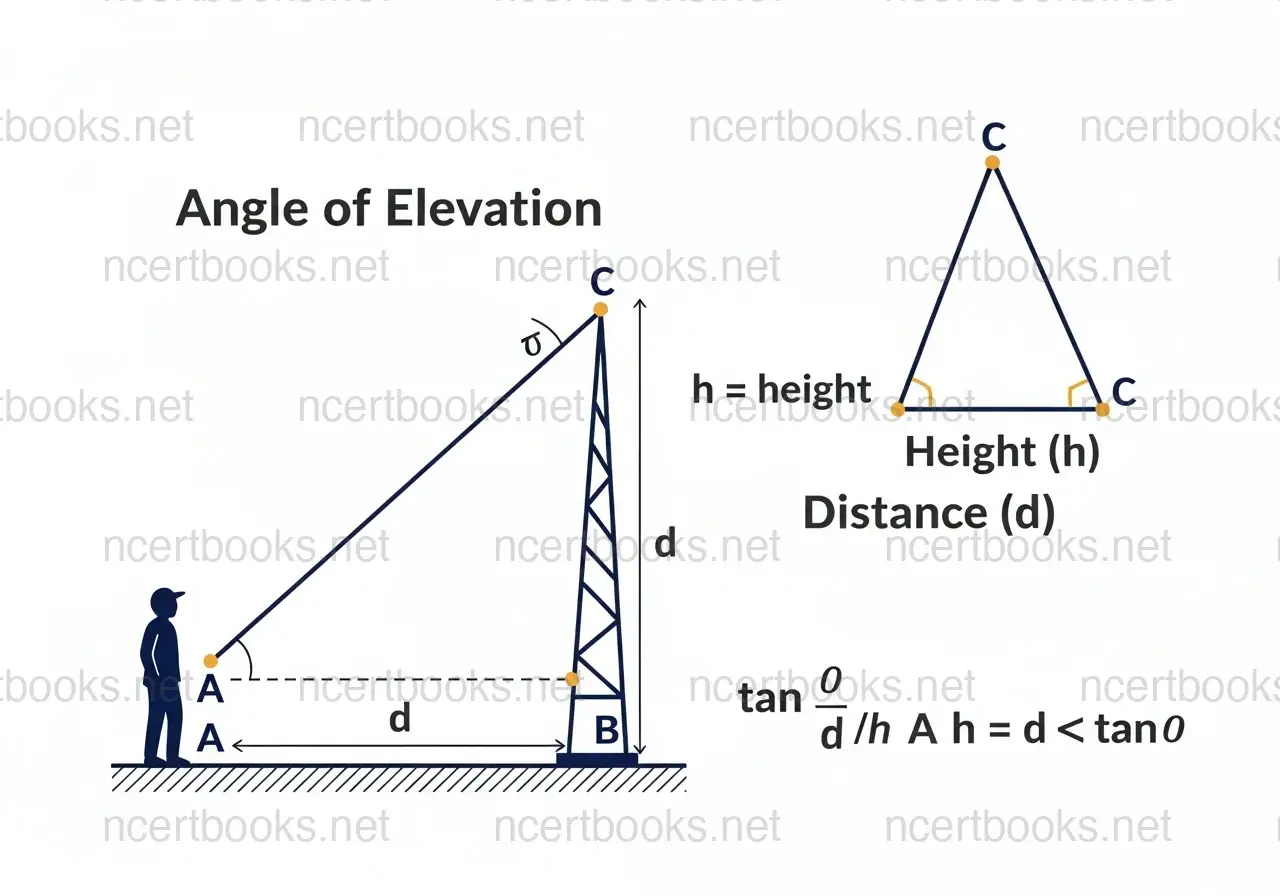
- Angle of Elevation (उन्नयन कोण): Angle formed when you look upward from horizontal to an object
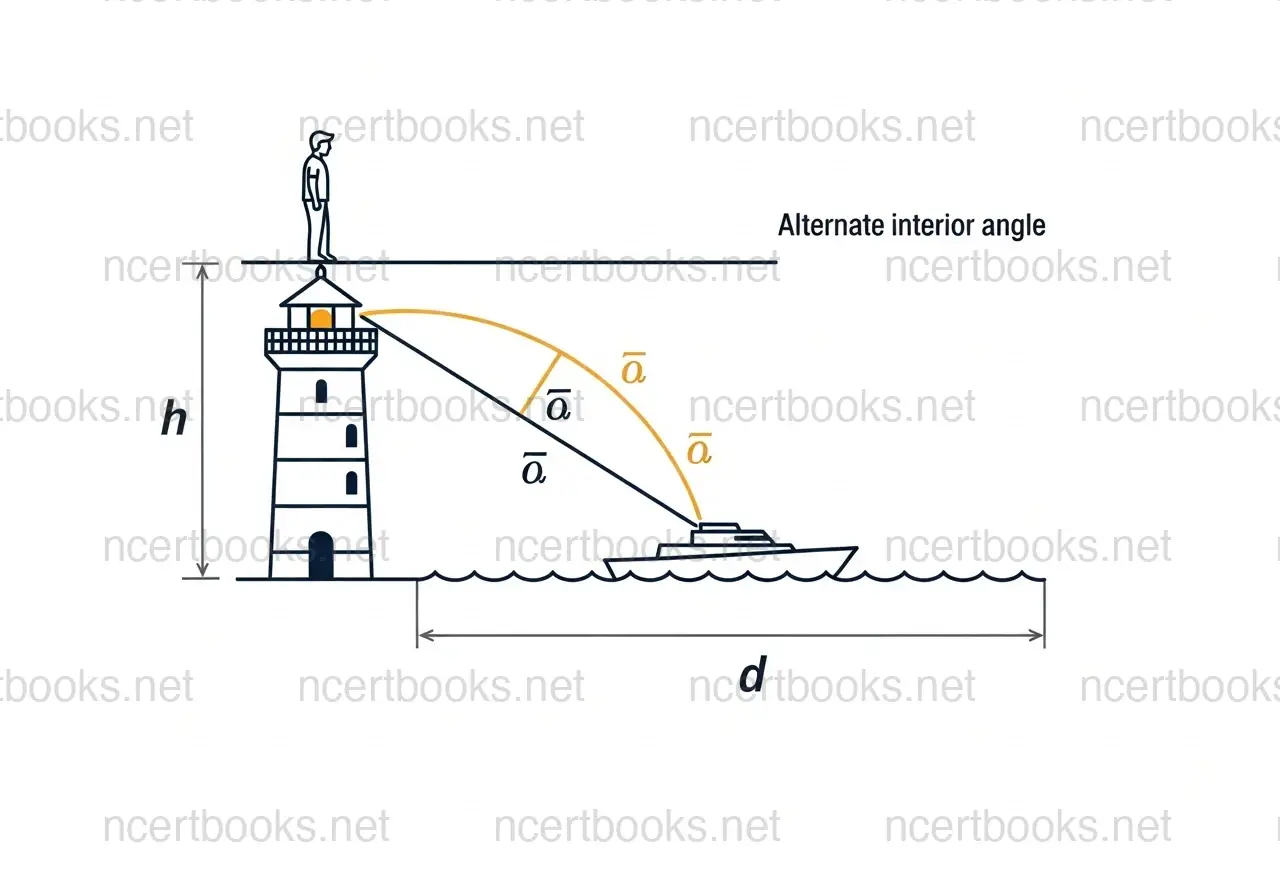
- Angle of Depression (अवनमन कोण): Angle formed when you look downward from horizontal to an object
- Key Formula: \( \tan\theta = \frac{\text{Opposite}}{\text{Adjacent}} \) — used in almost every question
- Standard Values: \( \tan 30° = \frac{1}{\sqrt{3}},\ \tan 45° = 1,\ \tan 60° = \sqrt{3} \)
- Board Exam Weightage: Trigonometry unit carries ~12 marks; Chapter 9 questions appear as 2–5 mark problems
- Tip: Always draw a labelled diagram before solving — CBSE awards marks for diagrams
The NCERT Solutions for Class 10 Maths Some Applications of Trigonometry (Chapter 9, Exercise 9.1) on this page are fully updated for the 2026-27 CBSE syllabus. You will find complete, step-by-step solutions to all 16 questions, with clear diagrams, LaTeX-rendered math, and board exam tips. These solutions are part of our comprehensive NCERT Solutions for Class 10 and are aligned with the official NCERT textbook. Whether you are revising for your board exam or completing homework, this page covers everything you need from Chapter 9.
This chapter is part of the broader NCERT Solutions collection on ncertbooks.net. Chapter 9 builds directly on Chapter 8 (Introduction to Trigonometry) and applies sin, cos, and tan ratios to real-world problems involving heights of towers, poles, buildings, and distances on the ground. Mastering this chapter helps you score confidently in the Trigonometry section of your CBSE board exam 2026-27.
- Quick Revision Box
- Chapter Overview
- Key Concepts: Angle of Elevation, Angle of Depression & Trigonometric Ratios
- Formula Reference Table
- NCERT Solutions Exercise 9.1 — All 16 Questions
- Solved Examples Beyond NCERT
- Important Questions for Board Exam 2026-27
- Common Mistakes Students Make
- Exam Tips for 2026-27
- Frequently Asked Questions
Chapter Overview — NCERT Solutions for Class 10 Maths Some Applications of Trigonometry
Chapter 9 of the Class 10 NCERT Maths textbook, Some Applications of Trigonometry, teaches you how to use trigonometric ratios to find heights of objects and distances between points that cannot be measured directly. The chapter has one exercise — Exercise 9.1 — with 16 problems covering a wide range of real-life scenarios such as towers, kites, statues, ships, and moving cars.
For the CBSE board exam 2026-27, the Trigonometry unit (Chapters 8 and 9) carries approximately 12 marks. Chapter 9 questions typically appear as 2-mark or 3-mark application problems, and sometimes as a 5-mark long-answer question. Drawing a correct diagram is mandatory and earns you marks even if your calculation is incomplete.
Before starting this chapter, make sure you are comfortable with: (1) the three basic trigonometric ratios — sin, cos, tan; (2) their standard values at 30°, 45°, and 60°; and (3) the Pythagoras theorem. These are covered in Class 10 Maths Chapter 8.
| Detail | Information |
|---|---|
| Chapter | 9 — Some Applications of Trigonometry |
| Textbook | NCERT Mathematics — Class 10 |
| Exercise | Exercise 9.1 (16 Questions) |
| Subject | Mathematics |
| Board | CBSE (2026-27) |
| Marks Weightage | ~12 marks (Trigonometry Unit) |
| Difficulty Level | Medium to Hard |
| Prerequisites | Chapter 8 — Introduction to Trigonometry |
Key Concepts: Angle of Elevation, Angle of Depression & Trigonometric Ratios
Angle of Elevation (उन्नयन कोण)
When you stand on the ground and look upward at an object (like the top of a tower), the angle your line of sight makes with the horizontal is called the angle of elevation. In Hindi, this is called उन्नयन कोण. In problems, if the angle of elevation is \( \theta \) and the horizontal distance is known, you use \( \tan\theta \) to find the height.
Angle of Depression (अवनमन कोण)
When you are at a height and look downward at an object below, the angle your line of sight makes with the horizontal is the angle of depression. In Hindi: अवनमन कोण. A key fact: the angle of depression from point A to point B equals the angle of elevation from point B to point A (alternate interior angles).
Standard Trigonometric Values You Must Know
Almost every question in Exercise 9.1 uses these values. Memorise them before your exam:
| Angle | sin | cos | tan |
|---|---|---|---|
| 30° | \( \frac{1}{2} \) | \( \frac{\sqrt{3}}{2} \) | \( \frac{1}{\sqrt{3}} \) |
| 45° | \( \frac{1}{\sqrt{2}} \) | \( \frac{1}{\sqrt{2}} \) | \( 1 \) |
| 60° | \( \frac{\sqrt{3}}{2} \) | \( \frac{1}{2} \) | \( \sqrt{3} \) |
Formula Reference Table — Heights and Distances
| Formula Name | Formula | Variables | When to Use |
|---|---|---|---|
| Tan of angle of elevation | \( \tan\theta = \frac{h}{d} \) | h = height, d = horizontal distance | Finding height or distance from ground |
| Sin of angle | \( \sin\theta = \frac{\text{Opposite}}{\text{Hypotenuse}} \) | Opposite = perpendicular side | Finding length of rope/string/ladder |
| Cos of angle | \( \cos\theta = \frac{\text{Adjacent}}{\text{Hypotenuse}} \) | Adjacent = base side | Finding horizontal projection |
| Pythagoras Theorem | \( h^2 + d^2 = l^2 \) | l = hypotenuse (rope/string) | Verification or finding third side |
| Angle of depression = Angle of elevation | \( \angle\text{dep} = \angle\text{elev} \) | Alternate interior angles | Two-observer problems |
NCERT Solutions for Class 10 Maths Some Applications of Trigonometry — Exercise 9.1 (All 16 Questions)
Below are complete, step-by-step solutions for all 16 questions of Exercise 9.1. Each solution includes a diagram description, working steps, and the final answer in a highlighted box.
Question 1
Easy
A circus artist is climbing a 20 m long rope, which is tightly stretched and tied from the top of a vertical pole to the ground. Find the height of the pole, if the angle made by the rope with the ground level is 30°.
Key Concept: The rope is the hypotenuse of a right triangle. The pole is the perpendicular (opposite side). The angle at the ground is 30°.
Step 1: Let the height of the pole be \( h \) metres. The rope length (hypotenuse) = 20 m. Angle with ground = 30°.
Step 2: Using sin ratio (opposite/hypotenuse):
\[ \sin 30° = \frac{h}{20} \]
Step 3: Substitute \( \sin 30° = \frac{1}{2} \):
\[ \frac{1}{2} = \frac{h}{20} \]
\[ h = 20 \times \frac{1}{2} = 10 \text{ m} \]
\( \therefore \) The height of the pole = 10 m
Question 2
Medium
A tree breaks due to storm and the broken part bends so that the top of the tree touches the ground making an angle 30° with it. The distance between the foot of the tree to the point where the top touches the ground is 8 m. Find the height of the tree.
Key Concept: The broken part of the tree forms the hypotenuse, the standing part is the perpendicular, and the distance on the ground is the base. Total height = standing part + broken part (length).
Step 1: Let the standing part of the tree = \( h_1 \) m and the broken part = \( l \) m. The distance on the ground = 8 m. Angle = 30°.
Step 2: Using tan for the standing part:
\[ \tan 30° = \frac{h_1}{8} \]
\[ \frac{1}{\sqrt{3}} = \frac{h_1}{8} \]
\[ h_1 = \frac{8}{\sqrt{3}} = \frac{8\sqrt{3}}{3} \text{ m} \]
Step 3: Using cos for the broken part (hypotenuse):
\[ \cos 30° = \frac{8}{l} \]
\[ \frac{\sqrt{3}}{2} = \frac{8}{l} \]
\[ l = \frac{16}{\sqrt{3}} = \frac{16\sqrt{3}}{3} \text{ m} \]
Step 4: Total height of the tree:
\[ H = h_1 + l = \frac{8\sqrt{3}}{3} + \frac{16\sqrt{3}}{3} = \frac{24\sqrt{3}}{3} = 8\sqrt{3} \text{ m} \]
\( \therefore \) Height of the tree = \( 8\sqrt{3} \) m ≈ 13.86 m
Question 3
Medium
A contractor plans to install two slides for the children to play in a park. For children below the age of 5 years, she prefers a slide whose top is at a height of 1.5 m, inclined at an angle of 30° to the ground. For elder children, she wants a steep slide at a height of 3 m, inclined at an angle of 60° to the ground. What should be the length of the slide in each case?
Step 1: The slide is the hypotenuse. Height = opposite side = 1.5 m. Angle = 30°.
\[ \sin 30° = \frac{1.5}{l_1} \]
\[ \frac{1}{2} = \frac{1.5}{l_1} \]
\[ l_1 = 1.5 \times 2 = 3 \text{ m} \]
\( \therefore \) Length of slide 1 = 3 m
Step 1: Height = 3 m, Angle = 60°.
\[ \sin 60° = \frac{3}{l_2} \]
\[ \frac{\sqrt{3}}{2} = \frac{3}{l_2} \]
\[ l_2 = \frac{3 \times 2}{\sqrt{3}} = \frac{6}{\sqrt{3}} = \frac{6\sqrt{3}}{3} = 2\sqrt{3} \text{ m} \]
\( \therefore \) Length of slide 2 = \( 2\sqrt{3} \) m ≈ 3.46 m
Question 4
Easy
The angle of elevation of the top of a tower from a point on the ground, which is 30 m away from the foot of the tower, is 30°. Find the height of the tower.
Step 1: Let height of tower = \( h \) m. Horizontal distance = 30 m. Angle of elevation = 30°.
Step 2: Using tan:
\[ \tan 30° = \frac{h}{30} \]
\[ \frac{1}{\sqrt{3}} = \frac{h}{30} \]
\[ h = \frac{30}{\sqrt{3}} = \frac{30\sqrt{3}}{3} = 10\sqrt{3} \text{ m} \]
\( \therefore \) Height of the tower = \( 10\sqrt{3} \) m ≈ 17.32 m
Question 5
Easy
A kite is flying at a height of 60 m above the ground. The string attached to the kite is temporarily tied to a point on the ground. The inclination of the string with the ground is 60°. Find the length of the string, assuming that there is no slack in the string.
Step 1: Height = 60 m (opposite side). String = hypotenuse = \( l \). Angle = 60°.
\[ \sin 60° = \frac{60}{l} \]
\[ \frac{\sqrt{3}}{2} = \frac{60}{l} \]
\[ l = \frac{60 \times 2}{\sqrt{3}} = \frac{120}{\sqrt{3}} = \frac{120\sqrt{3}}{3} = 40\sqrt{3} \text{ m} \]
\( \therefore \) Length of the string = \( 40\sqrt{3} \) m ≈ 69.28 m
Question 6
Medium
A 1.5 m tall boy is standing at some distance from a 30 m tall building. The angle of elevation from his eyes to the top of the building increases from 30° to 60° as he walks towards the building. Find the distance he walked towards the building.
Key Concept: Since the boy is 1.5 m tall, the effective height of the building from his eye level = 30 − 1.5 = 28.5 m.
Step 1: Let the initial distance from the building = \( d_1 \) and final distance = \( d_2 \).
Step 2: At angle 30°:
\[ \tan 30° = \frac{28.5}{d_1} \Rightarrow \frac{1}{\sqrt{3}} = \frac{28.5}{d_1} \Rightarrow d_1 = 28.5\sqrt{3} \text{ m} \]
Step 3: At angle 60°:
\[ \tan 60° = \frac{28.5}{d_2} \Rightarrow \sqrt{3} = \frac{28.5}{d_2} \Rightarrow d_2 = \frac{28.5}{\sqrt{3}} = \frac{28.5\sqrt{3}}{3} = 9.5\sqrt{3} \text{ m} \]
Step 4: Distance walked = \( d_1 – d_2 \):
\[ = 28.5\sqrt{3} – 9.5\sqrt{3} = 19\sqrt{3} \text{ m} \]
\( \therefore \) Distance walked = \( 19\sqrt{3} \) m ≈ 32.91 m
Question 7
Medium
From a point on the ground, the angles of elevation of the bottom and the top of a transmission tower fixed at the top of a 20 m high building are 45° and 60° respectively. Find the height of the tower.
Step 1: Let horizontal distance from the point to the building = \( d \) m. Height of building = 20 m. Let height of tower = \( h \) m.
Step 2: Angle of elevation to bottom of tower (top of building) = 45°:
\[ \tan 45° = \frac{20}{d} \Rightarrow 1 = \frac{20}{d} \Rightarrow d = 20 \text{ m} \]
Step 3: Angle of elevation to top of tower = 60°. Total height = 20 + h:
\[ \tan 60° = \frac{20 + h}{d} = \frac{20 + h}{20} \]
\[ \sqrt{3} = \frac{20 + h}{20} \]
\[ 20 + h = 20\sqrt{3} \]
\[ h = 20\sqrt{3} – 20 = 20(\sqrt{3} – 1) \text{ m} \]
\( \therefore \) Height of the transmission tower = \( 20(\sqrt{3} – 1) \) m ≈ 14.64 m
Question 8
Medium
A statue, 1.6 m tall, stands on the top of a pedestal. From a point on the ground, the angle of elevation of the top of the statue is 60° and from the same point the angle of elevation of the top of the pedestal is 45°. Find the height of the pedestal.
Step 1: Let height of pedestal = \( h \) m. Height of statue = 1.6 m. Total height = \( h + 1.6 \) m. Let horizontal distance = \( d \) m.
Step 2: Angle of elevation to top of pedestal = 45°:
\[ \tan 45° = \frac{h}{d} \Rightarrow 1 = \frac{h}{d} \Rightarrow d = h \]
Step 3: Angle of elevation to top of statue = 60°:
\[ \tan 60° = \frac{h + 1.6}{d} = \frac{h + 1.6}{h} \]
\[ \sqrt{3} = \frac{h + 1.6}{h} \]
\[ \sqrt{3}\,h = h + 1.6 \]
\[ h(\sqrt{3} – 1) = 1.6 \]
\[ h = \frac{1.6}{\sqrt{3} – 1} = \frac{1.6(\sqrt{3} + 1)}{(\sqrt{3} – 1)(\sqrt{3} + 1)} = \frac{1.6(\sqrt{3} + 1)}{2} = 0.8(\sqrt{3} + 1) \text{ m} \]
\( \therefore \) Height of pedestal = \( 0.8(\sqrt{3} + 1) \) m ≈ 2.19 m
Question 9
Medium
The angle of elevation of the top of a building from the foot of a tower is 30° and the angle of elevation of the top of the tower from the foot of the building is 60°. If the tower is 50 m high, find the height of the building.
Step 1: Let height of building = \( h \) m, height of tower = 50 m, horizontal distance between them = \( d \) m.
Step 2: From the foot of the tower, angle of elevation to top of building = 30°:
\[ \tan 30° = \frac{h}{d} \Rightarrow \frac{1}{\sqrt{3}} = \frac{h}{d} \Rightarrow d = h\sqrt{3} \]
Step 3: From the foot of the building, angle of elevation to top of tower = 60°:
\[ \tan 60° = \frac{50}{d} \Rightarrow \sqrt{3} = \frac{50}{d} \Rightarrow d = \frac{50}{\sqrt{3}} \]
Step 4: Equate the two expressions for \( d \):
\[ h\sqrt{3} = \frac{50}{\sqrt{3}} \]
\[ h = \frac{50}{\sqrt{3} \times \sqrt{3}} = \frac{50}{3} \text{ m} \]
\( \therefore \) Height of the building = \( \frac{50}{3} \) m ≈ 16.67 m
Question 10
Hard
Two poles of equal heights are standing opposite each other on either side of the road, which is 80 m wide. From a point between them on the road, the angles of elevation of the top of the poles are 60° and 30° respectively. Find the height of the poles and the distance of the point from the poles.
Step 1: Let height of each pole = \( h \) m. Let the point be at distance \( x \) m from the first pole, so distance from second pole = \( (80 – x) \) m.
Step 2: Angle of elevation to first pole = 60°:
\[ \tan 60° = \frac{h}{x} \Rightarrow \sqrt{3} = \frac{h}{x} \Rightarrow h = x\sqrt{3} \quad \text{…(i)} \]
Step 3: Angle of elevation to second pole = 30°:
\[ \tan 30° = \frac{h}{80 – x} \Rightarrow \frac{1}{\sqrt{3}} = \frac{h}{80 – x} \Rightarrow h = \frac{80 – x}{\sqrt{3}} \quad \text{…(ii)} \]
Step 4: From (i) and (ii):
\[ x\sqrt{3} = \frac{80 – x}{\sqrt{3}} \]
\[ 3x = 80 – x \]
\[ 4x = 80 \Rightarrow x = 20 \text{ m} \]
Step 5: Height: \( h = 20\sqrt{3} \) m. Distance from second pole = 80 − 20 = 60 m.
\( \therefore \) Height of each pole = \( 20\sqrt{3} \) m ≈ 34.64 m. Distance from first pole = 20 m, from second pole = 60 m.
Question 11
Hard
A TV tower stands vertically on a bank of a canal. From a point on the other bank directly opposite the tower, the angle of elevation of the top of the tower is 60°. From another point 20 m away from this point on the line joining this point to the foot of the tower, the angle of elevation of the top of the tower is 30°. Find the height of the tower and the width of the canal.
Step 1: Let height of tower AB = \( h \) m. Let width of canal = \( d \) m (distance from point C directly opposite to the foot of tower). Point D is 20 m farther from C.
Step 2: From point C, angle of elevation = 60°:
\[ \tan 60° = \frac{h}{d} \Rightarrow \sqrt{3} = \frac{h}{d} \Rightarrow h = d\sqrt{3} \quad \text{…(i)} \]
Step 3: From point D (distance = d + 20), angle of elevation = 30°:
\[ \tan 30° = \frac{h}{d + 20} \Rightarrow \frac{1}{\sqrt{3}} = \frac{h}{d + 20} \Rightarrow h = \frac{d + 20}{\sqrt{3}} \quad \text{…(ii)} \]
Step 4: From (i) and (ii):
\[ d\sqrt{3} = \frac{d + 20}{\sqrt{3}} \]
\[ 3d = d + 20 \]
\[ 2d = 20 \Rightarrow d = 10 \text{ m} \]
Step 5: Height: \( h = 10\sqrt{3} \) m.
\( \therefore \) Height of the tower = \( 10\sqrt{3} \) m ≈ 17.32 m. Width of the canal = 10 m.
Question 12
Hard
From the top of a 7 m high building, the angle of elevation of the top of a cable tower is 60° and the angle of depression of its foot is 45°. Determine the height of the tower.
Key Concept: The observer is at height 7 m. The angle of depression to the foot of the tower means the foot of the tower is at ground level, and the observer looks down at 45°.
Step 1: Let height of cable tower = \( H \) m. Horizontal distance between building and tower = \( d \) m.
Step 2: Angle of depression to foot of tower = 45°. The observer is 7 m high, foot of tower is at ground level:
\[ \tan 45° = \frac{7}{d} \Rightarrow 1 = \frac{7}{d} \Rightarrow d = 7 \text{ m} \]
Step 3: Angle of elevation to top of tower from top of building = 60°. The top of tower is \( (H – 7) \) m above the observer’s level:
\[ \tan 60° = \frac{H – 7}{d} = \frac{H – 7}{7} \]
\[ \sqrt{3} = \frac{H – 7}{7} \]
\[ H – 7 = 7\sqrt{3} \]
\[ H = 7 + 7\sqrt{3} = 7(1 + \sqrt{3}) \text{ m} \]
\( \therefore \) Height of the cable tower = \( 7(1 + \sqrt{3}) \) m ≈ 19.12 m
Question 13
Hard
As observed from the top of a 75 m high lighthouse from the sea-level, the angles of depression of two ships are 30° and 45°. If one ship is exactly behind the other on the same side of the lighthouse, find the distance between the two ships.
Step 1: Height of lighthouse = 75 m. Let distance of nearer ship = \( d_1 \) m, farther ship = \( d_2 \) m.
Step 2: For the ship with angle of depression 45° (nearer ship):
\[ \tan 45° = \frac{75}{d_1} \Rightarrow 1 = \frac{75}{d_1} \Rightarrow d_1 = 75 \text{ m} \]
Step 3: For the ship with angle of depression 30° (farther ship):
\[ \tan 30° = \frac{75}{d_2} \Rightarrow \frac{1}{\sqrt{3}} = \frac{75}{d_2} \Rightarrow d_2 = 75\sqrt{3} \text{ m} \]
Step 4: Distance between the two ships:
\[ = d_2 – d_1 = 75\sqrt{3} – 75 = 75(\sqrt{3} – 1) \text{ m} \]
\( \therefore \) Distance between the two ships = \( 75(\sqrt{3} – 1) \) m ≈ 54.9 m
Question 14
Hard
A 1.2 m tall girl spots a balloon moving with the wind in a horizontal line at a height of 88.2 m from the ground. The angle of elevation of the balloon from the eyes of the girl at any instant is 60°. After sometime, the angle of elevation reduces to 30°. Find the distance travelled by the balloon during the interval.
Key Concept: The girl’s eyes are at 1.2 m height. So effective height of balloon from eye level = 88.2 − 1.2 = 87 m.
Step 1: Let initial horizontal distance = \( d_1 \) m, final horizontal distance = \( d_2 \) m.
Step 2: At angle 60°:
\[ \tan 60° = \frac{87}{d_1} \Rightarrow \sqrt{3} = \frac{87}{d_1} \Rightarrow d_1 = \frac{87}{\sqrt{3}} = \frac{87\sqrt{3}}{3} = 29\sqrt{3} \text{ m} \]
Step 3: At angle 30°:
\[ \tan 30° = \frac{87}{d_2} \Rightarrow \frac{1}{\sqrt{3}} = \frac{87}{d_2} \Rightarrow d_2 = 87\sqrt{3} \text{ m} \]
Step 4: Distance travelled by balloon:
\[ = d_2 – d_1 = 87\sqrt{3} – 29\sqrt{3} = 58\sqrt{3} \text{ m} \]
\( \therefore \) Distance travelled by the balloon = \( 58\sqrt{3} \) m ≈ 100.47 m
Question 15
Hard
A straight highway leads to the foot of a tower. A man standing at the top of the tower observes a car at an angle of depression of 30°, which is approaching the foot of the tower with a uniform speed. Six seconds later, the angle of depression of the car is found to be 60°. Find the time taken by the car to reach the foot of the tower from this point.
Step 1: Let height of tower = \( h \) m. Initial position of car = A (angle of depression 30°), position after 6 s = B (angle of depression 60°).
Step 2: Distance OA (from foot of tower to A):
\[ \tan 30° = \frac{h}{OA} \Rightarrow OA = h\sqrt{3} \]
Step 3: Distance OB (from foot of tower to B):
\[ \tan 60° = \frac{h}{OB} \Rightarrow OB = \frac{h}{\sqrt{3}} \]
Step 4: Distance covered in 6 seconds = AB = OA − OB:
\[ AB = h\sqrt{3} – \frac{h}{\sqrt{3}} = h\left(\sqrt{3} – \frac{1}{\sqrt{3}}\right) = h \cdot \frac{3 – 1}{\sqrt{3}} = \frac{2h}{\sqrt{3}} \]
Step 5: Speed of car = \( \frac{AB}{6} = \frac{2h}{6\sqrt{3}} = \frac{h}{3\sqrt{3}} \) m/s.
Step 6: Time to travel remaining distance OB from point B:
\[ t = \frac{OB}{\text{speed}} = \frac{\frac{h}{\sqrt{3}}}{\frac{h}{3\sqrt{3}}} = \frac{h}{\sqrt{3}} \times \frac{3\sqrt{3}}{h} = 3 \text{ seconds} \]
\( \therefore \) The car will reach the foot of the tower in 3 seconds from point B.
Question 16
Hard
The angles of elevation of the top of a tower from two points at a distance of 4 m and 9 m from the base of the tower and in the same straight line with it are complementary. Prove that the height of the tower is 6 m.
Key Concept: Complementary angles means they add up to 90°. If one angle is \( \theta \), the other is \( 90° – \theta \). We use \( \tan\theta \cdot \tan(90°-\theta) = 1 \), i.e., \( \tan\theta \cdot \cot\theta = 1 \).
Step 1: Let height of tower = \( h \) m. Let the angle of elevation from the point 4 m away = \( \theta \), and from the point 9 m away = \( 90° – \theta \).
Step 2: From the point 4 m away:
\[ \tan\theta = \frac{h}{4} \quad \text{…(i)} \]
Step 3: From the point 9 m away:
\[ \tan(90° – \theta) = \frac{h}{9} \Rightarrow \cot\theta = \frac{h}{9} \quad \text{…(ii)} \]
Step 4: Multiply equations (i) and (ii):
\[ \tan\theta \times \cot\theta = \frac{h}{4} \times \frac{h}{9} \]
\[ 1 = \frac{h^2}{36} \]
\[ h^2 = 36 \]
\[ h = 6 \text{ m} \quad (\text{taking positive root since height} > 0) \]
\( \therefore \) The height of the tower = 6 m. (Proved)
Solved Examples Beyond NCERT — Extra Practice for Class 10 Maths Chapter 9
These extra examples go slightly beyond the NCERT level and are useful for competitive exams and CBSE sample papers.
Extra Example 1
Medium
A ladder 15 m long leans against a wall. The foot of the ladder is 9 m from the wall. Find the angle the ladder makes with the ground.
Step 1: \( \cos\theta = \frac{9}{15} = \frac{3}{5} = 0.6 \)
Step 2: \( \theta = \cos^{-1}(0.6) \approx 53.13° \)
\( \therefore \) The ladder makes approximately 53° with the ground.
Extra Example 2
Hard
From the top of a cliff 100 m high, the angles of depression of the top and bottom of a tower are 30° and 60° respectively. Find the height of the tower.
Step 1: Let height of tower = \( h \) m. Horizontal distance = \( d \) m.
Step 2: Angle of depression to bottom of tower = 60°:
\[ \tan 60° = \frac{100}{d} \Rightarrow d = \frac{100}{\sqrt{3}} \]
Step 3: Angle of depression to top of tower = 30°. Height difference = \( 100 – h \):
\[ \tan 30° = \frac{100 – h}{d} \Rightarrow \frac{1}{\sqrt{3}} = \frac{(100-h)\sqrt{3}}{100} \]
\[ 100 = \sqrt{3} \cdot (100 – h) \cdot \sqrt{3} = 3(100 – h) \]
\[ 100 = 300 – 3h \Rightarrow 3h = 200 \Rightarrow h = \frac{200}{3} \approx 66.67 \text{ m} \]
\( \therefore \) Height of the tower = \( \frac{200}{3} \) m ≈ 66.67 m
Important Questions for CBSE Board Exam 2026-27 — Some Applications of Trigonometry
These questions are selected based on past CBSE board papers and are highly likely to appear in your 2026-27 exam.
1-Mark Questions
- What is the angle of elevation? Give one real-life example. [Answer: Angle formed by line of sight above horizontal — e.g., looking up at a kite]
- If \( \tan\theta = 1 \), find \( \theta \). [Answer: 45°]
- State the relation between angle of elevation and angle of depression when two observers look at each other. [Answer: They are equal — alternate interior angles]
3-Mark Questions
- A pole 6 m high casts a shadow 2√3 m long on the ground. Find the angle of elevation of the sun. [Answer: tan θ = 6/(2√3) = √3, so θ = 60°]
- From a point 40 m away from the foot of a tower, the angle of elevation of the top is 45°. Find the height of the tower. [Answer: 40 m]
5-Mark Questions
- Two ships are sailing in the sea on either side of a lighthouse. The angles of elevation of the top of the lighthouse as observed from the ships are 30° and 45° respectively. If the lighthouse is 200 m high, find the distance between the two ships. [Answer: Distance = 200√3 + 200 = 200(√3 + 1) m ≈ 546.4 m]
Common Mistakes Students Make in Chapter 9 — Heights and Distances
Avoiding these errors can help you score full marks in your CBSE board exam 2026-27.
Mistake 1: Using sin or cos when tan is needed.
Why it’s wrong: When you know the opposite and adjacent sides, tan is the direct ratio. Using sin or cos introduces an extra unknown.
Correct approach: Use \( \tan\theta = \frac{\text{height}}{\text{distance}} \) for most heights-and-distances problems.Mistake 2: Forgetting to subtract the observer’s height.
Why it’s wrong: In Q6 and Q14, the observer is not at ground level. The effective height must be reduced.
Correct approach: Always subtract the observer’s eye-level height from the object’s height before applying trig.Mistake 3: Confusing angle of elevation with angle of depression.
Why it’s wrong: Students sometimes set up the triangle upside-down.
Correct approach: Draw the diagram first. Angle of elevation = look up; angle of depression = look down from a height.Mistake 4: Not rationalising the denominator in the final answer.
Why it’s wrong: CBSE marking scheme requires simplified surd answers.
Correct approach: Always rationalise: \( \frac{1}{\sqrt{3}} = \frac{\sqrt{3}}{3} \).Mistake 5: Skipping the diagram in board exam answers.
Why it’s wrong: CBSE awards 1 mark for a correct diagram in many questions.
Correct approach: Draw and label a diagram for every heights-and-distances question.
Exam Tips for 2026-27 — CBSE Class 10 Maths Chapter 9
- Memorise all trig values for 30°, 45°, 60° — every question in this chapter uses them. Write them on a revision card.
- Always draw a diagram before solving. CBSE awards marks for a correct, labelled diagram even if your calculation is wrong.
- Show step-by-step working — the 2026-27 CBSE marking scheme awards partial marks for correct method even if the final answer is wrong.
- Rationalise all surds in your final answer. An answer like \( \frac{50}{\sqrt{3}} \) should be written as \( \frac{50\sqrt{3}}{3} \).
- For two-observer problems (Q10, Q11), set up two equations and solve simultaneously. Label your variables clearly.
- Chapter 9 weightage: The Trigonometry unit carries ~12 marks in the board exam. Expect 1–2 questions directly from Exercise 9.1 in your 2026-27 board paper.
Frequently Asked Questions — NCERT Solutions for Class 10 Maths Some Applications of Trigonometry
How many questions are in NCERT Class 10 Maths Chapter 9 Exercise 9.1?
Exercise 9.1 of Class 10 Maths Chapter 9 contains exactly 16 questions. This is the only exercise in Chapter 9 as per the current NCERT syllabus. All 16 questions are based on real-life applications of trigonometry — specifically heights and distances. You can find complete solutions to all 16 questions on this page.
What is the difference between angle of elevation and angle of depression?
The angle of elevation (उन्नयन कोण) is the angle between the horizontal and the line of sight when you look upward at an object above you. The angle of depression (अवनमन कोण) is the angle between the horizontal and the line of sight when you look downward at an object below you. Importantly, the angle of depression from point A to point B equals the angle of elevation from point B to point A — this property is used in many CBSE board questions.
How to solve heights and distances problems in Class 10 Maths?
Follow these four steps: (1) Draw a diagram and label all known and unknown values. (2) Identify the right triangle — every heights-and-distances problem reduces to one or two right triangles. (3) Choose the correct trig ratio — use tan θ = opposite/adjacent when height and distance are involved, sin θ when the hypotenuse (rope/string/ladder) is involved. (4) Substitute standard values (tan 30° = 1/√3, tan 60° = √3, tan 45° = 1) and solve. Always rationalise surds in the final answer.
What is the weightage of Chapter 9 in CBSE Class 10 Maths board exam 2026-27?
Chapter 9 is part of the Trigonometry unit in CBSE Class 10 Maths, which carries approximately 12 marks in the board exam 2026-27. Questions from this chapter typically appear as 2-mark application problems or 3-mark/5-mark word problems. It is one of the most scoring chapters if you practise the standard question types from Exercise 9.1.
Which trigonometric ratios are most used in Class 10 Maths Chapter 9?
tan θ is the most frequently used ratio in Chapter 9, because most problems give you the height and horizontal distance. sin θ is used when the hypotenuse (length of rope, string, or ladder) is involved. cos θ appears less often but is needed in problems like the broken tree (Q2). The standard values for 30°, 45°, and 60° must be memorised — they appear in every single question of Exercise 9.1.