⚡ Quick Revision Box — Chapter 8 Ex 8.4
- Chapter: Introduction to Trigonometry — Exercise 8.4 (Trigonometric Identities)
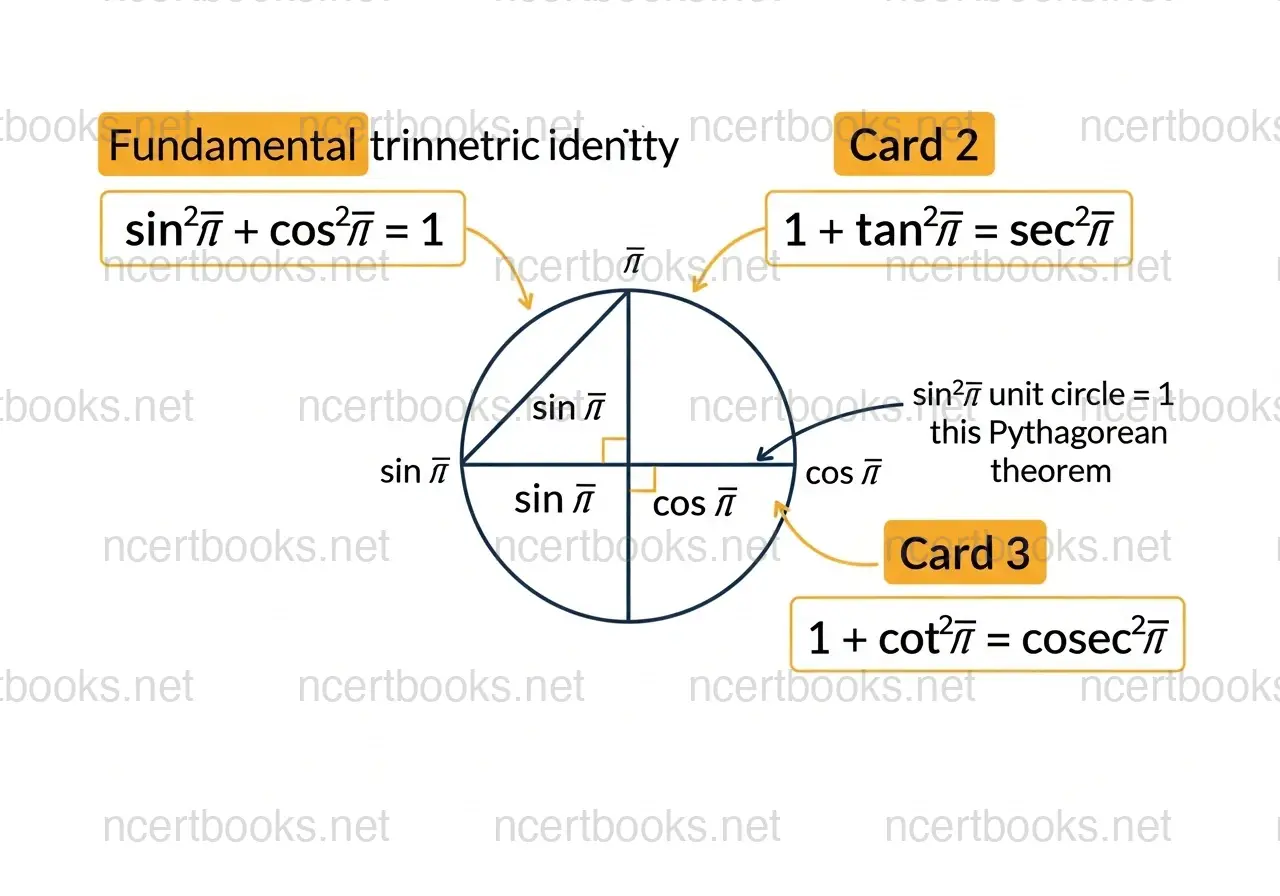
- Three fundamental identities: \( \sin^2 A + \cos^2 A = 1 \), \( 1 + \tan^2 A = \sec^2 A \), \( 1 + \cot^2 A = \cosec^2 A \)
- sin A in terms of cot A: \( \sin A = \dfrac{1}{\sqrt{1 + \cot^2 A}} \)
- tan A in terms of cot A: \( \tan A = \dfrac{1}{\cot A} \)
- sec A in terms of cot A: \( \sec A = \dfrac{\sqrt{1 + \cot^2 A}}{\cot A} \)
- 9 sec²A − 9 tan²A = 9 (using identity \( \sec^2 A – \tan^2 A = 1 \))
- Question 5 has 10 sub-parts — all identity proofs, frequently tested in CBSE board exams 2026-27
- Key strategy: Always convert everything to sin and cos when stuck in a proof
The NCERT Solutions for Class 10 Maths Chapter 8 Ex 8.4 on this page cover all 5 questions from the Trigonometric Identities exercise, fully solved with step-by-step working for the 2026-27 CBSE board exam. You can find the complete set of NCERT Solutions for Class 10 on our hub page. This exercise is one of the most important in the chapter because it tests your ability to prove identities and apply the three fundamental trigonometric identities. All solutions here match the official NCERT official website answer key. For the full collection of NCERT Solutions across all classes, visit our main solutions page.
- Quick Revision Box
- Chapter Overview — Introduction to Trigonometry
- Key Concepts and Trigonometric Identities
- NCERT Solutions for Class 10 Maths Chapter 8 Ex 8.4 — All Questions
- Formula Reference Table
- Solved Examples Beyond NCERT
- Important Questions for CBSE Board Exam 2026-27
- Common Mistakes Students Make
- Exam Tips for 2026-27
- Frequently Asked Questions
Chapter Overview — NCERT Class 10 Maths Chapter 8: Introduction to Trigonometry
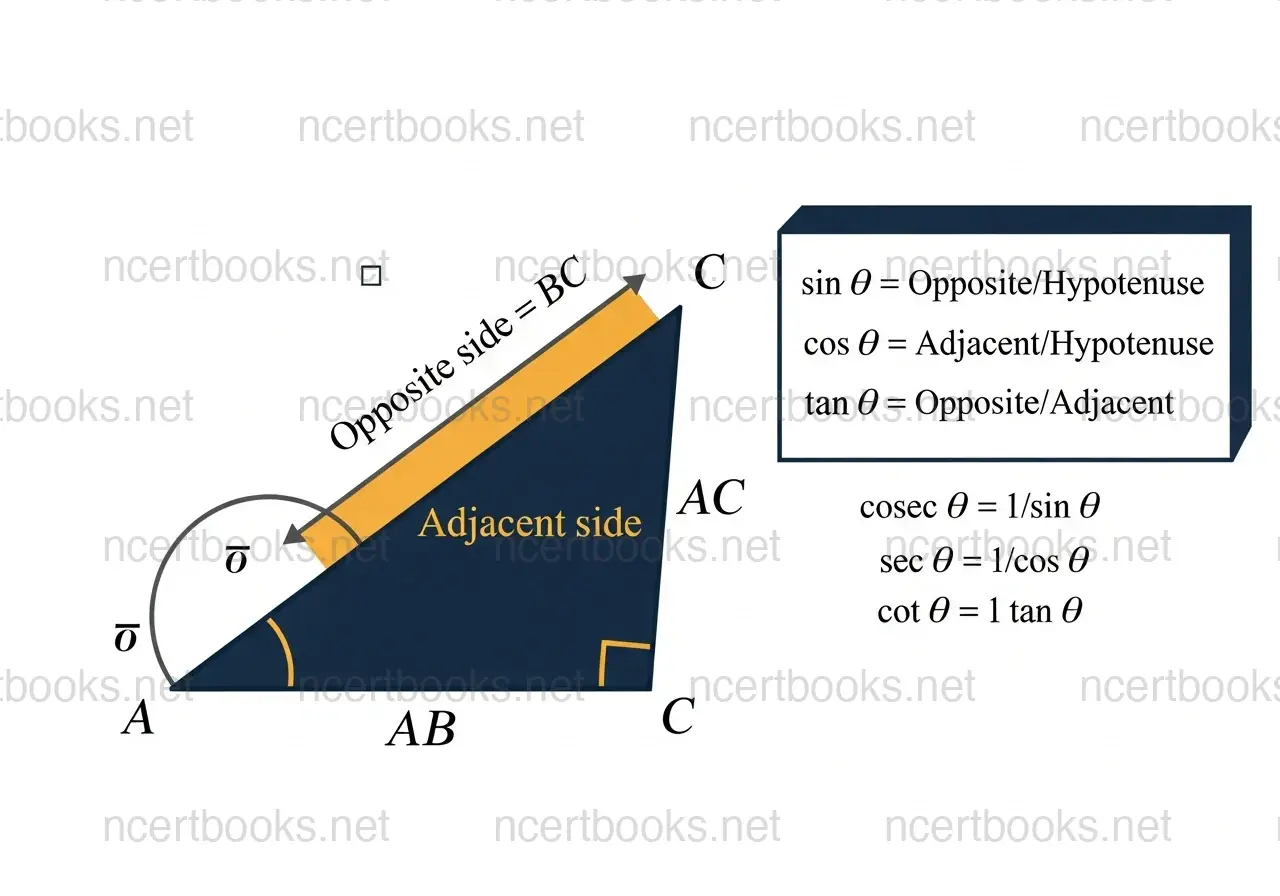
Chapter 8 of the NCERT Class 10 Maths textbook introduces trigonometric ratios, specific angle values, complementary angle relationships, and trigonometric identities. Exercise 8.4 specifically deals with Trigonometric Identities — the last major topic of the chapter. This exercise builds on all earlier concepts from Ex 8.1 to Ex 8.3.
For CBSE board exams 2026-27, this chapter carries significant weightage under the Trigonometry unit. Questions from this exercise appear as MCQs (1 mark), short answers (2–3 marks), and identity proof questions (3–4 marks). Mastering Exercise 8.4 can directly improve your board exam score.
You need to be comfortable with basic algebra, the Pythagoras theorem, and the six trigonometric ratios (sin, cos, tan, cosec, sec, cot) from earlier exercises before attempting these questions.
| Detail | Information |
|---|---|
| Chapter | Chapter 8 — Introduction to Trigonometry |
| Textbook | NCERT Mathematics — Class 10 (Ganit) |
| Exercise | Exercise 8.4 |
| Topic | Trigonometric Identities |
| Number of Questions | 5 (Q5 has 10 sub-parts) |
| Difficulty Level | Medium to Hard |
| CBSE Marks Weightage | Trigonometry unit — approx. 12 marks in board exam |
Key Concepts and Trigonometric Identities — Class 10 Chapter 8
A trigonometric identity is an equation involving trigonometric ratios that holds true for all values of the angle for which the ratios are defined. The three fundamental identities you must memorise are:
Identity 1:
\[ \sin^2 A + \cos^2 A = 1 \]
This gives: \( \sin^2 A = 1 – \cos^2 A \) and \( \cos^2 A = 1 – \sin^2 A \)
Identity 2:
\[ 1 + \tan^2 A = \sec^2 A \]
This gives: \( \sec^2 A – \tan^2 A = 1 \) and \( \tan^2 A = \sec^2 A – 1 \)
Identity 3:
\[ 1 + \cot^2 A = \cosec^2 A \]
This gives: \( \cosec^2 A – \cot^2 A = 1 \) and \( \cot^2 A = \cosec^2 A – 1 \)
All three identities are derived from the Pythagoras theorem applied to a right triangle. In every proof in Exercise 8.4, you will use one or more of these identities. The key skill is recognising which identity to apply and how to manipulate algebraic expressions.
Reciprocal relations you must know:
- \( \cosec A = \dfrac{1}{\sin A} \)
- \( \sec A = \dfrac{1}{\cos A} \)
- \( \cot A = \dfrac{1}{\tan A} = \dfrac{\cos A}{\sin A} \)
NCERT Solutions for Class 10 Maths Chapter 8 Ex 8.4 — All 5 Questions Solved
Below are complete, step-by-step solutions for every question in Exercise 8.4. These solutions are prepared for the 2026-27 CBSE board exam pattern. Each answer shows full working so you can write it exactly in your exam.
Question 1
Medium
Express the trigonometric ratios sin A, sec A and tan A in terms of cot A.
Step 1: Start with the identity \( \cosec^2 A = 1 + \cot^2 A \)
Step 2: Take the positive square root (since A is acute, cosec A > 0):
\[ \cosec A = \sqrt{1 + \cot^2 A} \]
Step 3: Since \( \sin A = \dfrac{1}{\cosec A} \):
\[ \sin A = \frac{1}{\sqrt{1 + \cot^2 A}} \]
\( \therefore \) \( \sin A = \dfrac{1}{\sqrt{1 + \cot^2 A}} \)
Step 1: We know \( \cos A = \dfrac{\sin A \cdot \cos A}{\sin A} \). Use \( \cot A = \dfrac{\cos A}{\sin A} \), so \( \cos A = \cot A \cdot \sin A \).
Step 2: Substitute the expression for sin A:
\[ \cos A = \cot A \cdot \frac{1}{\sqrt{1 + \cot^2 A}} = \frac{\cot A}{\sqrt{1 + \cot^2 A}} \]
Step 3: Take the reciprocal to get sec A:
\[ \sec A = \frac{\sqrt{1 + \cot^2 A}}{\cot A} \]
\( \therefore \) \( \sec A = \dfrac{\sqrt{1 + \cot^2 A}}{\cot A} \)
Step 1: tan A and cot A are reciprocals of each other:
\[ \tan A = \frac{1}{\cot A} \]
\( \therefore \) \( \tan A = \dfrac{1}{\cot A} \)
Question 2
Medium
Write all the other trigonometric ratios of ∠A in terms of sec A.
Key Concept: Start from \( \sec^2 A – \tan^2 A = 1 \) and \( \sin^2 A + \cos^2 A = 1 \) to derive all six ratios.
cos A is the reciprocal of sec A:
\[ \cos A = \frac{1}{\sec A} \]
\( \cos A = \dfrac{1}{\sec A} \)
Step 1: Use \( \sin^2 A + \cos^2 A = 1 \):
\[ \sin^2 A = 1 – \cos^2 A = 1 – \frac{1}{\sec^2 A} = \frac{\sec^2 A – 1}{\sec^2 A} \]
Step 2: Take the positive square root:
\[ \sin A = \frac{\sqrt{\sec^2 A – 1}}{\sec A} \]
\( \sin A = \dfrac{\sqrt{\sec^2 A – 1}}{\sec A} \)
Step 1: From \( \sec^2 A – \tan^2 A = 1 \):
\[ \tan^2 A = \sec^2 A – 1 \]
Step 2: Take the positive square root (A is acute):
\[ \tan A = \sqrt{\sec^2 A – 1} \]
\( \tan A = \sqrt{\sec^2 A – 1} \)
cosec A = 1/sin A:
\[ \cosec A = \frac{\sec A}{\sqrt{\sec^2 A – 1}} \]
\( \cosec A = \dfrac{\sec A}{\sqrt{\sec^2 A – 1}} \)
cot A = cos A / sin A = (1/sec A) / (√(sec²A − 1)/sec A):
\[ \cot A = \frac{1}{\sqrt{\sec^2 A – 1}} \]
\( \cot A = \dfrac{1}{\sqrt{\sec^2 A – 1}} \)
Question 3
Medium
Evaluate: (i) \(\dfrac{\sin^2 63° + \sin^2 27°}{\cos^2 17° + \cos^2 73°}\) (ii) \(\sin 25° \cos 65° + \cos 25° \sin 65°\)
Key Concept: Use the complementary angle identities: \( \sin(90° – \theta) = \cos\theta \) and \( \cos(90° – \theta) = \sin\theta \).
Step 1: Note that \( 63° + 27° = 90° \), so \( \sin 63° = \sin(90° – 27°) = \cos 27° \).
Therefore: \( \sin^2 63° = \cos^2 27° \)
Step 2: Substitute in the numerator:
\[ \sin^2 63° + \sin^2 27° = \cos^2 27° + \sin^2 27° = 1 \]
Step 3: Note that \( 17° + 73° = 90° \), so \( \cos 73° = \cos(90° – 17°) = \sin 17° \).
Therefore: \( \cos^2 73° = \sin^2 17° \)
Step 4: Substitute in the denominator:
\[ \cos^2 17° + \cos^2 73° = \cos^2 17° + \sin^2 17° = 1 \]
Step 5: Divide:
\[ \frac{\sin^2 63° + \sin^2 27°}{\cos^2 17° + \cos^2 73°} = \frac{1}{1} = 1 \]
\( \therefore \) Answer = 1
Step 1: Use \( \cos 65° = \cos(90° – 25°) = \sin 25° \) and \( \sin 65° = \sin(90° – 25°) = \cos 25° \).
Step 2: Substitute:
\[ \sin 25° \cdot \sin 25° + \cos 25° \cdot \cos 25° \]
\[ = \sin^2 25° + \cos^2 25° \]
Step 3: Apply identity \( \sin^2 \theta + \cos^2 \theta = 1 \):
\[ = 1 \]
Why does this work? The expression is actually the expansion of \( \sin(25° + 65°) = \sin 90° = 1 \) using the sine addition formula.
\( \therefore \) Answer = 1
Question 4
Easy
Choose the correct option. Justify your choice.
Step 1: Factor out 9:
\[ 9\sec^2 A – 9\tan^2 A = 9(\sec^2 A – \tan^2 A) \]
Step 2: Apply identity \( \sec^2 A – \tan^2 A = 1 \):
\[ = 9 \times 1 = 9 \]
\( \therefore \) Answer: (B) 9
Step 1: Write everything in terms of sin θ and cos θ:
\[ \left(1 + \frac{\sin\theta}{\cos\theta} + \frac{1}{\cos\theta}\right)\left(1 + \frac{\cos\theta}{\sin\theta} – \frac{1}{\sin\theta}\right) \]
Step 2: Combine fractions in each bracket:
\[ = \frac{\cos\theta + \sin\theta + 1}{\cos\theta} \times \frac{\sin\theta + \cos\theta – 1}{\sin\theta} \]
Step 3: Multiply the numerators. Let \( S = \sin\theta + \cos\theta \):
\[ = \frac{(S + 1)(S – 1)}{\sin\theta \cos\theta} = \frac{S^2 – 1}{\sin\theta\cos\theta} \]
Step 4: Expand \( S^2 = (\sin\theta + \cos\theta)^2 = \sin^2\theta + 2\sin\theta\cos\theta + \cos^2\theta = 1 + 2\sin\theta\cos\theta \):
\[ = \frac{1 + 2\sin\theta\cos\theta – 1}{\sin\theta\cos\theta} = \frac{2\sin\theta\cos\theta}{\sin\theta\cos\theta} = 2 \]
\( \therefore \) Answer: (C) 2
Step 1: Write sec A and tan A in terms of sin A and cos A:
\[ \left(\frac{1}{\cos A} + \frac{\sin A}{\cos A}\right)(1 – \sin A) \]
Step 2: Combine the bracket:
\[ = \frac{1 + \sin A}{\cos A} \times (1 – \sin A) \]
Step 3: Use difference of squares \( (1 + \sin A)(1 – \sin A) = 1 – \sin^2 A = \cos^2 A \):
\[ = \frac{\cos^2 A}{\cos A} = \cos A \]
\( \therefore \) Answer: (D) cos A
Step 1: Apply identities: \( 1 + \tan^2 A = \sec^2 A \) and \( 1 + \cot^2 A = \cosec^2 A \):
\[ \frac{1 + \tan^2 A}{1 + \cot^2 A} = \frac{\sec^2 A}{\cosec^2 A} \]
Step 2: Write in terms of sin and cos:
\[ = \frac{1/\cos^2 A}{1/\sin^2 A} = \frac{\sin^2 A}{\cos^2 A} = \tan^2 A \]
\( \therefore \) Answer: (D) tan² A
Question 5
Hard
Prove the following identities, where the angles involved are acute angles for which the expressions are defined.
Step 1: Write LHS in terms of sin and cos:
\[ \left(\frac{1}{\sin\theta} – \frac{\cos\theta}{\sin\theta}\right)^2 = \left(\frac{1 – \cos\theta}{\sin\theta}\right)^2 = \frac{(1-\cos\theta)^2}{\sin^2\theta} \]
Step 2: Replace \( \sin^2\theta = 1 – \cos^2\theta = (1-\cos\theta)(1+\cos\theta) \):
\[ = \frac{(1-\cos\theta)^2}{(1-\cos\theta)(1+\cos\theta)} = \frac{1-\cos\theta}{1+\cos\theta} \]
\( \therefore \) LHS = RHS. Proved.
Step 1: Take LCM of the two fractions:
\[ \frac{\cos^2 A + (1+\sin A)^2}{\cos A(1+\sin A)} \]
Step 2: Expand the numerator:
\[ \cos^2 A + 1 + 2\sin A + \sin^2 A = (\sin^2 A + \cos^2 A) + 1 + 2\sin A = 1 + 1 + 2\sin A = 2 + 2\sin A \]
Step 3: Simplify:
\[ = \frac{2(1+\sin A)}{\cos A(1+\sin A)} = \frac{2}{\cos A} = 2\sec A \]
\( \therefore \) LHS = RHS. Proved.
Step 1: Let \( t = \tan\theta \). Write \( \cot\theta = 1/t \). Substitute:
\[ \frac{t}{1 – 1/t} + \frac{1/t}{1 – t} = \frac{t^2}{t-1} + \frac{1}{t(1-t)} = \frac{t^2}{t-1} – \frac{1}{t(t-1)} \]
Step 2: Combine over common denominator \( t(t-1) \):
\[ = \frac{t^3 – 1}{t(t-1)} = \frac{(t-1)(t^2+t+1)}{t(t-1)} = \frac{t^2+t+1}{t} \]
Step 3: Expand:
\[ = t + 1 + \frac{1}{t} = \tan\theta + 1 + \cot\theta \]
Step 4: Show RHS equals the same. \( 1 + \sec\theta\cosec\theta = 1 + \dfrac{1}{\sin\theta\cos\theta} \). Also \( \tan\theta + \cot\theta = \dfrac{\sin\theta}{\cos\theta} + \dfrac{\cos\theta}{\sin\theta} = \dfrac{1}{\sin\theta\cos\theta} \). So LHS \( = 1 + \dfrac{1}{\sin\theta\cos\theta} = \) RHS.
\( \therefore \) LHS = RHS. Proved.
Step 1: Work on RHS. Use \( \sin^2 A = 1 – \cos^2 A = (1-\cos A)(1+\cos A) \):
\[ \frac{\sin^2 A}{1-\cos A} = \frac{(1-\cos A)(1+\cos A)}{1-\cos A} = 1 + \cos A \]
Step 2: Work on LHS:
\[ \frac{1 + \sec A}{\sec A} = \frac{1}{\sec A} + 1 = \cos A + 1 = 1 + \cos A \]
Step 3: Both sides equal \( 1 + \cos A \).
\( \therefore \) LHS = RHS. Proved.
Step 1: Divide numerator and denominator by sin A:
\[ \frac{\cot A – 1 + \cosec A}{\cot A + 1 – \cosec A} \]
Step 2: Let \( p = \cot A + \cosec A \). Numerator = \( p – 1 \), Denominator = \( \cot A – \cosec A + 1 \).
Step 3: Multiply numerator and denominator by \( (\cot A + \cosec A + 1) \) — use the identity \( \cosec^2 A – \cot^2 A = 1 \), i.e., \( (\cosec A – \cot A)(\cosec A + \cot A) = 1 \):
Denominator becomes: \( (\cot A + 1 – \cosec A)(\cot A + \cosec A + 1) \)
\[ = (\cot A + 1)^2 – \cosec^2 A = \cot^2 A + 2\cot A + 1 – \cosec^2 A \]
Since \( \cosec^2 A – \cot^2 A = 1 \Rightarrow \cot^2 A – \cosec^2 A = -1 \):
\[ = -1 + 2\cot A + 1 = 2\cot A \]
Numerator becomes: \( (\cot A – 1 + \cosec A)(\cot A + \cosec A + 1) = (\cot A + \cosec A)^2 – 1 \)
\[ = \cot^2 A + 2\cot A\cosec A + \cosec^2 A – 1 \]
Use \( \cosec^2 A = 1 + \cot^2 A \):
\[ = \cot^2 A + 2\cot A\cosec A + 1 + \cot^2 A – 1 = 2\cot^2 A + 2\cot A\cosec A = 2\cot A(\cot A + \cosec A) \]
So the fraction = \( \dfrac{2\cot A(\cot A + \cosec A)}{2\cot A} = \cot A + \cosec A = \cosec A + \cot A \) = RHS.
\( \therefore \) LHS = RHS. Proved.
Step 1: Rationalise by multiplying inside the square root by \(\dfrac{1+\sin A}{1+\sin A}\):
\[ \sqrt{\frac{(1+\sin A)^2}{(1-\sin A)(1+\sin A)}} = \sqrt{\frac{(1+\sin A)^2}{1-\sin^2 A}} = \sqrt{\frac{(1+\sin A)^2}{\cos^2 A}} \]
Step 2: Take the square root (all values positive for acute A):
\[ = \frac{1+\sin A}{\cos A} = \frac{1}{\cos A} + \frac{\sin A}{\cos A} = \sec A + \tan A \]
\( \therefore \) LHS = RHS. Proved.
Step 1: Factor the numerator and denominator:
\[ \text{Numerator} = \sin\theta(1 – 2\sin^2\theta) \]
\[ \text{Denominator} = \cos\theta(2\cos^2\theta – 1) \]
Step 2: Note that \( 1 – 2\sin^2\theta = 1 – 2(1-\cos^2\theta) = 2\cos^2\theta – 1 \). So both factors are equal:
\[ = \frac{\sin\theta \cdot (2\cos^2\theta – 1)}{\cos\theta \cdot (2\cos^2\theta – 1)} = \frac{\sin\theta}{\cos\theta} = \tan\theta \]
\( \therefore \) LHS = RHS. Proved.
Step 1: Expand LHS:
\[ \sin^2 A + 2\sin A\cosec A + \cosec^2 A + \cos^2 A + 2\cos A\sec A + \sec^2 A \]
Step 2: Simplify \( \sin A \cdot \cosec A = 1 \) and \( \cos A \cdot \sec A = 1 \):
\[ = (\sin^2 A + \cos^2 A) + 2 + 2 + \cosec^2 A + \sec^2 A \]
\[ = 1 + 4 + \cosec^2 A + \sec^2 A = 5 + \cosec^2 A + \sec^2 A \]
Step 3: Use \( \cosec^2 A = 1 + \cot^2 A \) and \( \sec^2 A = 1 + \tan^2 A \):
\[ = 5 + (1 + \cot^2 A) + (1 + \tan^2 A) = 7 + \tan^2 A + \cot^2 A \]
\( \therefore \) LHS = RHS. Proved.
Step 1: Simplify LHS:
\[ \left(\frac{1}{\sin A} – \sin A\right)\left(\frac{1}{\cos A} – \cos A\right) = \frac{1-\sin^2 A}{\sin A} \cdot \frac{1-\cos^2 A}{\cos A} \]
\[ = \frac{\cos^2 A}{\sin A} \cdot \frac{\sin^2 A}{\cos A} = \frac{\sin A \cos A \cdot \sin A \cos A}{\sin A \cos A} = \sin A \cos A \]
Step 2: Simplify RHS:
\[ \frac{1}{\tan A + \cot A} = \frac{1}{\dfrac{\sin A}{\cos A} + \dfrac{\cos A}{\sin A}} = \frac{1}{\dfrac{\sin^2 A + \cos^2 A}{\sin A \cos A}} = \frac{\sin A \cos A}{1} = \sin A \cos A \]
Step 3: Both sides equal \( \sin A \cos A \).
\( \therefore \) LHS = RHS. Proved.
Step 1: Prove first part equals tan²A. We already showed in Q4(iv) that \( \dfrac{1+\tan^2 A}{1+\cot^2 A} = \tan^2 A \).
Step 2: Prove second part equals tan²A:
\[ \left(\frac{1-\tan A}{1-\cot A}\right)^2 \]
Substitute \( \cot A = 1/\tan A \):
\[ = \left(\frac{1-\tan A}{1 – 1/\tan A}\right)^2 = \left(\frac{1-\tan A}{(\tan A – 1)/\tan A}\right)^2 = \left(\frac{(1-\tan A) \cdot \tan A}{\tan A – 1}\right)^2 \]
\[ = \left(\frac{-(\tan A – 1) \cdot \tan A}{\tan A – 1}\right)^2 = (-\tan A)^2 = \tan^2 A \]
Step 3: Both expressions equal \( \tan^2 A \), so all three are equal.
\( \therefore \) All three expressions equal \( \tan^2 A \). Proved.
Formula Reference Table — Trigonometric Identities Class 10
Use this table as a quick reference during revision. All formulas are from NCERT Class 10 Maths Chapter 8.
| Formula Name | Formula | Derived Form 1 | Derived Form 2 |
|---|---|---|---|
| Pythagorean Identity 1 | \( \sin^2 A + \cos^2 A = 1 \) | \( \sin^2 A = 1 – \cos^2 A \) | \( \cos^2 A = 1 – \sin^2 A \) |
| Pythagorean Identity 2 | \( 1 + \tan^2 A = \sec^2 A \) | \( \sec^2 A – \tan^2 A = 1 \) | \( \tan^2 A = \sec^2 A – 1 \) |
| Pythagorean Identity 3 | \( 1 + \cot^2 A = \cosec^2 A \) | \( \cosec^2 A – \cot^2 A = 1 \) | \( \cot^2 A = \cosec^2 A – 1 \) |
| Reciprocal — cosec | \( \cosec A = \dfrac{1}{\sin A} \) | — | |
| Reciprocal — sec | \( \sec A = \dfrac{1}{\cos A} \) | — | |
| Reciprocal — cot | \( \cot A = \dfrac{1}{\tan A} \) | \( \cot A = \dfrac{\cos A}{\sin A} \) | — |
| Complementary Angle | \( \sin(90°-A) = \cos A \) | \( \cos(90°-A) = \sin A \) | \( \tan(90°-A) = \cot A \) |
Solved Examples Beyond NCERT — Trigonometric Identities
These examples go slightly beyond the NCERT textbook and are useful for CBSE board exam preparation 2026-27.
Extra Example 1
Medium
Prove: \( \dfrac{\tan A + \sin A}{\tan A – \sin A} = \dfrac{\sec A + 1}{\sec A – 1} \)
Step 1: Write tan A = sin A / cos A in LHS:
\[ \frac{\dfrac{\sin A}{\cos A} + \sin A}{\dfrac{\sin A}{\cos A} – \sin A} = \frac{\sin A\left(\dfrac{1}{\cos A} + 1\right)}{\sin A\left(\dfrac{1}{\cos A} – 1\right)} \]
Step 2: Cancel sin A and replace 1/cos A with sec A:
\[ = \frac{\sec A + 1}{\sec A – 1} = \text{RHS} \]
Proved.
Extra Example 2
Hard
If \( \tan A + \sin A = m \) and \( \tan A – \sin A = n \), show that \( m^2 – n^2 = 4\sqrt{mn} \).
Step 1: \( m^2 – n^2 = (m+n)(m-n) = (2\tan A)(2\sin A) = 4\tan A\sin A \)
Step 2: \( mn = (\tan A + \sin A)(\tan A – \sin A) = \tan^2 A – \sin^2 A \)
Step 3: \( \tan^2 A – \sin^2 A = \dfrac{\sin^2 A}{\cos^2 A} – \sin^2 A = \sin^2 A\left(\dfrac{1-\cos^2 A}{\cos^2 A}\right) = \dfrac{\sin^2 A \cdot \sin^2 A}{\cos^2 A} = \tan^2 A \sin^2 A \)
Step 4: \( \sqrt{mn} = \sqrt{\tan^2 A \sin^2 A} = \tan A \sin A \), so \( 4\sqrt{mn} = 4\tan A\sin A = m^2 – n^2 \).
Proved.
Important Questions for CBSE Board Exam 2026-27 — Trigonometric Identities
These questions are based on the pattern of previous CBSE board papers. Practise all of them for the 2026-27 exam.
1-Mark Questions
- Q1. What is the value of \( \sin^2 30° + \cos^2 30° \)? Answer: 1
- Q2. Write the value of \( \sec^2 A – \tan^2 A \). Answer: 1
- Q3. If \( \cot A = 4/3 \), find \( \tan A \). Answer: 3/4
3-Mark Questions
- Q4. Prove: \( \dfrac{1 + \cos A}{\sin A} + \dfrac{\sin A}{1 + \cos A} = 2\cosec A \)
Hint: Take LCM, use \( \sin^2 A + (1+\cos A)^2 = 2 + 2\cos A \), then simplify. - Q5. Evaluate: \( \dfrac{\tan 65°}{\cot 25°} \)
Answer: \( \tan 65° = \tan(90°-25°) = \cot 25° \), so the expression = 1.
5-Mark Question
- Q6. Prove: \( (\sin A + \cosec A)^2 + (\cos A + \sec A)^2 = 7 + \tan^2 A + \cot^2 A \)
This is directly from Exercise 8.4 Q5(viii) — see full solution above.
Common Mistakes Students Make in Trigonometric Identities
Mistake 1: Writing \( \sin^2 A + \cos^2 A = 2 \) instead of 1.
Why it’s wrong: The Pythagorean identity always equals 1, not 2. This is a fundamental identity derived from the unit circle / Pythagoras theorem.
Correct approach: \( \sin^2 A + \cos^2 A = 1 \) — memorise this without exception.
Mistake 2: Trying to prove both sides simultaneously (working on LHS and RHS at the same time in the same column).
Why it’s wrong: CBSE marking scheme requires you to start from one side and reach the other. Cross-working loses marks.
Correct approach: Always start from the more complex side. Write LHS = … = … = RHS clearly.
Mistake 3: Forgetting to take the positive square root when deriving sin A from cosec A.
Why it’s wrong: Since angles in Exercise 8.4 are acute, all ratios are positive. Taking a negative root gives a wrong expression.
Correct approach: State “since A is acute, all ratios are positive” and take the positive root.
Mistake 4: Writing \( \sec A = \cos A \) instead of \( \sec A = 1/\cos A \).
Why it’s wrong: sec and cos are reciprocals, not equal. This is one of the most frequent errors in identity proofs.
Correct approach: Memorise all six reciprocal pairs before attempting Exercise 8.4.
Mistake 5: Not simplifying \( (1 – \sin A)(1 + \sin A) \) as \( \cos^2 A \).
Why it’s wrong: Students expand this as \( 1 – \sin^2 A \) and stop, missing the final simplification to \( \cos^2 A \).
Correct approach: Always complete the substitution: \( 1 – \sin^2 A = \cos^2 A \).
Exam Tips for CBSE Board Exam 2026-27 — Chapter 8 Trigonometry
- Tip 1 — Know all three identities cold: The CBSE 2026-27 marking scheme awards full marks only when the correct identity is cited. Write the identity name or form before using it.
- Tip 2 — Start from the complex side: In proof questions, always simplify the more complex expression. If both sides look equal in complexity, start from LHS.
- Tip 3 — Convert to sin and cos: When stuck in any proof, convert every ratio to sin and cos. This almost always leads to a solution.
- Tip 4 — Show every step: CBSE board papers for 2026-27 award step marks. Even if your final answer is wrong, you can score 2 out of 3 marks by showing correct working.
- Tip 5 — MCQ justification: For Question 4-type MCQs in board exams, always write the identity you used as justification — examiners look for this even in objective questions.
- Tip 6 — Revise complementary angles: Question 3 of Ex 8.4 uses complementary angle identities from Ex 8.3. These two exercises are often combined in board questions.
For the complete set of NCERT Solutions for Class 10 Maths, including all chapters, visit our Class 10 hub. You can also check NCERT Solutions Class 10 Maths Chapter 8 Ex 8.3 and NCERT Solutions Class 10 Maths Chapter 8 Ex 8.1 for related exercises.
Frequently Asked Questions — Trigonometric Identities Exercise 8.4