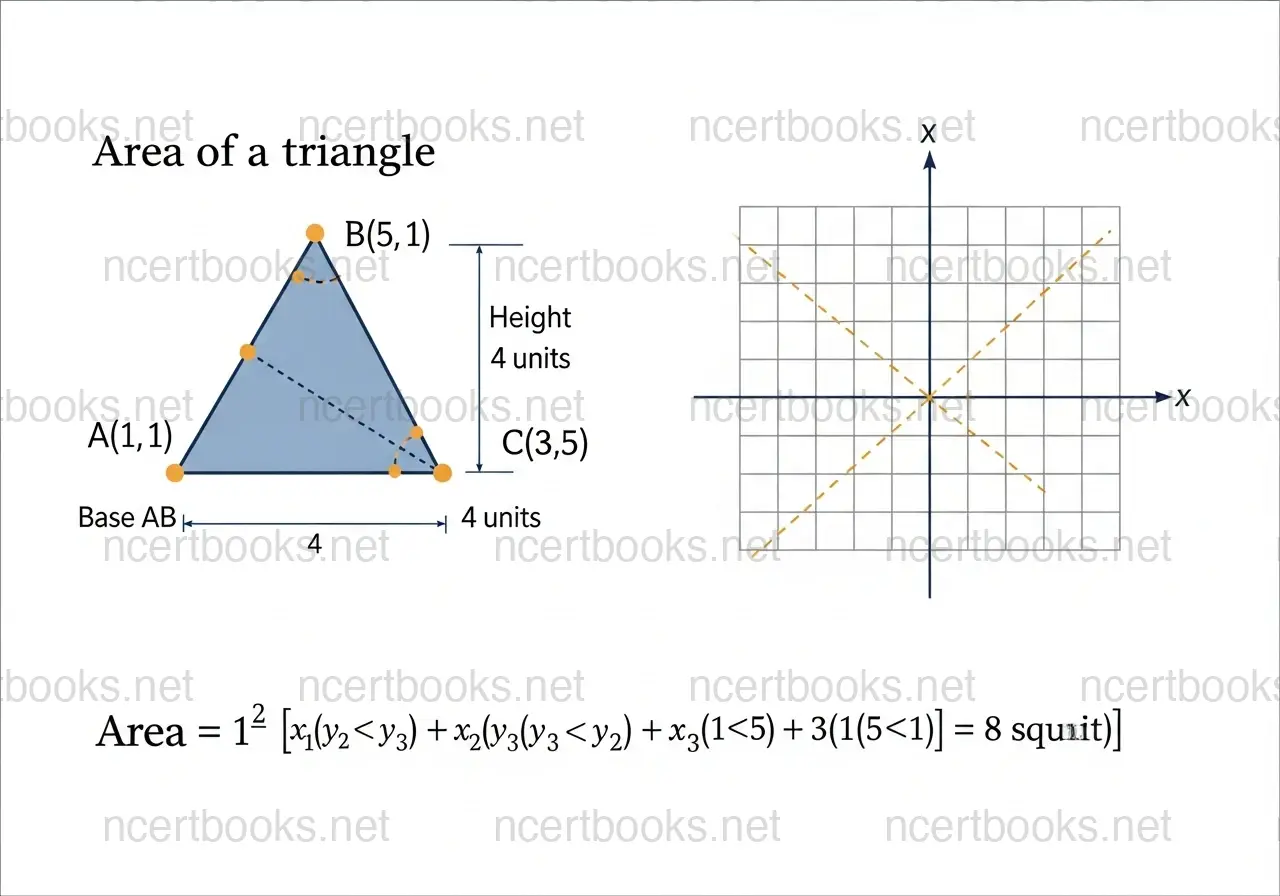
- Area of Triangle Formula: \( \text{Area} = \frac{1}{2} |x_1(y_2 – y_3) + x_2(y_3 – y_1) + x_3(y_1 – y_2)| \)
- Collinearity Condition: Three points are collinear if the area of the triangle formed = 0
- Section Formula (Internal): \( P = \left(\frac{m x_2 + n x_1}{m+n}, \frac{m y_2 + n y_1}{m+n}\right) \)
- Mid-Point Formula: \( M = \left(\frac{x_1+x_2}{2}, \frac{y_1+y_2}{2}\right) \)
- Centroid Formula: \( G = \left(\frac{x_1+x_2+x_3}{3}, \frac{y_1+y_2+y_3}{3}\right) \)
- Centroid divides each median in the ratio 2:1 from the vertex
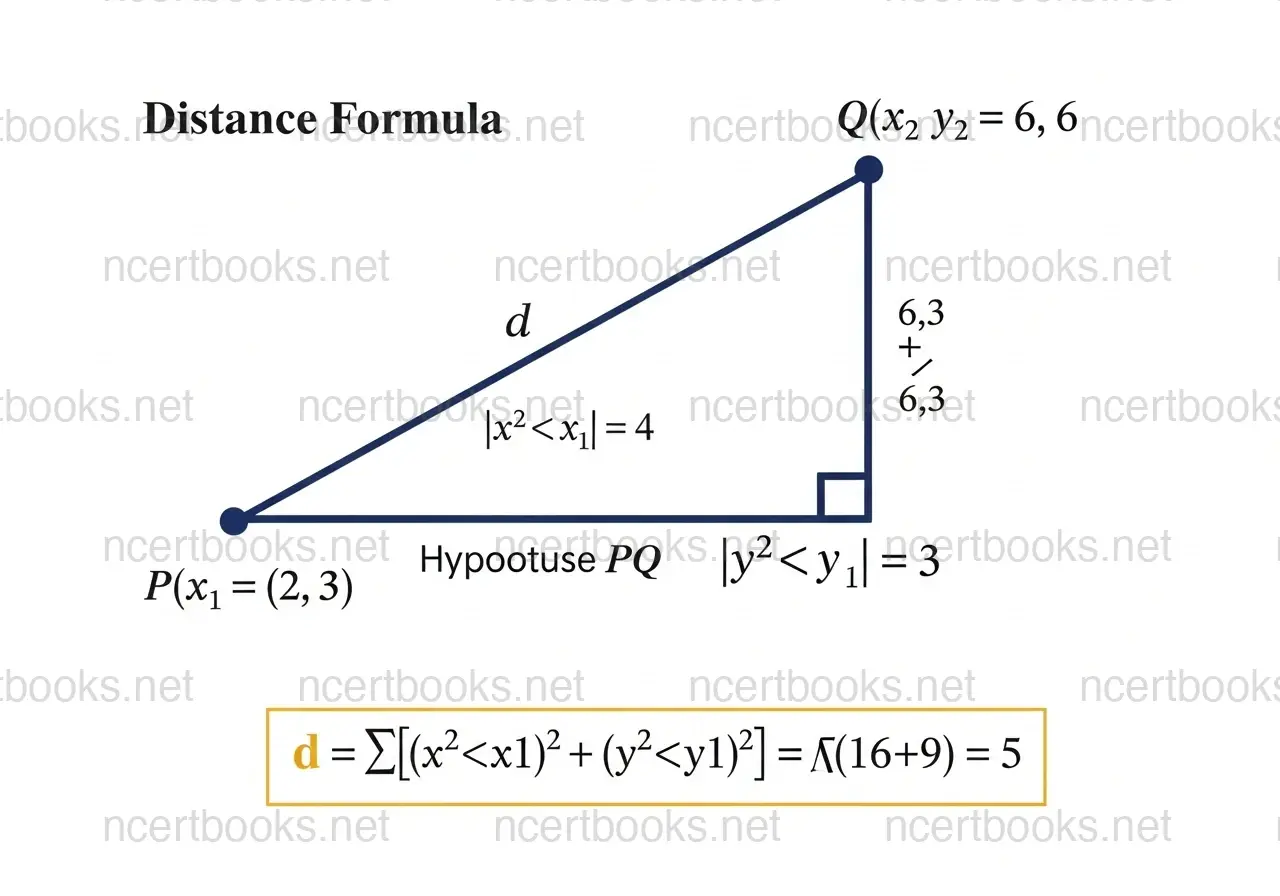
- Distance Formula: \( d = \sqrt{(x_2-x_1)^2 + (y_2-y_1)^2} \)
- Chapter Weightage: Coordinate Geometry carries 6 marks in CBSE Class 10 board exams
The NCERT Solutions for Class 10 Maths Chapter 7 Ex 7.4 on this page cover all 8 questions from the Coordinate Geometry exercise, fully updated for the 2026-27 CBSE board exam. You will find complete step-by-step solutions using the area of triangle formula, section formula, collinearity condition, and centroid — all essential topics for scoring well. These solutions are part of our comprehensive NCERT Solutions for Class 10 and are prepared by experienced CBSE teachers. You can also explore all chapters in our NCERT Solutions library.
NCERT Solutions for Class 10 Maths Chapter 7 Ex 7.4 — Chapter Overview
Chapter 7 of the NCERT Class 10 Maths textbook is Coordinate Geometry. Exercise 7.4 is the final and most application-heavy exercise of this chapter. It tests your ability to apply the area of triangle formula, section formula, collinearity condition, and the concept of centroid in real-world and abstract problems. You can download the official textbook from the NCERT official website.
For CBSE board exams, Coordinate Geometry carries 6 marks in the standard question paper. Questions from Exercise 7.4 typically appear as 2–3 mark problems or as part of case-study questions. The chapter builds on your knowledge of the distance formula (Ex 7.1) and section formula (Ex 7.2 and 7.3), so make sure those concepts are clear before attempting Ex 7.4.
| Detail | Information |
|---|---|
| Chapter | Chapter 7 — Coordinate Geometry |
| Textbook | NCERT Mathematics (Class 10) |
| Exercise | Exercise 7.4 |
| Number of Questions | 8 |
| Subject | Mathematics |
| Marks Weightage | 6 marks (full chapter) |
| Difficulty Level | Medium to Hard |
| Academic Year | 2026-27 |
Key Concepts and Formulas — Coordinate Geometry Exercise 7.4
Area of a Triangle Using Coordinates
If \( A(x_1, y_1) \), \( B(x_2, y_2) \) and \( C(x_3, y_3) \) are the vertices of a triangle, then:
\[ \text{Area of } \triangle ABC = \frac{1}{2} |x_1(y_2 – y_3) + x_2(y_3 – y_1) + x_3(y_1 – y_2)| \]
The modulus (absolute value) ensures the area is always positive. If the result is 0, the three points are collinear (they lie on the same line).
Section Formula — Internal Division
If point \( P \) divides the segment joining \( A(x_1, y_1) \) and \( B(x_2, y_2) \) in the ratio \( m:n \) internally, then:
\[ P = \left(\frac{mx_2 + nx_1}{m+n},\ \frac{my_2 + ny_1}{m+n}\right) \]
Centroid of a Triangle
The centroid is the point where all three medians of a triangle intersect. For a triangle with vertices \( A(x_1, y_1) \), \( B(x_2, y_2) \), \( C(x_3, y_3) \):
\[ G = \left(\frac{x_1+x_2+x_3}{3},\ \frac{y_1+y_2+y_3}{3}\right) \]
The centroid divides each median in the ratio 2:1 from the vertex side.
Collinearity of Three Points
Three points \( P(x_1, y_1) \), \( Q(x_2, y_2) \), \( R(x_3, y_3) \) are collinear if and only if:
\[ x_1(y_2 – y_3) + x_2(y_3 – y_1) + x_3(y_1 – y_2) = 0 \]
NCERT Solutions Class 10 Maths Chapter 7 Ex 7.4 — All 8 Questions Solved Step by Step
Question 1
Medium
Determine the ratio in which the line \( 2x + y – 4 = 0 \) divides the line segment joining the points \( A(2, -2) \) and \( B(3, 7) \).
Key Concept: Use the section formula. Let the line divide AB in ratio \( k:1 \). Then find the coordinates of the dividing point and substitute into the line equation.
Step 1: Let the line \( 2x + y – 4 = 0 \) divide AB in ratio \( k:1 \) at point \( P \).
Step 2: By section formula, coordinates of \( P \) are:
\[ P = \left(\frac{3k + 2}{k+1},\ \frac{7k – 2}{k+1}\right) \]
Step 3: Since \( P \) lies on \( 2x + y – 4 = 0 \), substitute:
\[ 2 \cdot \frac{3k+2}{k+1} + \frac{7k-2}{k+1} – 4 = 0 \]
Step 4: Multiply throughout by \( (k+1) \):
\[ 2(3k+2) + (7k-2) – 4(k+1) = 0 \]
\[ 6k + 4 + 7k – 2 – 4k – 4 = 0 \]
\[ 9k – 2 = 0 \]
\[ k = \frac{2}{9} \]
Step 5: The ratio is \( k:1 = \frac{2}{9}:1 = 2:9 \).
Why does this work? Since \( k \) is positive, the division is internal.
\( \therefore \) The line \( 2x + y – 4 = 0 \) divides AB in the ratio 2:9 internally.
Question 2
Easy
Find a relation between \( x \) and \( y \), if the points \( (x, y) \), \( (1, 2) \) and \( (7, 0) \) are collinear.
Key Concept: Three points are collinear when the area of the triangle formed by them equals zero.
Step 1: Let \( A(x, y) \), \( B(1, 2) \), \( C(7, 0) \). Apply the collinearity condition:
\[ x_1(y_2 – y_3) + x_2(y_3 – y_1) + x_3(y_1 – y_2) = 0 \]
Step 2: Substitute the values:
\[ x(2 – 0) + 1(0 – y) + 7(y – 2) = 0 \]
Step 3: Expand and simplify:
\[ 2x – y + 7y – 14 = 0 \]
\[ 2x + 6y – 14 = 0 \]
\[ x + 3y – 7 = 0 \]
\( \therefore \) The required relation is \( x + 3y – 7 = 0 \).
Question 3
Medium
Find the centre of a circle passing through the points \( (6, -6) \), \( (3, -7) \) and \( (3, 3) \).
Key Concept: The centre of a circle is equidistant from all points on the circle. Set up two distance equations and solve simultaneously.
Step 1: Let the centre be \( O(x, y) \). Then \( OA = OB = OC \).
Step 2: Using \( OA^2 = OB^2 \) with \( A(6,-6) \) and \( B(3,-7) \):
\[ (x-6)^2 + (y+6)^2 = (x-3)^2 + (y+7)^2 \]
\[ x^2 – 12x + 36 + y^2 + 12y + 36 = x^2 – 6x + 9 + y^2 + 14y + 49 \]
\[ -12x + 12y + 72 = -6x + 14y + 58 \]
\[ -6x – 2y + 14 = 0 \]
\[ 3x + y = 7 \quad \cdots (1) \]
Step 3: Using \( OB^2 = OC^2 \) with \( B(3,-7) \) and \( C(3,3) \):
\[ (x-3)^2 + (y+7)^2 = (x-3)^2 + (y-3)^2 \]
\[ (y+7)^2 = (y-3)^2 \]
\[ y^2 + 14y + 49 = y^2 – 6y + 9 \]
\[ 20y = -40 \]
\[ y = -2 \]
Step 4: Substitute \( y = -2 \) into equation (1):
\[ 3x + (-2) = 7 \Rightarrow 3x = 9 \Rightarrow x = 3 \]
\( \therefore \) The centre of the circle is \( (3, -2) \).
Question 4
Hard
The two opposite vertices of a square are \( (-1, 2) \) and \( (3, 2) \). Find the coordinates of the other two vertices.
Key Concept: In a square, diagonals are equal, bisect each other at right angles, and all sides are equal. Use the midpoint of the diagonal and properties of a square to find the unknown vertices.
Step 1: Let \( A(-1, 2) \) and \( C(3, 2) \) be opposite vertices. The midpoint of diagonal AC is:
\[ M = \left(\frac{-1+3}{2}, \frac{2+2}{2}\right) = (1, 2) \]
Step 2: Let the other two vertices be \( B(x, y) \) and \( D(x’, y’) \). Since ABCD is a square, \( AB = BC \) and \( \angle ABC = 90° \).
Step 3: Since \( AB = BC \):
\[ (x+1)^2 + (y-2)^2 = (x-3)^2 + (y-2)^2 \]
\[ (x+1)^2 = (x-3)^2 \]
\[ x^2 + 2x + 1 = x^2 – 6x + 9 \]
\[ 8x = 8 \Rightarrow x = 1 \]
Step 4: Since \( AB^2 + BC^2 = AC^2 \) (right angle at B):
\[ AC^2 = (3-(-1))^2 + (2-2)^2 = 16 \]
\[ AB^2 = (1+1)^2 + (y-2)^2 = 4 + (y-2)^2 \]
\[ BC^2 = (1-3)^2 + (y-2)^2 = 4 + (y-2)^2 \]
\[ AB^2 + BC^2 = AC^2 \Rightarrow 8 + 2(y-2)^2 = 16 \]
\[ (y-2)^2 = 4 \Rightarrow y – 2 = \pm 2 \]
\[ y = 4 \text{ or } y = 0 \]
\( \therefore \) The other two vertices of the square are \( B(1, 4) \) and \( D(1, 0) \).
Question 5
Hard
The class X students of a school in Krishnagar have been allotted a rectangular plot of land for their gardening activity. Saplings of Gulmohar are planted on the boundary at a distance of 1 m from each other. There is a triangular grassy lawn in the plot as shown in the figure. The students are to sow seeds of flowering plants on the remaining area of the plot.
(i) Taking A as origin, find the coordinates of the vertices of the triangle.
(ii) What will be the coordinates of the vertices of ∆PQR, if C is the origin? Also, calculate the areas of the triangles in these cases. What do you observe?
Step 1: The rectangular plot has dimensions 12 m × 10 m (as given in the NCERT figure). Taking A as origin, the x-axis runs along AB and the y-axis runs along AD.
Step 2: From the NCERT figure, the triangular lawn has vertices at:
- \( P = (4, 6) \)
- \( Q = (3, 2) \)
- \( R = (6, 5) \)
Step 3: Calculate area of \( \triangle PQR \) with \( A \) as origin:
\[ \text{Area} = \frac{1}{2} |4(2-5) + 3(5-6) + 6(6-2)| \]
\[ = \frac{1}{2} |4(-3) + 3(-1) + 6(4)| \]
\[ = \frac{1}{2} |-12 – 3 + 24| \]
\[ = \frac{1}{2} |9| = 4.5 \text{ sq. m} \]
Coordinates with A as origin: P(4, 6), Q(3, 2), R(6, 5). Area = 4.5 sq. m
Step 1: When C is the origin, the axes are reversed. C is at the corner diagonally opposite to A. The plot is 12 m × 10 m, so C is at (12, 10) from A.
Step 2: New coordinates = (12 − old x, 10 − old y):
- \( P’ = (12-4,\ 10-6) = (8, 4) \)
- \( Q’ = (12-3,\ 10-2) = (9, 8) \)
- \( R’ = (12-6,\ 10-5) = (6, 5) \)
Step 3: Calculate area with C as origin:
\[ \text{Area} = \frac{1}{2} |8(8-5) + 9(5-4) + 6(4-8)| \]
\[ = \frac{1}{2} |24 + 9 – 24| \]
\[ = \frac{1}{2} |9| = 4.5 \text{ sq. m} \]
Coordinates with C as origin: P'(8, 4), Q'(9, 8), R'(6, 5). Area = 4.5 sq. m
Observation: The area of the triangle is the same (4.5 sq. m) regardless of which corner is taken as the origin. The area of a figure is independent of the choice of coordinate axes.
Question 6
Hard
The vertices of \( \triangle ABC \) are \( A(4, 6) \), \( B(1, 5) \) and \( C(7, 2) \). A line is drawn to intersect sides AB and AC at D and E respectively, such that \( \frac{AD}{AB} = \frac{AE}{AC} = \frac{1}{4} \). Calculate the area of \( \triangle ADE \) and compare it with the area of \( \triangle ABC \).
Step 1: Since \( \frac{AD}{AB} = \frac{1}{4} \), point D divides AB in ratio \( AD:DB = 1:3 \).
Coordinates of D:
\[ D = \left(\frac{1 \cdot 1 + 3 \cdot 4}{1+3},\ \frac{1 \cdot 5 + 3 \cdot 6}{1+3}\right) = \left(\frac{13}{4},\ \frac{23}{4}\right) \]
Step 2: Since \( \frac{AE}{AC} = \frac{1}{4} \), point E divides AC in ratio \( AE:EC = 1:3 \).
Coordinates of E:
\[ E = \left(\frac{1 \cdot 7 + 3 \cdot 4}{1+3},\ \frac{1 \cdot 2 + 3 \cdot 6}{1+3}\right) = \left(\frac{19}{4},\ \frac{20}{4}\right) = \left(\frac{19}{4}, 5\right) \]
Step 3: Area of \( \triangle ADE \) with \( A(4,6) \), \( D\left(\frac{13}{4}, \frac{23}{4}\right) \), \( E\left(\frac{19}{4}, 5\right) \):
\[ \text{Area}_{ADE} = \frac{1}{2} \left| 4\left(\frac{23}{4} – 5\right) + \frac{13}{4}\left(5 – 6\right) + \frac{19}{4}\left(6 – \frac{23}{4}\right) \right| \]
\[ = \frac{1}{2} \left| 4 \cdot \frac{3}{4} + \frac{13}{4}(-1) + \frac{19}{4} \cdot \frac{1}{4} \right| \]
\[ = \frac{1}{2} \left| 3 – \frac{13}{4} + \frac{19}{16} \right| \]
\[ = \frac{1}{2} \left| \frac{48 – 52 + 19}{16} \right| = \frac{1}{2} \cdot \frac{15}{16} = \frac{15}{32} \text{ sq. units} \]
Step 4: Area of \( \triangle ABC \) with \( A(4,6) \), \( B(1,5) \), \( C(7,2) \):
\[ \text{Area}_{ABC} = \frac{1}{2} |4(5-2) + 1(2-6) + 7(6-5)| \]
\[ = \frac{1}{2} |12 – 4 + 7| = \frac{1}{2} \times 15 = \frac{15}{2} \text{ sq. units} \]
Step 5: Ratio:
\[ \frac{\text{Area}_{ADE}}{\text{Area}_{ABC}} = \frac{15/32}{15/2} = \frac{15}{32} \times \frac{2}{15} = \frac{1}{16} \]
\( \therefore \) Area of \( \triangle ADE = \frac{15}{32} \) sq. units. Area of \( \triangle ABC = \frac{15}{2} \) sq. units. The ratio \( \frac{\text{Area of } \triangle ADE}{\text{Area of } \triangle ABC} = \frac{1}{16} \).
Question 7
Hard
Let \( A(4, 2) \), \( B(6, 5) \) and \( C(1, 4) \) be the vertices of \( \triangle ABC \).
(i) The median from A meets BC at D. Find the coordinates of point D.
(ii) Find the coordinates of point P on AD such that \( AP:PD = 2:1 \).
(iii) Find the coordinates of points Q and R on medians BE and CF respectively, such that \( BQ:QE = 2:1 \) and \( CR:RF = 2:1 \).
(iv) What do you observe?
(v) If \( A(x_1, y_1) \), \( B(x_2, y_2) \) and \( C(x_3, y_3) \) are the vertices of \( \triangle ABC \), find the coordinates of the centroid.
D is the midpoint of BC where \( B(6,5) \) and \( C(1,4) \):
\[ D = \left(\frac{6+1}{2},\ \frac{5+4}{2}\right) = \left(\frac{7}{2},\ \frac{9}{2}\right) \]
D = \( \left(\frac{7}{2}, \frac{9}{2}\right) \)
P divides AD in ratio 2:1 with \( A(4,2) \) and \( D\left(\frac{7}{2}, \frac{9}{2}\right) \):
\[ P = \left(\frac{2 \cdot \frac{7}{2} + 1 \cdot 4}{3},\ \frac{2 \cdot \frac{9}{2} + 1 \cdot 2}{3}\right) = \left(\frac{7+4}{3},\ \frac{9+2}{3}\right) = \left(\frac{11}{3},\ \frac{11}{3}\right) \]
P = \( \left(\frac{11}{3}, \frac{11}{3}\right) \)
For Q: E is the midpoint of AC where \( A(4,2) \) and \( C(1,4) \):
\[ E = \left(\frac{4+1}{2},\ \frac{2+4}{2}\right) = \left(\frac{5}{2}, 3\right) \]
Q divides BE in ratio 2:1 with \( B(6,5) \) and \( E\left(\frac{5}{2}, 3\right) \):
\[ Q = \left(\frac{2 \cdot \frac{5}{2} + 1 \cdot 6}{3},\ \frac{2 \cdot 3 + 1 \cdot 5}{3}\right) = \left(\frac{5+6}{3},\ \frac{6+5}{3}\right) = \left(\frac{11}{3},\ \frac{11}{3}\right) \]
For R: F is the midpoint of AB where \( A(4,2) \) and \( B(6,5) \):
\[ F = \left(\frac{4+6}{2},\ \frac{2+5}{2}\right) = \left(5,\ \frac{7}{2}\right) \]
R divides CF in ratio 2:1 with \( C(1,4) \) and \( F\left(5, \frac{7}{2}\right) \):
\[ R = \left(\frac{2 \cdot 5 + 1 \cdot 1}{3},\ \frac{2 \cdot \frac{7}{2} + 1 \cdot 4}{3}\right) = \left(\frac{11}{3},\ \frac{7+4}{3}\right) = \left(\frac{11}{3},\ \frac{11}{3}\right) \]
Q = R = P = \( \left(\frac{11}{3}, \frac{11}{3}\right) \)
All three points P, Q, and R are the same: \( \left(\frac{11}{3}, \frac{11}{3}\right) \). This means all three medians of a triangle meet at a single point called the centroid, which divides each median in the ratio 2:1 from the vertex.
For a triangle with vertices \( A(x_1, y_1) \), \( B(x_2, y_2) \), \( C(x_3, y_3) \), the centroid G is the point dividing each median in ratio 2:1. Using the section formula on median from A to midpoint of BC:
\[ G = \left(\frac{x_1 + x_2 + x_3}{3},\ \frac{y_1 + y_2 + y_3}{3}\right) \]
Centroid \( G = \left(\frac{x_1+x_2+x_3}{3},\ \frac{y_1+y_2+y_3}{3}\right) \)
Question 8
Hard
ABCD is a rectangle formed by the points \( A(-1, -1) \), \( B(-1, 4) \), \( C(5, 4) \) and \( D(5, -1) \). P, Q, R and S are the midpoints of AB, BC, CD and DA respectively. Is the quadrilateral PQRS a square? a rectangle? or a rhombus? Justify your answer.
Step 1: Find midpoints of each side using the midpoint formula.
P = midpoint of AB: \( P = \left(\frac{-1+(-1)}{2}, \frac{-1+4}{2}\right) = \left(-1, \frac{3}{2}\right) \)
Q = midpoint of BC: \( Q = \left(\frac{-1+5}{2}, \frac{4+4}{2}\right) = (2, 4) \)
R = midpoint of CD: \( R = \left(\frac{5+5}{2}, \frac{4+(-1)}{2}\right) = \left(5, \frac{3}{2}\right) \)
S = midpoint of DA: \( S = \left(\frac{5+(-1)}{2}, \frac{-1+(-1)}{2}\right) = (2, -1) \)
Step 2: Find all side lengths of PQRS.
\[ PQ = \sqrt{(2-(-1))^2 + \left(4 – \frac{3}{2}\right)^2} = \sqrt{9 + \frac{25}{4}} = \sqrt{\frac{61}{4}} = \frac{\sqrt{61}}{2} \]
\[ QR = \sqrt{(5-2)^2 + \left(\frac{3}{2}-4\right)^2} = \sqrt{9 + \frac{25}{4}} = \frac{\sqrt{61}}{2} \]
\[ RS = \sqrt{(2-5)^2 + \left(-1 – \frac{3}{2}\right)^2} = \sqrt{9 + \frac{25}{4}} = \frac{\sqrt{61}}{2} \]
\[ SP = \sqrt{(-1-2)^2 + \left(\frac{3}{2}-(-1)\right)^2} = \sqrt{9 + \frac{25}{4}} = \frac{\sqrt{61}}{2} \]
All four sides are equal. This rules out a rectangle (unless it’s also a square).
Step 3: Find the diagonals of PQRS.
\[ PR = \sqrt{(5-(-1))^2 + \left(\frac{3}{2} – \frac{3}{2}\right)^2} = \sqrt{36} = 6 \]
\[ QS = \sqrt{(2-2)^2 + (-1-4)^2} = \sqrt{25} = 5 \]
Step 4: Since \( PR \neq QS \), the diagonals are unequal, so PQRS is not a square (a square has equal diagonals). Since all sides are equal and diagonals are unequal, PQRS is a rhombus.
\( \therefore \) PQRS is a rhombus. All four sides are equal \( \left(\frac{\sqrt{61}}{2}\right) \) but the diagonals PR = 6 and QS = 5 are unequal, confirming it is a rhombus and not a square or rectangle.
Formula Reference Table — Coordinate Geometry Class 10
| Formula Name | Formula | Variables Defined |
|---|---|---|
| Distance Formula | \( d = \sqrt{(x_2-x_1)^2 + (y_2-y_1)^2} \) | d = distance between two points |
| Section Formula (Internal) | \( \left(\frac{mx_2+nx_1}{m+n}, \frac{my_2+ny_1}{m+n}\right) \) | m:n = ratio of division |
| Mid-Point Formula | \( \left(\frac{x_1+x_2}{2}, \frac{y_1+y_2}{2}\right) \) | Special case of section formula (1:1) |
| Area of Triangle | \( \frac{1}{2}|x_1(y_2-y_3)+x_2(y_3-y_1)+x_3(y_1-y_2)| \) | Vertices: \((x_1,y_1), (x_2,y_2), (x_3,y_3)\) |
| Centroid | \( \left(\frac{x_1+x_2+x_3}{3}, \frac{y_1+y_2+y_3}{3}\right) \) | Intersection of all three medians |
| Collinearity Condition | \( x_1(y_2-y_3)+x_2(y_3-y_1)+x_3(y_1-y_2)=0 \) | Area = 0 means points are collinear |
Extra Solved Examples Beyond NCERT — Coordinate Geometry
Extra Example 1
Medium
Find the area of a triangle whose vertices are \( (1, -1) \), \( (-4, 6) \) and \( (-3, -5) \).
Step 1: Apply area formula with \( x_1=1, y_1=-1 \), \( x_2=-4, y_2=6 \), \( x_3=-3, y_3=-5 \):
\[ \text{Area} = \frac{1}{2}|1(6-(-5)) + (-4)((-5)-(-1)) + (-3)((-1)-6)| \]
\[ = \frac{1}{2}|1(11) + (-4)(-4) + (-3)(-7)| \]
\[ = \frac{1}{2}|11 + 16 + 21| = \frac{1}{2} \times 48 = 24 \text{ sq. units} \]
Area = 24 sq. units
Extra Example 2
Medium
Find the value of \( k \) if the points \( A(2, 3) \), \( B(4, k) \) and \( C(6, -3) \) are collinear.
Step 1: For collinearity, area = 0:
\[ 2(k-(-3)) + 4((-3)-3) + 6(3-k) = 0 \]
\[ 2k + 6 – 24 + 18 – 6k = 0 \]
\[ -4k + 0 = 0 \Rightarrow k = 0 \]
k = 0
Extra Example 3
Hard
The vertices of a triangle are \( A(3, 4) \), \( B(-4, 3) \) and \( C(8, -6) \). Find the centroid of the triangle.
Step 1: Apply centroid formula:
\[ G = \left(\frac{3+(-4)+8}{3},\ \frac{4+3+(-6)}{3}\right) = \left(\frac{7}{3},\ \frac{1}{3}\right) \]
Centroid \( G = \left(\frac{7}{3}, \frac{1}{3}\right) \)
Important Questions for CBSE Board Exam — Coordinate Geometry Ex 7.4
1-Mark Questions
Q1. What is the condition for three points to be collinear?
Answer: Three points are collinear if the area of the triangle formed by them is zero, i.e., \( x_1(y_2-y_3)+x_2(y_3-y_1)+x_3(y_1-y_2) = 0 \).
Q2. State the centroid formula for a triangle with vertices \( A(x_1,y_1) \), \( B(x_2,y_2) \), \( C(x_3,y_3) \).
Answer: \( G = \left(\frac{x_1+x_2+x_3}{3}, \frac{y_1+y_2+y_3}{3}\right) \).
Q3. In what ratio does the centroid divide each median?
Answer: The centroid divides each median in the ratio 2:1 from the vertex.
3-Mark Questions
Q4. Find the area of the triangle with vertices \( A(0, 0) \), \( B(3, 0) \) and \( C(0, 4) \).
Answer: Area \( = \frac{1}{2}|0(0-4)+3(4-0)+0(0-0)| = \frac{1}{2}|12| = 6 \) sq. units.
Q5. Determine if points \( P(2, 1) \), \( Q(5, -8) \) and \( R(4, -3) \) are collinear.
Answer: Area \( = \frac{1}{2}|2(-8-(-3))+5((-3)-1)+4(1-(-8))| = \frac{1}{2}|-10-20+36| = \frac{1}{2}|6| = 3 \neq 0 \). Not collinear.
5-Mark Questions
Q6. The vertices of \( \triangle ABC \) are \( A(1, 2) \), \( B(4, 6) \) and \( C(7, 2) \). Find the centroid and verify that it lies on all three medians.
Answer: Centroid \( G = \left(\frac{1+4+7}{3}, \frac{2+6+2}{3}\right) = (4, \frac{10}{3}) \). Midpoint of BC = \( \left(\frac{11}{2}, 4\right) \). Show that G lies on the line from A to midpoint of BC using the section formula with ratio 2:1 to verify.
Common Mistakes Students Make in Coordinate Geometry Ex 7.4
Mistake 1: Forgetting the modulus (absolute value) in the area formula.
Why it’s wrong: Area is always positive. Without the modulus, you may get a negative value which has no geometric meaning.
Correct approach: Always write \( \frac{1}{2}|\ldots| \) and take the absolute value before writing the final answer.
Mistake 2: Confusing the order of coordinates in the section formula.
Why it’s wrong: The section formula \( \frac{mx_2+nx_1}{m+n} \) uses the ratio m:n where m is the part closer to \( (x_2, y_2) \). Swapping gives the wrong point.
Correct approach: Always label the ratio clearly as m:n and match it to the correct vertex.
Mistake 3: Not verifying whether the division is internal or external.
Why it’s wrong: A negative ratio value means external division, which uses a different formula.
Correct approach: If k is positive in \( k:1 \), it is internal; if negative, it is external.
Mistake 4: Using the distance formula instead of the midpoint formula to find the median’s midpoint.
Why it’s wrong: The distance formula gives the length, not the coordinates of the midpoint.
Correct approach: Always use \( M = \left(\frac{x_1+x_2}{2}, \frac{y_1+y_2}{2}\right) \) for midpoints.
Mistake 5: Concluding PQRS is a square just because all sides are equal.
Why it’s wrong: A rhombus also has all sides equal. You must also check whether the diagonals are equal to distinguish between a square and a rhombus.
Correct approach: Check both side lengths AND diagonal lengths before classifying the quadrilateral.
Exam Tips for 2026-27 — CBSE Class 10 Maths Chapter 7 Coordinate Geometry
- Show all steps: The 2026-27 CBSE marking scheme awards marks for each correct step. Even if your final answer is wrong, you earn step marks.
- Use the standard formula format: Write the area formula first, then substitute values. Examiners follow a set marking scheme and expect this sequence.
- Check collinearity with area = 0: This is faster than slope comparison and is the method NCERT uses — stick to it in board exams.
- Label your ratio correctly: When using the section formula, always write the ratio as m:n and identify which point corresponds to m and which to n before substituting.
- For quadrilateral classification: Always compute all four side lengths AND both diagonals. This is the only way to distinguish between a square, rectangle, and rhombus in coordinate geometry.
- Chapter weightage in 2026-27: Coordinate Geometry carries 6 marks. Expect 1 question of 2 marks and 1 question of 4 marks from this chapter in the standard CBSE board paper.