- Discriminant (D): For \( ax^2 + bx + c = 0 \), discriminant \( D = b^2 – 4ac \)
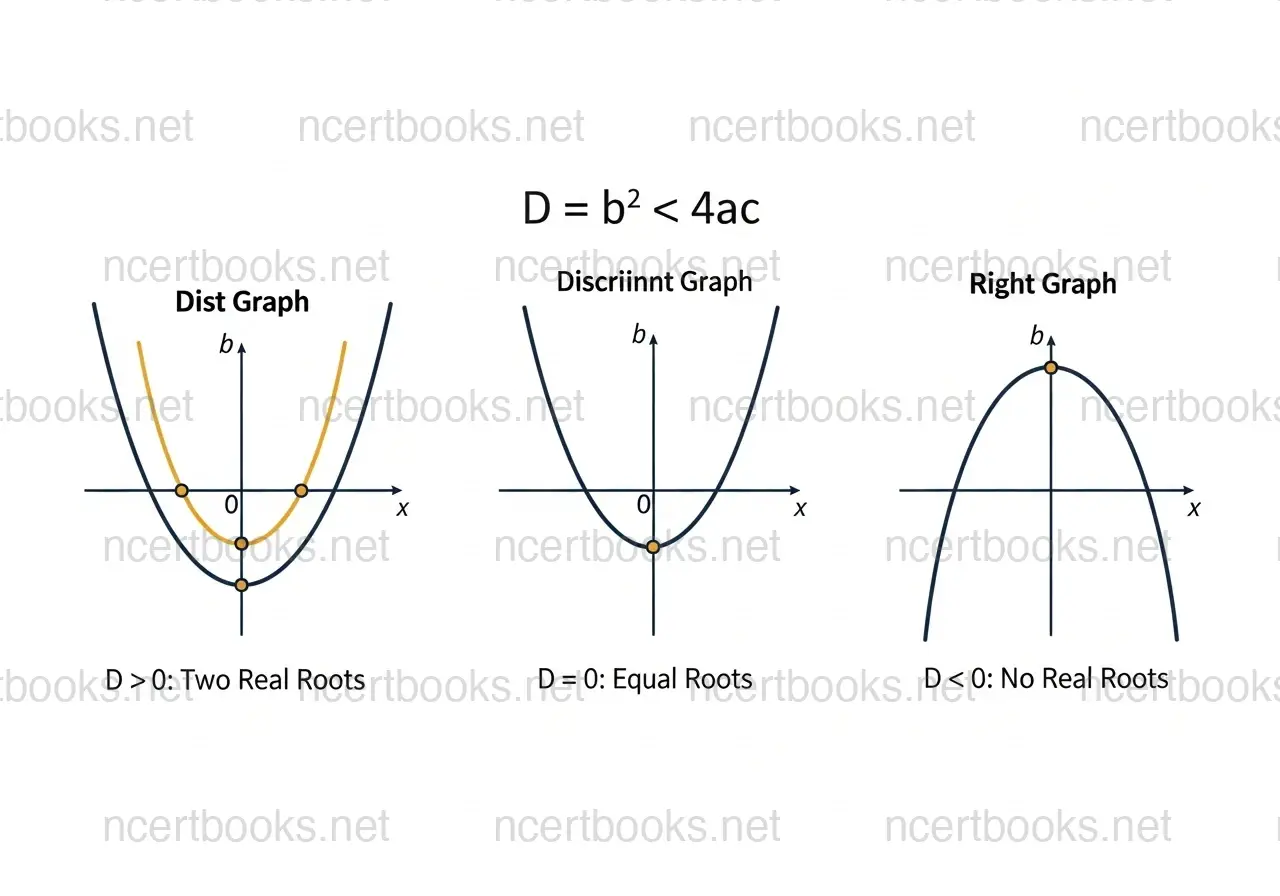
- D > 0: Two distinct real roots — \( x = \frac{-b \pm \sqrt{D}}{2a} \)
- D = 0: Two equal real roots — \( x = \frac{-b}{2a} \)
- D < 0: No real roots (roots are complex/imaginary)
- Equal roots condition: Set \( D = 0 \) and solve for the unknown (usually k)
- Word problems: Form the quadratic equation from given conditions, then check D
- Exercise 4.4 has 5 questions — all solvable using the discriminant method
- Chapter weightage: Quadratic Equations carries 10–12 marks in CBSE Class 10 board exam
The ncert solutions for class 10 maths chapter 4 ex 4 4 on this page are fully updated for the 2026-27 CBSE board exam. Exercise 4.4 of Chapter 4 — Quadratic Equations — is one of the most important exercises in NCERT Solutions for Class 10 Maths because it tests your ability to use the discriminant to determine whether a quadratic equation has real roots, equal roots, or no real roots. All 5 questions are solved here with complete step-by-step working, LaTeX-rendered formulas, and board exam tips. You can also refer to the official NCERT textbook to cross-check the questions.
These NCERT Solutions are prepared by experienced CBSE teachers and follow the exact marking scheme expected in your board exam. Whether you need cbse class 10 maths ncert solutions for homework, revision, or last-minute exam prep, this page covers everything you need.
Table of Contents
- Quick Revision Box
- Chapter Overview — Quadratic Equations Class 10
- Key Concepts: Discriminant and Nature of Roots
- NCERT Solutions for Class 10 Maths Chapter 4 Ex 4.4 — All Questions
- Formula Reference Table
- Solved Examples Beyond NCERT
- Important Questions for CBSE Board Exam 2026-27
- Common Mistakes Students Make
- Exam Tips for CBSE 2026-27
- Frequently Asked Questions
Chapter Overview — Quadratic Equations Class 10 Maths (CBSE 2026-27)
Chapter 4 of the NCERT Class 10 Maths textbook is titled Quadratic Equations. It covers the definition of a quadratic equation, methods of solving them (factorisation, completing the square, quadratic formula), and the nature of roots using the discriminant. Exercise 4.4 specifically deals with the nature of roots — a concept that connects algebra to real-world problem solving.
For CBSE 2026-27 board exams, this chapter typically carries 10–12 marks. Questions from Exercise 4.4 appear in both the 2-mark and 3-mark sections. The discriminant concept is also tested in MCQ format in the objective section. You should know how to identify the nature of roots without actually solving the equation — that is the core skill this exercise builds.
| Detail | Information |
|---|---|
| Chapter | Chapter 4 — Quadratic Equations |
| Textbook | NCERT Mathematics (Class 10) |
| Exercise | Exercise 4.4 |
| Subject | Mathematics |
| Board | CBSE |
| Academic Year | 2026-27 |
| Number of Questions | 5 |
| Difficulty Level | Medium to Hard |
| Key Topic | Nature of Roots using Discriminant |
Key Concepts: Discriminant and Nature of Roots — Class 10 Maths
Before you solve Exercise 4.4, you must understand the discriminant (판별식 in Korean, but in Hindi: विविक्तकर / D का मान). For a quadratic equation \( ax^2 + bx + c = 0 \) where \( a \neq 0 \), the discriminant is defined as:
\[ D = b^2 – 4ac \]
The value of D tells you the nature of the roots without actually solving the equation:
- If \( D > 0 \): The equation has two distinct real roots. The roots are \( x = \frac{-b + \sqrt{D}}{2a} \) and \( x = \frac{-b – \sqrt{D}}{2a} \).
- If \( D = 0 \): The equation has two equal real roots. Both roots equal \( x = \frac{-b}{2a} \).
- If \( D < 0 \): The equation has no real roots (the roots are imaginary/complex).
Key Concept: The word “nature” of roots refers to whether they are real or imaginary, and if real, whether they are equal or distinct. This is the only thing Exercise 4.4 asks you to determine in Question 1. For Questions 2–5, you apply this knowledge to find unknown values and solve word problems.
Prerequisites for this exercise: You should be comfortable with the quadratic formula, completing the square (Exercise 4.3), and basic algebraic manipulation. If you need a refresher, check the NCERT Solutions Class 10 Maths hub for earlier exercises.
NCERT Solutions for Class 10 Maths Chapter 4 Ex 4.4 — All 5 Questions Solved
Below are complete, step-by-step solutions to all 5 questions in Exercise 4.4. These ncert solutions for class 10 maths chapter 4 ex 4 4 follow the exact method expected in CBSE board exams. Show all working in your answer sheet — partial steps carry marks.
Question 1
Medium
Find the nature of the roots of the following quadratic equations. If the real roots exist, find them:
(i) \( 2x^2 – 3x + 5 = 0 \)
(ii) \( 3x^2 – 4\sqrt{3}x + 4 = 0 \)
(iii) \( 2x^2 – 6x + 3 = 0 \)
Step 1: Identify the coefficients: \( a = 2 \), \( b = -3 \), \( c = 5 \).
Step 2: Calculate the discriminant:
\[ D = b^2 – 4ac = (-3)^2 – 4(2)(5) = 9 – 40 = -31 \]
Step 3: Since \( D = -31 < 0 \), the equation has no real roots.
Why does this work? The square root of a negative number is not real, so the quadratic formula gives imaginary values. There are no real solutions.
\( \therefore \) D < 0 — The equation \( 2x^2 – 3x + 5 = 0 \) has NO real roots.
Step 1: Identify the coefficients: \( a = 3 \), \( b = -4\sqrt{3} \), \( c = 4 \).
Step 2: Calculate the discriminant:
\[ D = b^2 – 4ac = (-4\sqrt{3})^2 – 4(3)(4) = 48 – 48 = 0 \]
Step 3: Since \( D = 0 \), the equation has two equal real roots.
Step 4: Find the roots using \( x = \frac{-b}{2a} \):
\[ x = \frac{-(-4\sqrt{3})}{2 \times 3} = \frac{4\sqrt{3}}{6} = \frac{2\sqrt{3}}{3} \]
Why does this work? When D = 0, both roots are identical and equal to \( \frac{-b}{2a} \). The \( \pm \sqrt{D} \) term vanishes.
Verification: \( 3 \left(\frac{2\sqrt{3}}{3}\right)^2 – 4\sqrt{3} \cdot \frac{2\sqrt{3}}{3} + 4 = 3 \cdot \frac{4}{3} – \frac{8 \times 3}{3} + 4 = 4 – 8 + 4 = 0 \) ✓
\( \therefore \) D = 0 — Two equal real roots: \( x = \frac{2\sqrt{3}}{3} \) (both roots are equal)
Step 1: Identify the coefficients: \( a = 2 \), \( b = -6 \), \( c = 3 \).
Step 2: Calculate the discriminant:
\[ D = b^2 – 4ac = (-6)^2 – 4(2)(3) = 36 – 24 = 12 \]
Step 3: Since \( D = 12 > 0 \), the equation has two distinct real roots.
Step 4: Find the roots using the quadratic formula:
\[ x = \frac{-b \pm \sqrt{D}}{2a} = \frac{6 \pm \sqrt{12}}{4} = \frac{6 \pm 2\sqrt{3}}{4} = \frac{3 \pm \sqrt{3}}{2} \]
Step 5: Write both roots separately:
\[ x_1 = \frac{3 + \sqrt{3}}{2}, \quad x_2 = \frac{3 – \sqrt{3}}{2} \]
Why does this work? \( \sqrt{12} = \sqrt{4 \times 3} = 2\sqrt{3} \). Simplifying the fraction by dividing numerator and denominator by 2 gives the final answer.
\( \therefore \) D > 0 — Two distinct real roots: \( x = \frac{3 + \sqrt{3}}{2} \) and \( x = \frac{3 – \sqrt{3}}{2} \)
Question 2
Medium
Find the values of k for each of the following quadratic equations, so that they have two equal roots.
(1) \( 2x^2 + kx + 3 = 0 \)
(2) \( kx(x – 2) + 6 = 0 \)
Key Concept: For two equal roots, the discriminant must equal zero: \( D = b^2 – 4ac = 0 \).
Step 1: Identify the coefficients: \( a = 2 \), \( b = k \), \( c = 3 \).
Step 2: Set the discriminant equal to zero:
\[ D = k^2 – 4(2)(3) = 0 \]
\[ k^2 – 24 = 0 \]
\[ k^2 = 24 \]
\[ k = \pm \sqrt{24} = \pm 2\sqrt{6} \]
Why does this work? Equal roots occur when the parabola just touches the x-axis at one point, which happens exactly when D = 0. Any other value of k gives either two distinct roots or no real roots.
\( \therefore \) \( k = 2\sqrt{6} \) or \( k = -2\sqrt{6} \)
Step 1: Expand the equation:
\[ kx^2 – 2kx + 6 = 0 \]
Step 2: Identify the coefficients: \( a = k \), \( b = -2k \), \( c = 6 \).
Step 3: For equal roots, set \( D = 0 \):
\[ D = (-2k)^2 – 4(k)(6) = 0 \]
\[ 4k^2 – 24k = 0 \]
\[ 4k(k – 6) = 0 \]
Step 4: Solve for k:
\[ k = 0 \quad \text{or} \quad k = 6 \]
Step 5: Check validity. If \( k = 0 \), the equation becomes \( 6 = 0 \), which is not a quadratic equation. So \( k = 0 \) is rejected.
Why do we reject k = 0? A quadratic equation requires the coefficient of \( x^2 \) to be non-zero (\( a \neq 0 \)). When \( k = 0 \), the equation loses its quadratic nature.
\( \therefore \) \( k = 6 \) (k = 0 is rejected as it does not give a quadratic equation)
Question 3
Medium
Is it possible to design a rectangular mango grove whose length is twice its breadth, and the area is 800 m²? If so, find its length and breadth.
Step 1: Let the breadth of the rectangle be \( x \) metres. Since length is twice the breadth:
\[ \text{Length} = 2x \text{ metres} \]
Step 2: Use the area formula. Area = Length × Breadth:
\[ 2x \times x = 800 \]
\[ 2x^2 = 800 \]
\[ x^2 = 400 \]
\[ x^2 – 400 = 0 \]
Step 3: Identify coefficients: \( a = 1 \), \( b = 0 \), \( c = -400 \). Calculate the discriminant:
\[ D = b^2 – 4ac = 0 – 4(1)(-400) = 1600 \]
Step 4: Since \( D = 1600 > 0 \), real roots exist. Find the roots:
\[ x = \frac{-0 \pm \sqrt{1600}}{2 \times 1} = \frac{\pm 40}{2} = \pm 20 \]
Step 5: Since breadth cannot be negative, \( x = 20 \) m. Therefore, length \( = 2 \times 20 = 40 \) m.
Why do we reject the negative root? Dimensions of a physical shape must be positive. A breadth of −20 m has no real-world meaning.
Verification: Area \( = 40 \times 20 = 800 \) m² ✓. Length \( = 2 \times \) Breadth ✓.
\( \therefore \) Yes, it is possible. Breadth = 20 m, Length = 40 m.
Question 4
Hard
Is the following situation possible? If so, determine their present ages. The sum of the ages of two friends is 20 years. Four years ago, the product of their ages in years was 48.
Step 1: Let the present age of one friend be \( x \) years. Since the sum of their ages is 20:
\[ \text{Present age of second friend} = (20 – x) \text{ years} \]
Step 2: Four years ago, their ages were \( (x – 4) \) and \( (20 – x – 4) = (16 – x) \) years respectively.
Step 3: Use the condition that the product of ages four years ago was 48:
\[ (x – 4)(16 – x) = 48 \]
\[ 16x – x^2 – 64 + 4x = 48 \]
\[ -x^2 + 20x – 64 = 48 \]
\[ -x^2 + 20x – 112 = 0 \]
\[ x^2 – 20x + 112 = 0 \]
Step 4: Identify coefficients: \( a = 1 \), \( b = -20 \), \( c = 112 \). Calculate the discriminant:
\[ D = b^2 – 4ac = (-20)^2 – 4(1)(112) = 400 – 448 = -48 \]
Step 5: Since \( D = -48 < 0 \), the equation has no real roots.
What does this mean? A negative discriminant means the mathematical conditions given in the problem are contradictory — no real values of age satisfy both conditions simultaneously.
\( \therefore \) No, the situation is NOT possible. The discriminant is negative (\( D = -48 < 0 \)), so no real ages satisfy both the given conditions.
Question 5
Hard
Is it possible to design a rectangular park of perimeter 80 m and area 400 m²? If so, find its length and breadth.
Step 1: Let the length of the park be \( l \) metres and breadth be \( b \) metres.
Step 2: Use the perimeter condition:
\[ 2(l + b) = 80 \implies l + b = 40 \implies l = 40 – b \]
Step 3: Use the area condition:
\[ l \times b = 400 \]
\[ (40 – b) \times b = 400 \]
\[ 40b – b^2 = 400 \]
\[ b^2 – 40b + 400 = 0 \]
Step 4: Identify coefficients: \( a = 1 \), \( b_{\text{coeff}} = -40 \), \( c = 400 \). Calculate the discriminant:
\[ D = (-40)^2 – 4(1)(400) = 1600 – 1600 = 0 \]
Step 5: Since \( D = 0 \), real roots exist and they are equal. Find the root:
\[ b = \frac{-(-40)}{2 \times 1} = \frac{40}{2} = 20 \text{ m} \]
\[ l = 40 – 20 = 20 \text{ m} \]
What does D = 0 mean here? Equal roots mean both length and breadth are the same — the rectangle is actually a square. There is exactly one design possible.
Verification: Perimeter \( = 2(20 + 20) = 80 \) m ✓. Area \( = 20 \times 20 = 400 \) m² ✓.
\( \therefore \) Yes, it is possible. Length = Breadth = 20 m (the park is a square).
 0 D=0 D<0 for quadratic equations - NCERT Class 10 Maths Chapter 4" width="1280" height="896" loading="lazy">
Formula Reference Table — Quadratic Equations Chapter 4
| Formula Name | Formula | Variables Defined |
|---|---|---|
| Standard Form | \( ax^2 + bx + c = 0 \) | \( a \neq 0 \); a, b, c are real numbers |
| Discriminant | \( D = b^2 – 4ac \) | a = coefficient of \( x^2 \), b = coefficient of x, c = constant |
| Quadratic Formula | \( x = \frac{-b \pm \sqrt{D}}{2a} \) | Use when D ≥ 0 for real roots |
| Equal Roots Condition | \( D = 0 \implies x = \frac{-b}{2a} \) | Both roots are equal to \( \frac{-b}{2a} \) |
| Sum of Roots | \( \alpha + \beta = \frac{-b}{a} \) | \( \alpha, \beta \) are the two roots |
| Product of Roots | \( \alpha \beta = \frac{c}{a} \) | \( \alpha, \beta \) are the two roots |
| Area of Rectangle | \( A = l \times b \) | l = length, b = breadth |
| Perimeter of Rectangle | \( P = 2(l + b) \) | l = length, b = breadth |
Solved Examples Beyond NCERT — Extra Practice for Class 10 Maths
Extra Example 1 — Find k for Equal Roots
Medium
Find the value of k so that \( (k+1)x^2 – 2(k-1)x + 1 = 0 \) has equal roots.
Step 1: Here \( a = k+1 \), \( b = -2(k-1) \), \( c = 1 \). For equal roots, \( D = 0 \).
\[ [-2(k-1)]^2 – 4(k+1)(1) = 0 \]
\[ 4(k-1)^2 – 4(k+1) = 0 \]
\[ (k-1)^2 – (k+1) = 0 \]
\[ k^2 – 2k + 1 – k – 1 = 0 \]
\[ k^2 – 3k = 0 \]
\[ k(k-3) = 0 \]
Step 2: So \( k = 0 \) or \( k = 3 \). Check: if \( k = 0 \), the equation becomes \( x^2 + 2x + 1 = 0 \) — still quadratic, so \( k = 0 \) is valid here.
\( \therefore \) k = 0 or k = 3
Extra Example 2 — Nature of Roots with Parameter
Hard
For what values of p does \( px^2 + 4x + 1 = 0 \) have real roots?
Step 1: For real roots, \( D \geq 0 \). Here \( a = p \), \( b = 4 \), \( c = 1 \).
\[ D = 16 – 4p \geq 0 \]
\[ 16 \geq 4p \]
\[ p \leq 4 \]
Step 2: Also, for the equation to be quadratic, \( p \neq 0 \).
\( \therefore \) The equation has real roots when \( p \leq 4 \) and \( p \neq 0 \).
Extra Example 3 — Age Word Problem
Medium
The sum of two numbers is 15 and the sum of their squares is 113. Find the numbers.
Step 1: Let the numbers be \( x \) and \( 15 – x \).
\[ x^2 + (15-x)^2 = 113 \]
\[ x^2 + 225 – 30x + x^2 = 113 \]
\[ 2x^2 – 30x + 112 = 0 \]
\[ x^2 – 15x + 56 = 0 \]
Step 2: Check discriminant: \( D = 225 – 224 = 1 > 0 \). Two distinct real roots exist.
\[ x = \frac{15 \pm 1}{2} \implies x = 8 \text{ or } x = 7 \]
\( \therefore \) The two numbers are 7 and 8.
Important Questions for CBSE Board Exam 2026-27 — Chapter 4 Ex 4.4
1-Mark Questions (Definition / MCQ Type)
- Q: If the discriminant of a quadratic equation is zero, what is the nature of its roots?
A: The equation has two equal real roots. - Q: Write the discriminant of \( 3x^2 + 5x + 2 = 0 \).
A: \( D = 25 – 24 = 1 \) - Q: For what condition does \( ax^2 + bx + c = 0 \) have no real roots?
A: When \( b^2 – 4ac < 0 \).
3-Mark Questions
- Q: Find the value of k for which \( 4x^2 + kx + 9 = 0 \) has equal roots.
A: For equal roots, \( D = 0 \): \( k^2 – 4(4)(9) = 0 \implies k^2 = 144 \implies k = \pm 12 \). - Q: Determine the nature of roots of \( x^2 + 2x + 3 = 0 \) without solving it.
A: \( D = 4 – 12 = -8 < 0 \). The equation has no real roots.
5-Mark (Long Answer) Question
Q: A train travels 360 km at a uniform speed. If the speed had been 5 km/h more, it would have taken 1 hour less for the same journey. Find the speed of the train using the discriminant method to verify that real roots exist.
A: Let speed = \( x \) km/h. Time = \( \frac{360}{x} \). With increased speed: \( \frac{360}{x+5} = \frac{360}{x} – 1 \). Solving: \( 360x – 360(x+5) = -x(x+5) \implies x^2 + 5x – 1800 = 0 \). Check: \( D = 25 + 7200 = 7225 > 0 \). Real roots exist. \( x = \frac{-5 + 85}{2} = 40 \) km/h (rejecting negative value). Speed = 40 km/h.
Common Mistakes Students Make in Exercise 4.4
Mistake 1: Students write \( D = b^2 + 4ac \) instead of \( b^2 – 4ac \).
Why it’s wrong: The correct discriminant formula uses subtraction. Adding 4ac gives a completely different value and wrong conclusion about nature of roots.
Correct approach: Always write \( D = b^2 – 4ac \) and double-check the sign before substituting.
Mistake 2: In Question 2(2), students accept \( k = 0 \) as a valid answer.
Why it’s wrong: When \( k = 0 \), the equation \( kx^2 – 2kx + 6 = 0 \) becomes \( 6 = 0 \), which is not a quadratic equation at all.
Correct approach: Always check if \( k = 0 \) makes the leading coefficient zero. If yes, reject it with a written reason.
Mistake 3: In word problems (Q3, Q5), students do not state whether the situation is possible or not.
Why it’s wrong: The question specifically asks “Is it possible?” — not stating this explicitly loses marks even if the calculation is correct.
Correct approach: Start your answer with “Yes, it is possible” or “No, it is not possible” before showing any working.
Mistake 4: Students forget to reject negative values of dimensions (length, breadth) in geometry word problems.
Why it’s wrong: Physical dimensions must be positive. A negative length is mathematically valid but physically meaningless.
Correct approach: After finding roots, always state “Since length/breadth cannot be negative, we reject \( x = \text{negative value} \).”
Mistake 5: In Q4 (ages problem), students set up the equation incorrectly by not subtracting 4 from both ages for “four years ago.”
Why it’s wrong: “Four years ago” means you subtract 4 from each person’s current age. Forgetting this gives a wrong quadratic.
Correct approach: If present ages are \( x \) and \( 20-x \), then four years ago they were \( x-4 \) and \( 16-x \).
Exam Tips for CBSE 2026-27 — Quadratic Equations Chapter 4
- Show D calculation explicitly: The CBSE 2026-27 marking scheme awards 1 mark specifically for writing and calculating the discriminant. Never skip this step.
- State the conclusion: After computing D, write a clear conclusion (“two distinct real roots”, “two equal roots”, or “no real roots”). This conclusion carries a separate mark.
- Word problems need a “possibility statement”: In Q3, Q4, Q5-type problems, the first sentence of your answer must state whether the situation is possible or not. Examiners check this before reading your working.
- Simplify surds fully: In Q1(iii), \( \sqrt{12} = 2\sqrt{3} \). If you leave the answer as \( \frac{6 \pm \sqrt{12}}{4} \), you may lose a mark for incomplete simplification.
- Chapter weightage in 2026-27: Chapter 4 (Quadratic Equations) is part of the Algebra unit, which carries approximately 20 marks in the Class 10 CBSE board exam. Exercise 4.4-type questions appear in 2–3 mark slots.
- Last-minute revision checklist:
- ✅ Memorise \( D = b^2 – 4ac \) and the three conditions (D>0, D=0, D<0)
- ✅ Practise setting up quadratic equations from word problems
- ✅ Know how to reject extraneous (negative/zero) solutions with justification
- ✅ Revise simplification of surds (\( \sqrt{12}, \sqrt{24}, \sqrt{48} \))
- ✅ Practise Q4-type age problems — they are a common CBSE favourite
Frequently Asked Questions — NCERT Solutions Class 10 Maths Chapter 4 Ex 4.4
How do you find the nature of roots of a quadratic equation using the discriminant?
To find the nature of roots, calculate \( D = b^2 – 4ac \) from the standard form \( ax^2 + bx + c = 0 \). If D > 0, the equation has two distinct real roots. If D = 0, it has two equal real roots. If D < 0, there are no real roots. This is the core concept of Exercise 4.4 and is directly tested in CBSE board exams every year.
How do you find the value of k for two equal roots in a quadratic equation?
For two equal roots, set the discriminant equal to zero: \( b^2 – 4ac = 0 \). Express the coefficients in terms of k, substitute into this equation, and solve for k. Always check whether any solution makes the leading coefficient zero — if it does, reject that value because the equation would no longer be quadratic. This is exactly the method used in Question 2 of Exercise 4.4.
Is it possible to design a rectangular park of perimeter 80 m and area 400 m²?
Yes, it is possible. Setting up the equations from the given perimeter and area conditions gives the quadratic \( b^2 – 40b + 400 = 0 \), whose discriminant is \( D = 1600 – 1600 = 0 \). Since D = 0, real roots exist and length = breadth = 20 m. The park is actually a square. This is Question 5 of Exercise 4.4 in the NCERT Class 10 Maths textbook.
Why is the ages problem in Exercise 4.4 Question 4 not possible?
The ages problem sets up the quadratic \( x^2 – 20x + 112 = 0 \). Its discriminant is \( D = 400 – 448 = -48 \). Since D < 0, there are no real roots, meaning no real ages satisfy both conditions (sum = 20 and product four years ago = 48). The situation is mathematically impossible. This is a great example of how the discriminant can tell you whether a real-world problem has a valid solution.
What is the difference between no real roots and two equal roots?
When D < 0, the square root of a negative number appears in the quadratic formula, giving imaginary (complex) roots — these are called “no real roots.” When D = 0, the square root term disappears and both roots are the same real number \( \frac{-b}{2a} \) — these are called “two equal real roots” or “repeated roots.” Both cases are tested in NCERT Class 10 Maths Chapter 4 Exercise 4.4.
Where can I download NCERT Class 10 Maths Chapter 4 Exercise 4.4 PDF?
You can download the complete NCERT solutions for Class 10 Maths Chapter 4 Exercise 4.4 as a PDF from this page using the download button above. The PDF is free, updated for 2026-27, and contains all 5 questions with step-by-step solutions. You can also access the official NCERT textbook from the NCERT official website.