- Chapter: 3 — Pair of Linear Equations in Two Variables
- Exercise: 3.3 — Substitution Method
- Total Questions: 3 (Q1 has 6 sub-parts; Q3 has 6 word problems)
- Core Skill: Express one variable in terms of the other, then substitute into the second equation
- Key Condition: A unique solution exists when \( \frac{a_1}{a_2} \neq \frac{b_1}{b_2} \)
- Board Weightage: Chapter 3 carries approximately 6 marks in CBSE Class 10 Maths board exam 2026-27
- Most Asked: Word problems on ages, fractions, and cost — appear almost every year
- Verification: Always substitute your answer back into both original equations to confirm
Table of Contents
These NCERT Solutions for Class 10 Maths Chapter 3 Ex 3.3 give you complete, step-by-step answers to all questions in Exercise 3.3 — Pair of Linear Equations in Two Variables, updated for the 2026-27 CBSE board exam. Whether you are solving simple equation pairs or tackling real-life word problems, this page covers every sub-part with full working and clear reasoning. You can also explore our full NCERT Solutions for Class 10 hub for solutions to all subjects and chapters. For the official NCERT textbook, visit the NCERT official website.
Exercise 3.3 focuses entirely on the substitution method — one of the three algebraic methods taught in this chapter. The other two methods (elimination and cross-multiplication) are covered in later exercises. Browse all exercises and extra questions through our NCERT Solutions library.
Chapter Overview — Pair of Linear Equations in Two Variables (Class 10 Maths Chapter 3)
Chapter 3 of the NCERT Class 10 Maths textbook deals with Pair of Linear Equations in Two Variables. You learn to represent real-life situations as a system of two equations and solve them using graphical and algebraic methods. This chapter is part of the Algebra unit and is directly assessed in CBSE board exams.
Exercise 3.3 specifically covers the substitution method (Section 3.4.1 of the textbook). You will solve 3 questions — the first with 6 algebraic sub-parts, the second requiring you to find an unknown constant, and the third with 6 real-world word problems. This exercise builds the foundation for the elimination and cross-multiplication methods that follow.
| Detail | Information |
|---|---|
| Class | 10 |
| Subject | Mathematics |
| Chapter | 3 — Pair of Linear Equations in Two Variables |
| Exercise | 3.3 |
| Method Covered | Substitution Method |
| Number of Questions | 3 (with sub-parts) |
| CBSE Syllabus Status | Active — included in 2026-27 syllabus |
| Difficulty Level | Medium |
Key Concepts and Theorems — Substitution Method for Pair of Linear Equations
A pair of linear equations in two variables has the general form:
\[ a_1 x + b_1 y + c_1 = 0 \]
\[ a_2 x + b_2 y + c_2 = 0 \]
where \( a_1, b_1, c_1, a_2, b_2, c_2 \) are real numbers and \( a_1^2 + b_1^2 \neq 0 \), \( a_2^2 + b_2^2 \neq 0 \).
Steps of the Substitution Method
- Step 1: From one equation, express one variable (say \( y \)) in terms of the other (\( x \)).
- Step 2: Substitute this expression into the second equation. You now have a single equation in one variable.
- Step 3: Solve this single-variable equation.
- Step 4: Substitute the value found back into the expression from Step 1 to get the second variable.
- Step 5: Verify both values satisfy both original equations.
Consistency Conditions
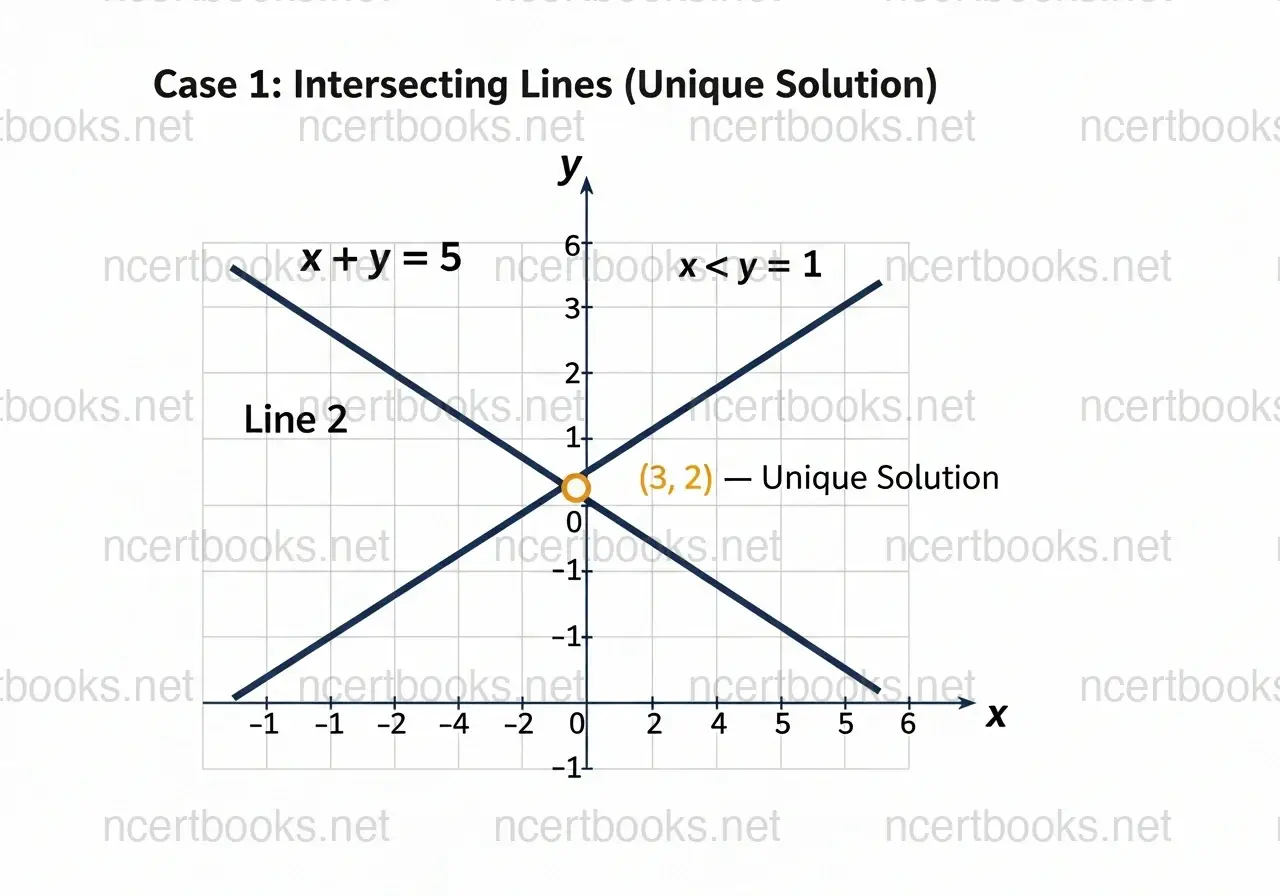
- Unique solution (consistent): \( \frac{a_1}{a_2} \neq \frac{b_1}{b_2} \) — lines intersect at one point
- Infinitely many solutions (consistent, dependent): \( \frac{a_1}{a_2} = \frac{b_1}{b_2} = \frac{c_1}{c_2} \) — lines coincide
- No solution (inconsistent): \( \frac{a_1}{a_2} = \frac{b_1}{b_2} \neq \frac{c_1}{c_2} \) — lines are parallel
NCERT Solutions for Class 10 Maths Chapter 3 Ex 3.3 — All Questions (Substitution Method)
Question 1 — Solve the Following Pairs of Linear Equations by the Substitution Method
Question 1
Medium
Solve the following pairs of linear equations by the substitution method:
Step 1: From equation (1): \( x + y = 14 \), express \( x \) in terms of \( y \):
\[ x = 14 – y \quad \cdots (3) \]
Step 2: Substitute (3) into equation (2): \( x – y = 4 \):
\[ (14 – y) – y = 4 \]
\[ 14 – 2y = 4 \]
\[ 2y = 10 \]
\[ y = 5 \]
Step 3: Substitute \( y = 5 \) back into (3):
\[ x = 14 – 5 = 9 \]
Verification: \( 9 + 5 = 14 \) ✓ and \( 9 – 5 = 4 \) ✓
\( \therefore \) x = 9, y = 5
Step 1: From equation (1): \( s – t = 3 \), express \( s \) in terms of \( t \):
\[ s = t + 3 \quad \cdots (3) \]
Step 2: Substitute (3) into equation (2): \( \frac{s}{3} + \frac{t}{2} = 6 \):
\[ \frac{t + 3}{3} + \frac{t}{2} = 6 \]
Multiply throughout by 6 (LCM of 3 and 2):
\[ 2(t + 3) + 3t = 36 \]
\[ 2t + 6 + 3t = 36 \]
\[ 5t = 30 \]
\[ t = 6 \]
Step 3: Substitute \( t = 6 \) into (3):
\[ s = 6 + 3 = 9 \]
Verification: \( 9 – 6 = 3 \) ✓ and \( \frac{9}{3} + \frac{6}{2} = 3 + 3 = 6 \) ✓
\( \therefore \) s = 9, t = 6
Step 1: From equation (1): \( 3x – y = 3 \), express \( y \) in terms of \( x \):
\[ y = 3x – 3 \quad \cdots (3) \]
Step 2: Substitute (3) into equation (2): \( 9x – 3y = 9 \):
\[ 9x – 3(3x – 3) = 9 \]
\[ 9x – 9x + 9 = 9 \]
\[ 9 = 9 \]
Why does this happen? The variable terms cancel out, leaving a true statement. This means both equations represent the same line — the system has infinitely many solutions.
\( \therefore \) Infinitely many solutions (the equations are dependent; every point on \( 3x – y = 3 \) is a solution).
Step 1: Multiply both equations by 10 to remove decimals:
\[ 2x + 3y = 13 \quad \cdots (1′) \]
\[ 4x + 5y = 23 \quad \cdots (2′) \]
Step 2: From (1′): \( 2x = 13 – 3y \Rightarrow x = \frac{13 – 3y}{2} \quad \cdots (3) \)
Step 3: Substitute (3) into (2′):
\[ 4 \times \frac{13 – 3y}{2} + 5y = 23 \]
\[ 2(13 – 3y) + 5y = 23 \]
\[ 26 – 6y + 5y = 23 \]
\[ -y = -3 \]
\[ y = 3 \]
Step 4: Substitute \( y = 3 \) into (3):
\[ x = \frac{13 – 9}{2} = \frac{4}{2} = 2 \]
Verification: \( 0.2(2) + 0.3(3) = 0.4 + 0.9 = 1.3 \) ✓ and \( 0.4(2) + 0.5(3) = 0.8 + 1.5 = 2.3 \) ✓
\( \therefore \) x = 2, y = 3
Step 1: From equation (1): \( \sqrt{2}\, x + \sqrt{3}\, y = 0 \):
\[ x = \frac{-\sqrt{3}\, y}{\sqrt{2}} \quad \cdots (3) \]
Step 2: Substitute (3) into equation (2): \( \sqrt{3}\, x – \sqrt{8}\, y = 0 \):
\[ \sqrt{3} \times \frac{-\sqrt{3}\, y}{\sqrt{2}} – \sqrt{8}\, y = 0 \]
\[ \frac{-3y}{\sqrt{2}} – 2\sqrt{2}\, y = 0 \]
Multiply throughout by \( \sqrt{2} \):
\[ -3y – 2\sqrt{2} \times \sqrt{2}\, y = 0 \]
\[ -3y – 4y = 0 \]
\[ -7y = 0 \]
\[ y = 0 \]
Step 3: Substitute \( y = 0 \) into (3):
\[ x = \frac{-\sqrt{3} \times 0}{\sqrt{2}} = 0 \]
\( \therefore \) x = 0, y = 0
Step 1: Multiply equation (1) by 6 to clear fractions:
\[ 9x – 10y = -12 \quad \cdots (1′) \]
Multiply equation (2) by 6:
\[ 2x + 3y = 13 \quad \cdots (2′) \]
Step 2: From (2′): \( 2x = 13 – 3y \Rightarrow x = \frac{13 – 3y}{2} \quad \cdots (3) \)
Step 3: Substitute (3) into (1′):
\[ 9 \times \frac{13 – 3y}{2} – 10y = -12 \]
\[ \frac{117 – 27y}{2} – 10y = -12 \]
Multiply throughout by 2:
\[ 117 – 27y – 20y = -24 \]
\[ -47y = -141 \]
\[ y = 3 \]
\[ x = \frac{13 – 9}{2} = 2 \]
Verification: \( \frac{3(2)}{2} – \frac{5(3)}{3} = 3 – 5 = -2 \) ✓ and \( \frac{2}{3} + \frac{3}{2} = \frac{4}{6} + \frac{9}{6} = \frac{13}{6} \) ✓
\( \therefore \) x = 2, y = 3
Question 2 — Solve 2x + 3y = 11 and 2x – 4y = –24 and Find the Value of m
Question 2
Medium
Solve \( 2x + 3y = 11 \) and \( 2x – 4y = -24 \) and hence find the value of \( m \) for which \( y = mx + 3 \).
Key Concept: First solve the system to find \( x \) and \( y \). Then substitute these values into \( y = mx + 3 \) and solve for \( m \).
Step 1: From equation (1): \( 2x + 3y = 11 \), express \( x \) in terms of \( y \):
\[ 2x = 11 – 3y \]
\[ x = \frac{11 – 3y}{2} \quad \cdots (3) \]
Step 2: Substitute (3) into equation (2): \( 2x – 4y = -24 \):
\[ 2 \times \frac{11 – 3y}{2} – 4y = -24 \]
\[ (11 – 3y) – 4y = -24 \]
\[ 11 – 7y = -24 \]
\[ -7y = -35 \]
\[ y = 5 \]
Step 3: Substitute \( y = 5 \) into (3):
\[ x = \frac{11 – 15}{2} = \frac{-4}{2} = -2 \]
Verification: \( 2(-2) + 3(5) = -4 + 15 = 11 \) ✓ and \( 2(-2) – 4(5) = -4 – 20 = -24 \) ✓
Step 4: Find \( m \) using \( y = mx + 3 \). Substitute \( x = -2 \) and \( y = 5 \):
\[ 5 = m(-2) + 3 \]
\[ 5 – 3 = -2m \]
\[ 2 = -2m \]
\[ m = -1 \]
\( \therefore \) x = –2, y = 5, and m = –1
Question 3 — Word Problems: Form and Solve Using Substitution Method
Question 3
Hard
Form the pair of linear equations for the following problems and find their solution by substitution method.
Let the two numbers be \( x \) and \( y \), where \( x > y \).
Forming equations:
\[ x – y = 26 \quad \cdots (1) \]
\[ x = 3y \quad \cdots (2) \]
Step 1: Substitute (2) into (1):
\[ 3y – y = 26 \]
\[ 2y = 26 \]
\[ y = 13 \]
Step 2: From (2): \( x = 3 \times 13 = 39 \)
Verification: \( 39 – 13 = 26 \) ✓ and \( 39 = 3 \times 13 \) ✓
\( \therefore \) The two numbers are 39 and 13.
Key Concept: Supplementary angles (पूरक कोण) sum to \( 180^\circ \).
Let the larger angle be \( x \) and the smaller angle be \( y \).
Forming equations:
\[ x + y = 180 \quad \cdots (1) \]
\[ x – y = 18 \quad \cdots (2) \]
Step 1: From (2): \( x = y + 18 \quad \cdots (3) \)
Step 2: Substitute (3) into (1):
\[ (y + 18) + y = 180 \]
\[ 2y = 162 \]
\[ y = 81 \]
Step 3: From (3): \( x = 81 + 18 = 99 \)
Verification: \( 99 + 81 = 180 \) ✓ and \( 99 – 81 = 18 \) ✓
\( \therefore \) The two supplementary angles are 99° and 81°.
Let the cost of one bat be \( ₹x \) and the cost of one ball be \( ₹y \).
Forming equations:
\[ 7x + 6y = 3800 \quad \cdots (1) \]
\[ 3x + 5y = 1750 \quad \cdots (2) \]
Step 1: From (2): \( 3x = 1750 – 5y \Rightarrow x = \frac{1750 – 5y}{3} \quad \cdots (3) \)
Step 2: Substitute (3) into (1):
\[ 7 \times \frac{1750 – 5y}{3} + 6y = 3800 \]
\[ \frac{12250 – 35y}{3} + 6y = 3800 \]
Multiply throughout by 3:
\[ 12250 – 35y + 18y = 11400 \]
\[ -17y = -850 \]
\[ y = 50 \]
Step 3: From (3): \( x = \frac{1750 – 250}{3} = \frac{1500}{3} = 500 \)
Verification: \( 7(500) + 6(50) = 3500 + 300 = 3800 \) ✓ and \( 3(500) + 5(50) = 1500 + 250 = 1750 \) ✓
\( \therefore \) Cost of each bat = ₹500 and cost of each ball = ₹50.
Let the fixed charge be \( ₹x \) and the charge per km be \( ₹y \).
Forming equations:
\[ x + 10y = 105 \quad \cdots (1) \]
\[ x + 15y = 155 \quad \cdots (2) \]
Step 1: From (1): \( x = 105 – 10y \quad \cdots (3) \)
Step 2: Substitute (3) into (2):
\[ (105 – 10y) + 15y = 155 \]
\[ 105 + 5y = 155 \]
\[ 5y = 50 \]
\[ y = 10 \]
Step 3: From (3): \( x = 105 – 100 = 5 \)
Verification: \( 5 + 10(10) = 105 \) ✓ and \( 5 + 15(10) = 155 \) ✓
Charge for 25 km:
\[ \text{Total} = x + 25y = 5 + 25 \times 10 = 5 + 250 = 255 \]
\( \therefore \) Fixed charge = ₹5, charge per km = ₹10, and total charge for 25 km = ₹255.
Let the numerator be \( x \) and the denominator be \( y \). The fraction is \( \frac{x}{y} \).
Forming equations:
\[ \frac{x + 2}{y + 2} = \frac{9}{11} \Rightarrow 11(x + 2) = 9(y + 2) \Rightarrow 11x + 22 = 9y + 18 \Rightarrow 11x – 9y = -4 \quad \cdots (1) \]
\[ \frac{x + 3}{y + 3} = \frac{5}{6} \Rightarrow 6(x + 3) = 5(y + 3) \Rightarrow 6x + 18 = 5y + 15 \Rightarrow 6x – 5y = -3 \quad \cdots (2) \]
Step 1: From (2): \( 6x = 5y – 3 \Rightarrow x = \frac{5y – 3}{6} \quad \cdots (3) \)
Step 2: Substitute (3) into (1):
\[ 11 \times \frac{5y – 3}{6} – 9y = -4 \]
\[ \frac{55y – 33}{6} – 9y = -4 \]
Multiply throughout by 6:
\[ 55y – 33 – 54y = -24 \]
\[ y = 9 \]
Step 3: From (3): \( x = \frac{5(9) – 3}{6} = \frac{42}{6} = 7 \)
Verification: \( \frac{7+2}{9+2} = \frac{9}{11} \) ✓ and \( \frac{7+3}{9+3} = \frac{10}{12} = \frac{5}{6} \) ✓
\( \therefore \) The fraction is \( \frac{7}{9} \).
Let Jacob’s present age be \( x \) years and his son’s present age be \( y \) years.
Forming equations:
Five years hence: \( (x + 5) = 3(y + 5) \)
\[ x + 5 = 3y + 15 \Rightarrow x – 3y = 10 \quad \cdots (1) \]
Five years ago: \( (x – 5) = 7(y – 5) \)
\[ x – 5 = 7y – 35 \Rightarrow x – 7y = -30 \quad \cdots (2) \]
Step 1: From (1): \( x = 3y + 10 \quad \cdots (3) \)
Step 2: Substitute (3) into (2):
\[ (3y + 10) – 7y = -30 \]
\[ -4y = -40 \]
\[ y = 10 \]
Step 3: From (3): \( x = 3(10) + 10 = 40 \)
Verification: Five years hence: \( 45 = 3 \times 15 \) ✓ and Five years ago: \( 35 = 7 \times 5 \) ✓
\( \therefore \) Jacob’s present age = 40 years and his son’s present age = 10 years.
Formula Reference Table — Pair of Linear Equations (Class 10 Maths Chapter 3)
| Formula / Concept | Expression | Variables Defined |
|---|---|---|
| General form of a linear equation | \( ax + by + c = 0 \) | \( a, b \neq 0 \) simultaneously; \( c \) is a constant |
| Substitution: express one variable | \( y = \frac{c – ax}{b} \) | Isolate \( y \) from one equation |
| Unique solution condition | \( \frac{a_1}{a_2} \neq \frac{b_1}{b_2} \) | Lines intersect — one solution |
| Infinite solutions condition | \( \frac{a_1}{a_2} = \frac{b_1}{b_2} = \frac{c_1}{c_2} \) | Lines coincide |
| No solution condition | \( \frac{a_1}{a_2} = \frac{b_1}{b_2} \neq \frac{c_1}{c_2} \) | Lines are parallel |
| Supplementary angles | \( x + y = 180^\circ \) | \( x \) = larger angle, \( y \) = smaller angle |
| Age problem (n years hence) | \( \text{Future age} = \text{Present age} + n \) | \( n \) = number of years |
Solved Examples Beyond NCERT — Substitution Method Practice
Extra Example 1
Easy
Solve: \( 4x + 3y = 24 \) and \( x – y = 1 \) by the substitution method.
Step 1: From \( x – y = 1 \): \( x = y + 1 \)
Step 2: Substitute into \( 4x + 3y = 24 \):
\[ 4(y + 1) + 3y = 24 \Rightarrow 7y = 20 \Rightarrow y = \frac{20}{7} \]
Step 3: \( x = \frac{20}{7} + 1 = \frac{27}{7} \)
\( \therefore \) \( x = \frac{27}{7} \), \( y = \frac{20}{7} \)
Extra Example 2
Medium
The sum of the digits of a two-digit number is 9. If the digits are reversed, the new number is 27 more than the original number. Find the number.
Let the tens digit be \( x \) and the units digit be \( y \). The number is \( 10x + y \).
\[ x + y = 9 \quad \cdots (1) \]
\[ (10y + x) – (10x + y) = 27 \Rightarrow 9y – 9x = 27 \Rightarrow y – x = 3 \quad \cdots (2) \]
From (2): \( y = x + 3 \). Substitute into (1): \( x + x + 3 = 9 \Rightarrow x = 3, y = 6 \).
\( \therefore \) The original number is 36.
Extra Example 3
Hard
A boat goes 30 km upstream and 44 km downstream in 10 hours. It also goes 40 km upstream and 55 km downstream in 13 hours. Find the speed of the boat in still water and the speed of the stream.
Let speed of boat in still water = \( u \) km/h and speed of stream = \( v \) km/h.
Let \( p = \frac{1}{u – v} \) and \( q = \frac{1}{u + v} \).
\[ 30p + 44q = 10 \quad \cdots (1) \]
\[ 40p + 55q = 13 \quad \cdots (2) \]
From (1): \( p = \frac{10 – 44q}{30} \). Substitute into (2) and solve: \( q = \frac{1}{11} \), \( p = \frac{1}{5} \).
Therefore \( u – v = 5 \) and \( u + v = 11 \). Solving: \( u = 8 \) km/h, \( v = 3 \) km/h.
\( \therefore \) Speed of boat = 8 km/h; Speed of stream = 3 km/h.
Important Questions for CBSE Board Exam — Chapter 3 Substitution Method
1-Mark Questions
- What does it mean when the substitution method gives \( 0 = 0 \) after substitution? Answer: The system has infinitely many solutions (dependent equations).
- If \( \frac{a_1}{a_2} = \frac{b_1}{b_2} \neq \frac{c_1}{c_2} \), how many solutions does the system have? Answer: No solution (inconsistent system).
- Define supplementary angles. Answer: Two angles whose sum is \( 180^\circ \) are called supplementary angles (पूरक कोण).
3-Mark Questions
- Solve \( 3x + 2y = 12 \) and \( 5x – 2y = 4 \) by substitution method. From eq (2): \( y = \frac{5x – 4}{2} \). Substitute into eq (1): \( 3x + (5x – 4) = 12 \Rightarrow 8x = 16 \Rightarrow x = 2, y = 3 \).
- The sum of two numbers is 50 and their difference is 10. Find them using the substitution method. Let numbers be \( x \) and \( y \): \( x + y = 50 \), \( x – y = 10 \). From eq 2: \( x = y + 10 \). Substitute: \( 2y + 10 = 50 \Rightarrow y = 20, x = 30 \).
5-Mark Questions
- A person invested some money at 12% per annum simple interest and some at 10% per annum. He received ₹1300 as annual interest. Had he interchanged the amounts, he would have received ₹40 more. Find the amounts invested at each rate. Let amounts be \( ₹x \) and \( ₹y \): \( \frac{12x}{100} + \frac{10y}{100} = 1300 \Rightarrow 12x + 10y = 130000 \) and \( 10x + 12y = 134000 \). Solve by substitution to get \( x = 5000, y = 7000 \).
Common Mistakes Students Make in Substitution Method
Mistake 1: Students forget to substitute the found value back to get the second variable.
Why it’s wrong: You need both \( x \) and \( y \) values for a complete answer. Finding only one variable gives zero marks in board exams.
Correct approach: After finding \( y \), always go back to your expression for \( x \) and calculate it explicitly.
Mistake 2: Students substitute into the same equation they used to express the variable.
Why it’s wrong: This always gives a true statement (like \( 0 = 0 \)) and does not help you find the variable’s value.
Correct approach: Always substitute the expression into the OTHER equation.
Mistake 3: Students skip clearing fractions or decimals before substituting, leading to arithmetic errors.
Why it’s wrong: Working with fractions increases the chance of sign errors and wrong calculations.
Correct approach: Multiply both sides by the LCM to get integer coefficients before applying substitution.
Mistake 4: In word problems, students form only one equation and solve it alone.
Why it’s wrong: Two unknowns require two independent equations. One equation gives infinitely many solutions.
Correct approach: Read the problem carefully, identify two separate conditions, and form one equation from each condition.
Mistake 5: Students do not verify their answer in both original equations.
Why it’s wrong: A calculation error might give a value that satisfies one equation but not the other. Verification catches such errors before the exam.
Correct approach: Always substitute both values into both original equations and confirm equality.
Exam Tips for 2026-27 CBSE Board — Chapter 3 Pair of Linear Equations
- Show all steps: The CBSE marking scheme awards marks for each step. Even if your final answer is wrong, correct working earns partial marks.
- State your variables: In word problems, always write “Let x = … and y = …” at the start. This earns the first step mark.
- Write both equations: Form and clearly label both equations before solving. Examiners check that you formed the system correctly.
- Verification is recommended: While not always mandatory, substituting your answer back into the original equations demonstrates accuracy and can earn bonus confidence with the examiner.
- Chapter 3 weightage: The Algebra unit (Chapters 3 and 4) carries significant weightage in the CBSE Class 10 Maths paper. Aim to score full marks in this chapter.
- Word problem types to prioritise: Age problems, fraction problems, and cost problems from Exercise 3.3 appear most frequently in CBSE board papers. Practise these until they feel automatic.
- Use the substitution method when: One equation has a variable with coefficient 1 (e.g., \( x + y = 14 \)) — it makes substitution clean and fast.