⚡ Quick Revision Box — Chapter 15 Probability
- Probability of event E: \( P(E) = \frac{\text{Number of favourable outcomes}}{\text{Total number of equally likely outcomes}} \)
- Range: \( 0 \leq P(E) \leq 1 \) always
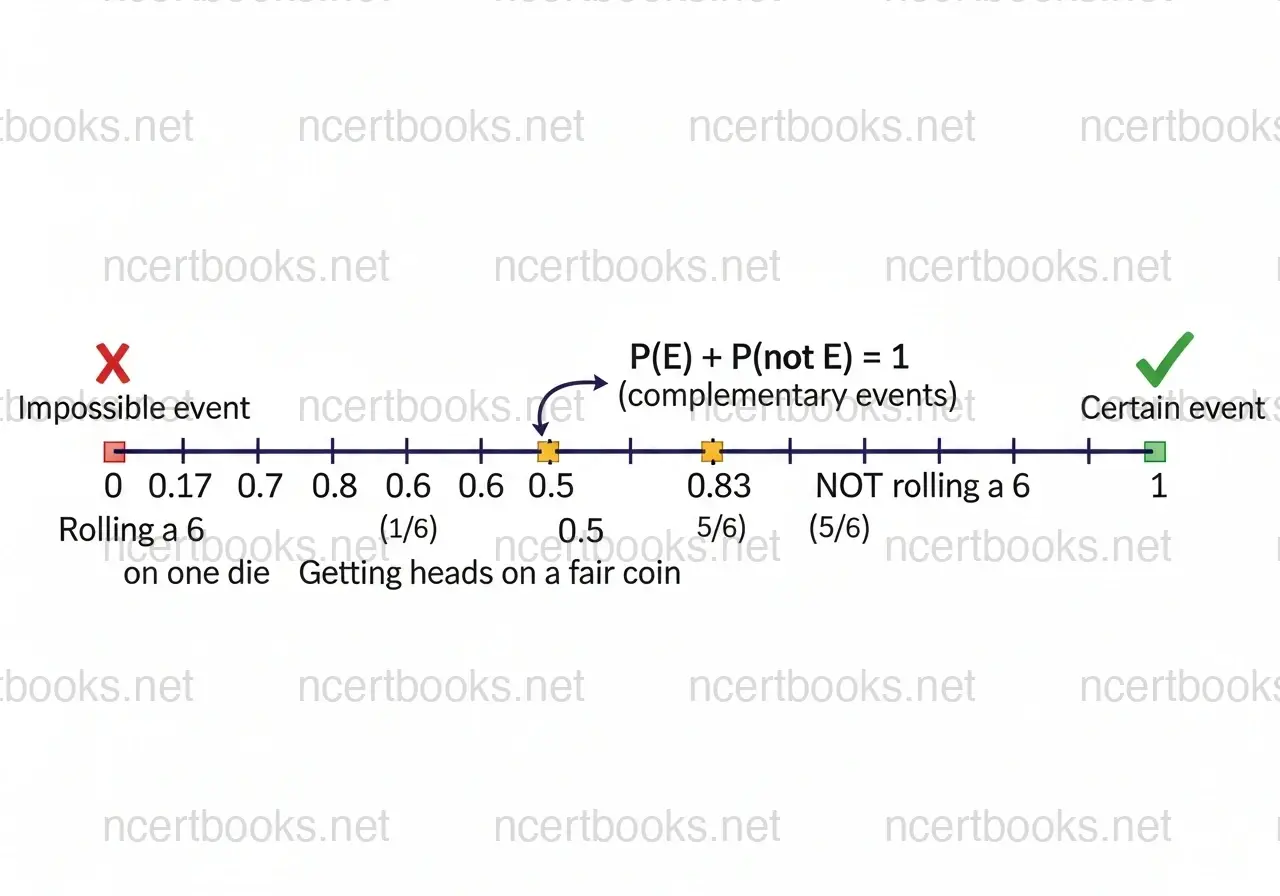
- Complementary event: \( P(E) + P(\overline{E}) = 1 \)
- Impossible event: P = 0 (e.g., getting 7 on a die)
- Sure/Certain event: P = 1 (e.g., getting a number ≤ 6 on a die)
- Sum of all elementary event probabilities: Always equals 1
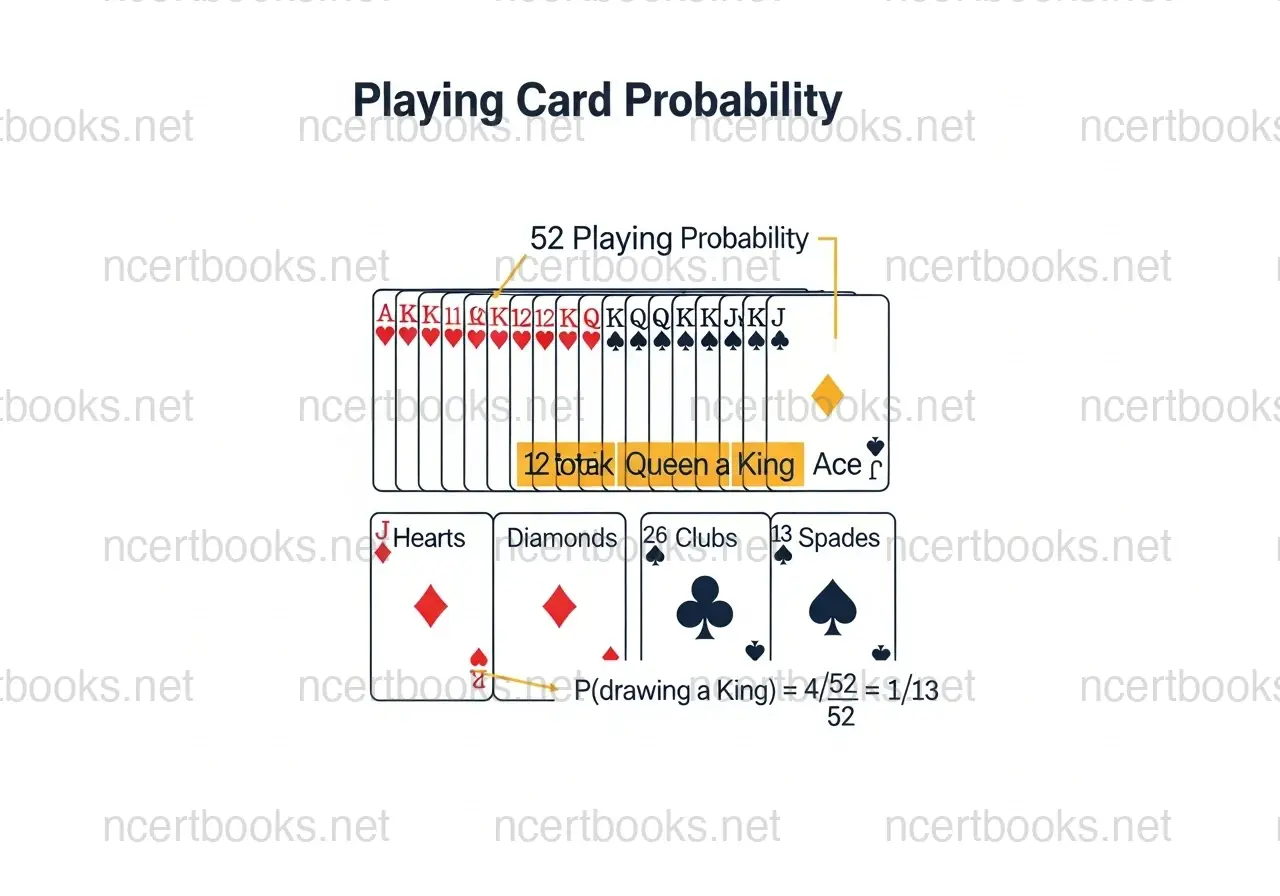
- Deck of 52 cards: 4 suits × 13 cards; 12 face cards (J, Q, K in each suit); 26 red, 26 black
- Key chapter: Chapter 15, NCERT Maths Class 10 — carries 4–5 marks in CBSE board exams
The NCERT Solutions for Class 10 Maths Chapter 15 Probability on this page cover all 25 questions of Exercise 15.1 with complete step-by-step working, updated for the 2026-27 CBSE board exam. You can find the full set of NCERT Solutions for all classes and subjects on our website. This chapter introduces the theoretical (classical) approach to probability and builds directly on the experimental probability concepts you studied in Class 9.
For all chapters of Class 10 Maths, visit our NCERT Solutions for Class 10 hub. The official textbook is available on the NCERT official website.
Chapter Overview — NCERT Solutions for Class 10 Maths Chapter 15 Probability (2026-27)
Chapter 15 of the NCERT Class 10 Maths textbook is titled Probability. It covers the theoretical (classical) definition of probability, equally likely outcomes, complementary events, impossible events, and certain events. This chapter has one main exercise — Exercise 15.1 — with 25 questions ranging from fill-in-the-blanks to multi-step word problems involving dice, cards, coins, marbles, and real-life scenarios.
In CBSE board exams, the Probability chapter typically contributes 4 to 5 marks through 1-mark MCQs, 2-mark short answer questions, and occasionally a 3-mark problem. The concepts here connect directly to Statistics (Chapter 14) and to the experimental probability you covered in Class 9 Chapter 15. Students who are clear on sample space, favourable outcomes, and the complementary event rule score full marks in this chapter.
| Detail | Information |
|---|---|
| Chapter | Chapter 15 — Probability |
| Textbook | NCERT Mathematics Class 10 |
| Class | Class 10 |
| Subject | Mathematics |
| Exercise | Exercise 15.1 (25 Questions) |
| Marks Weightage | 4–5 marks in CBSE board |
| Difficulty Level | Easy to Medium |
| Academic Year | 2026-27 |
Key Concepts and Theorems in Probability — Class 10 Maths
Theoretical (Classical) Probability
When all outcomes of an experiment are equally likely, the probability of an event E is:
\[ P(E) = \frac{\text{Number of outcomes favourable to E}}{\text{Total number of equally likely outcomes}} \]
This is the core formula for the entire chapter. Every question in Exercise 15.1 uses this definition.
Sample Space and Events
The sample space is the set of all possible outcomes of an experiment. An event is any subset of the sample space. For example, when a die is thrown, the sample space is \( \{1, 2, 3, 4, 5, 6\} \) and the event “getting an even number” is \( \{2, 4, 6\} \).
Complementary Events
For any event E, its complement \( \overline{E} \) (read as “not E”) satisfies:
\[ P(E) + P(\overline{E}) = 1 \]
So \( P(\overline{E}) = 1 – P(E) \). This rule is used in Questions 5, 7, 8, 9, 10, and many others in Exercise 15.1.
Impossible and Certain Events
An impossible event has no favourable outcomes: \( P(E) = 0 \). A certain (sure) event has all outcomes favourable: \( P(E) = 1 \). All real probabilities lie between these: \( 0 \leq P(E) \leq 1 \).
Equally Likely Outcomes
Outcomes are equally likely when each has the same chance of occurring. A fair coin gives equally likely outcomes (Head or Tail). A loaded die does NOT give equally likely outcomes. The theoretical probability formula is valid only when outcomes are equally likely.
NCERT Solutions for Class 10 Maths Chapter 15 Probability — Exercise 15.1 (All 25 Questions)
Below are complete, step-by-step solutions for every question in Exercise 15.1 of NCERT Class 10 Maths Chapter 15, updated for the 2026-27 CBSE syllabus.
Question 1
Easy
Complete the following statements:
(i) Probability of an event E + Probability of the event ‘not E’ = ………
(ii) The probability of an event that cannot happen is ……… Such an event is called ………
(iii) The probability of an event that is certain to happen is ………. Such an event is called ………
(iv) The sum of the probabilities of all the elementary events of an experiment is ……….
(v) The probability of an event is greater than or equal to ………… and less than or equal to ………….
By the complementary event rule, \( P(E) + P(\overline{E}) = 1 \). The two events E and ‘not E’ together cover all possible outcomes.
\( P(E) + P(\text{not } E) = \mathbf{1} \)
An event that cannot happen has zero favourable outcomes. Its probability is 0. Such an event is called an impossible event.
Probability = 0; called an Impossible Event
An event certain to happen has all outcomes as favourable. Its probability is 1. Such an event is called a sure event (or certain event).
Probability = 1; called a Sure Event (Certain Event)
Elementary events are the simplest possible outcomes of an experiment. Since every outcome must occur (collectively they cover the entire sample space), their probabilities sum to 1.
Sum of probabilities of all elementary events = 1
Probability is always a number between 0 (impossible) and 1 (certain), inclusive.
\( P(E) \geq \mathbf{0} \) and \( P(E) \leq \mathbf{1} \)
Question 2
Medium
Which of the following experiments have equally likely outcomes? Explain.
(i) A driver attempts to start a car. The car starts or does not start.
(ii) A player attempts to shoot a basketball. She/he shoots or misses the shot.
(iii) A trial is made to answer a true-false question. The answer is right or wrong.
(iv) A baby is born. It is a boy or a girl.
The car starting depends on its condition, fuel, battery, etc. These factors make the two outcomes unequal in likelihood.
Not equally likely. The car may be more likely to start (if well-maintained) or not start (if faulty).
Whether the player shoots or misses depends on skill, distance, and practice. These are not equally likely for most players.
Not equally likely. A skilled player is more likely to shoot successfully.
If the student answers randomly (without any knowledge), both outcomes — right or wrong — are equally likely. There are only two options and no skill advantage.
Equally likely (when answering randomly). Each outcome has probability \( \frac{1}{2} \).
Statistically, the probability of a baby being born male or female is approximately equal (roughly 50-50), assuming no external factors.
Equally likely. The probability of a boy ≈ probability of a girl ≈ \( \frac{1}{2} \).
Question 3
Easy
Why is tossing a coin considered to be a fair way of deciding which team should get the ball at the beginning of a football game?
A fair coin has two faces — Head and Tail. When tossed, each face is equally likely to come up, with probability \( \frac{1}{2} \) each.
Neither team has any advantage over the other. The outcome is purely random and unbiased, so neither team can influence the result.
Tossing a coin is fair because both outcomes (Head and Tail) are equally likely with probability \( \frac{1}{2} \) each. No team gets an unfair advantage, making it an unbiased method of decision-making.
Question 4
Easy
Which of the following cannot be the probability of an event?
(A) \( \frac{2}{3} \) (B) −1.5 (C) 15% (D) 0.7
Key Concept: Probability of any event must satisfy \( 0 \leq P(E) \leq 1 \).
Check each option:
- (A) \( \frac{2}{3} \approx 0.667 \) — lies between 0 and 1. ✓ Valid
- (B) \( -1.5 \) — negative value. ✗ Cannot be a probability
- (C) \( 15\% = 0.15 \) — lies between 0 and 1. ✓ Valid
- (D) \( 0.7 \) — lies between 0 and 1. ✓ Valid
Answer: (B) −1.5 cannot be the probability of an event because probability cannot be negative.
Question 5
Easy
If P(E) = 0.05, what is the probability of ‘not E’?
Using the complementary event rule:
\[ P(\overline{E}) = 1 – P(E) \]
\[ P(\overline{E}) = 1 – 0.05 = 0.95 \]
\( \therefore P(\text{not } E) = \mathbf{0.95} \)
Question 6
Easy
A bag contains lemon flavoured candies only. Malini takes out one candy without looking into the bag. What is the probability that she takes out (i) an orange flavoured candy? (ii) a lemon flavoured candy?
The bag contains only lemon flavoured candies. There are no orange candies. So the number of favourable outcomes = 0.
\[ P(\text{orange candy}) = \frac{0}{\text{total candies}} = 0 \]
\( P(\text{orange candy}) = \mathbf{0} \) — This is an impossible event.
All candies in the bag are lemon flavoured. Every outcome is favourable.
\[ P(\text{lemon candy}) = \frac{\text{total candies}}{\text{total candies}} = 1 \]
\( P(\text{lemon candy}) = \mathbf{1} \) — This is a sure (certain) event.
Question 7
Easy
It is given that in a group of 3 students, the probability of 2 students not having the same birthday is 0.992. What is the probability that the 2 students have the same birthday?
Let E = event that 2 students have the same birthday.
Then \( \overline{E} \) = event that 2 students do NOT have the same birthday.
Given: \( P(\overline{E}) = 0.992 \)
\[ P(E) = 1 – P(\overline{E}) = 1 – 0.992 = 0.008 \]
\( \therefore \) Probability that 2 students have the same birthday = 0.008
Question 8
Easy
A bag contains 3 red balls and 5 black balls. A ball is drawn at random from the bag. What is the probability that the ball drawn is (i) red? (ii) not red?
Total balls = 3 red + 5 black = 8
Favourable outcomes (red balls) = 3
\[ P(\text{red}) = \frac{3}{8} \]
\( P(\text{red}) = \dfrac{3}{8} \)
Using the complement rule:
\[ P(\text{not red}) = 1 – P(\text{red}) = 1 – \frac{3}{8} = \frac{5}{8} \]
Alternatively: Favourable outcomes (black balls) = 5, so \( P = \frac{5}{8} \).
\( P(\text{not red}) = \dfrac{5}{8} \)
Question 9
Easy
A box contains 5 red marbles, 8 white marbles and 4 green marbles. One marble is taken out of the box at random. What is the probability that the marble taken out will be (i) red? (ii) white? (iii) not green?
Total marbles = 5 + 8 + 4 = 17
\( P(\text{red}) = \dfrac{5}{17} \)
\( P(\text{white}) = \dfrac{8}{17} \)
Green marbles = 4, so \( P(\text{green}) = \frac{4}{17} \).
\[ P(\text{not green}) = 1 – \frac{4}{17} = \frac{13}{17} \]
\( P(\text{not green}) = \dfrac{13}{17} \)
Question 10
Easy
A piggy bank contains hundred 50 p coins, fifty ₹ 1 coins, twenty ₹ 2 coins and ten ₹ 5 coins. If it is equally likely that one of the coins will fall out when the bank is turned upside down, what is the probability that the coin (i) will be a 50 p coin? (ii) will not be a ₹ 5 coin?
Total coins = 100 + 50 + 20 + 10 = 180
\( P(50\text{ p coin}) = \dfrac{5}{9} \)
₹ 5 coins = 10
\[ P(\text{not } ₹5) = 1 – \frac{10}{180} = 1 – \frac{1}{18} = \frac{17}{18} \]
\( P(\text{not } ₹5\text{ coin}) = \dfrac{17}{18} \)
Question 11
Easy
Gopi buys a fish from a shop for his aquarium. The shopkeeper takes out one fish at random from a tank containing 5 male fish and 8 female fish. What is the probability that the fish taken out is a male fish?
Total fish = 5 male + 8 female = 13
Favourable outcomes (male fish) = 5
\[ P(\text{male fish}) = \frac{5}{13} \]
\( \therefore P(\text{male fish}) = \dfrac{5}{13} \)
Question 12
Easy
A game of chance consists of spinning an arrow which comes to rest pointing at one of the numbers 1, 2, 3, 4, 5, 6, 7, 8, and these are equally likely outcomes. What is the probability that it will point at (i) 8? (ii) an odd number? (iii) a number greater than 2? (iv) a number less than 9?
Total outcomes = 8 (numbers 1 through 8, equally likely)
Favourable outcomes = {8} = 1
\[ P(8) = \frac{1}{8} \]
\( P(8) = \dfrac{1}{8} \)
Odd numbers from 1–8: {1, 3, 5, 7} = 4 outcomes
\[ P(\text{odd}) = \frac{4}{8} = \frac{1}{2} \]
\( P(\text{odd}) = \dfrac{1}{2} \)
Numbers greater than 2: {3, 4, 5, 6, 7, 8} = 6 outcomes
\[ P(>2) = \frac{6}{8} = \frac{3}{4} \]
\( P(\text{number} > 2) = \dfrac{3}{4} \)
All numbers 1–8 are less than 9. Favourable outcomes = 8 (all).
\[ P(<9) = \frac{8}{8} = 1 \]
\( P(\text{number} < 9) = \mathbf{1} \) — This is a sure event.
Question 13
Easy
A die is thrown once. Find the probability of getting (i) a prime number (ii) a number lying between 2 and 6 (iii) an odd number
Sample space = {1, 2, 3, 4, 5, 6}; Total outcomes = 6
Prime numbers on a die: {2, 3, 5} = 3 outcomes
\[ P(\text{prime}) = \frac{3}{6} = \frac{1}{2} \]
\( P(\text{prime}) = \dfrac{1}{2} \)
Numbers strictly between 2 and 6: {3, 4, 5} = 3 outcomes
\[ P(\text{between 2 and 6}) = \frac{3}{6} = \frac{1}{2} \]
\( P(\text{between 2 and 6}) = \dfrac{1}{2} \)
Odd numbers: {1, 3, 5} = 3 outcomes
\[ P(\text{odd}) = \frac{3}{6} = \frac{1}{2} \]
\( P(\text{odd}) = \dfrac{1}{2} \)
Question 14
Medium
One card is drawn from a well-shuffled deck of 52 cards. Find the probability of getting (i) a king of red colour (ii) a face card (iii) a red face card (iv) the jack of hearts (v) a spade (vi) the queen of diamonds
Total cards = 52. The deck has 4 suits (Spades ♠, Hearts ♥, Diamonds ♦, Clubs ♣), each with 13 cards. Hearts and Diamonds are red; Spades and Clubs are black. Face cards = Jack, Queen, King (3 per suit × 4 suits = 12 total).
Red kings: King of Hearts + King of Diamonds = 2 cards
\[ P = \frac{2}{52} = \frac{1}{26} \]
\( P(\text{red king}) = \dfrac{1}{26} \)
Total face cards (J, Q, K in all 4 suits) = 12
\[ P(\text{face card}) = \frac{12}{52} = \frac{3}{13} \]
\( P(\text{face card}) = \dfrac{3}{13} \)
Red face cards (J, Q, K of Hearts and Diamonds) = 6
\[ P(\text{red face card}) = \frac{6}{52} = \frac{3}{26} \]
\( P(\text{red face card}) = \dfrac{3}{26} \)
There is exactly 1 Jack of Hearts in the deck.
\[ P(\text{Jack of Hearts}) = \frac{1}{52} \]
\( P(\text{Jack of Hearts}) = \dfrac{1}{52} \)
Spades = 13 cards
\[ P(\text{spade}) = \frac{13}{52} = \frac{1}{4} \]
\( P(\text{spade}) = \dfrac{1}{4} \)
There is exactly 1 Queen of Diamonds.
\[ P(\text{Queen of Diamonds}) = \frac{1}{52} \]
\( P(\text{Queen of Diamonds}) = \dfrac{1}{52} \)
Question 15
Medium
Five cards — the ten, jack, queen, king and ace of diamonds — are well shuffled with their face downwards. One card is then picked up at random.
(i) What is the probability that the card is the queen?
(ii) If the queen is drawn and put aside, what is the probability that the second card picked up is (a) an ace? (b) a queen?
Total cards = 5 (Ten, Jack, Queen, King, Ace of diamonds). Favourable outcome = Queen = 1.
\[ P(\text{Queen}) = \frac{1}{5} \]
\( P(\text{Queen}) = \dfrac{1}{5} \)
(a) Probability of Ace: Favourable = 1 (Ace of Diamonds)
\[ P(\text{Ace}) = \frac{1}{4} \]
\( P(\text{Ace}) = \dfrac{1}{4} \)
(b) Probability of Queen: The queen has already been removed. Favourable = 0.
\[ P(\text{Queen}) = \frac{0}{4} = 0 \]
\( P(\text{Queen}) = \mathbf{0} \) — Impossible event (queen already removed).
Question 16
Easy
12 defective pens are accidentally mixed with 132 good ones. It is not possible to just look at a pen and tell whether or not it is defective. One pen is taken out at random from this lot. Determine the probability that the pen taken out is a good one.
Total pens = 12 (defective) + 132 (good) = 144
Favourable outcomes (good pens) = 132
\[ P(\text{good pen}) = \frac{132}{144} = \frac{11}{12} \]
\( \therefore P(\text{good pen}) = \dfrac{11}{12} \)
Question 17
Medium
(i) A lot of 20 bulbs contain 4 defective ones. One bulb is drawn at random from the lot. What is the probability that this bulb is defective?
(ii) Suppose the bulb drawn in (i) is not defective and is not replaced. Now one bulb is drawn at random from the rest. What is the probability that this bulb is not defective?
Total bulbs = 20; Defective = 4
\[ P(\text{defective}) = \frac{4}{20} = \frac{1}{5} \]
\( P(\text{defective bulb}) = \dfrac{1}{5} \)
One non-defective bulb is removed. Remaining bulbs = 19.
Remaining non-defective bulbs = 20 − 4 − 1 = 15 (since the removed bulb was good, defective count stays 4, good count becomes 15).
Wait — let us recount: Originally 20 bulbs, 4 defective, 16 good. One good bulb is drawn and not replaced. Now: Total = 19, Good = 15, Defective = 4.
\[ P(\text{not defective}) = \frac{15}{19} \]
\( P(\text{not defective}) = \dfrac{15}{19} \)
Question 18
Medium
A box contains 90 discs which are numbered from 1 to 90. If one disc is drawn at random from the box, find the probability that it bears (i) a two-digit number (ii) a perfect square number (iii) a number divisible by 5.
Total discs = 90 (numbered 1 to 90)
Two-digit numbers from 1 to 90: 10, 11, 12, …, 90 = 81 numbers
\[ P(\text{two-digit}) = \frac{81}{90} = \frac{9}{10} \]
\( P(\text{two-digit number}) = \dfrac{9}{10} \)
Perfect squares from 1 to 90: 1, 4, 9, 16, 25, 36, 49, 64, 81 = 9 numbers
\[ P(\text{perfect square}) = \frac{9}{90} = \frac{1}{10} \]
\( P(\text{perfect square}) = \dfrac{1}{10} \)
Multiples of 5 from 1 to 90: 5, 10, 15, …, 90 = 18 numbers
\[ P(\text{divisible by 5}) = \frac{18}{90} = \frac{1}{5} \]
\( P(\text{divisible by 5}) = \dfrac{1}{5} \)
Question 19
Easy
A child has a die whose six faces show the letters as given below: A, B, C, D, E, A. The die is thrown once. What is the probability of getting (i) A? (ii) D?
Six faces: A, B, C, D, E, A — Total outcomes = 6
A appears on 2 faces (face 1 and face 6).
\[ P(A) = \frac{2}{6} = \frac{1}{3} \]
\( P(A) = \dfrac{1}{3} \)
D appears on 1 face only.
\[ P(D) = \frac{1}{6} \]
\( P(D) = \dfrac{1}{6} \)
Question 20
Hard
Suppose you drop a die at random on the rectangular region shown in the figure. What is the probability that it will land inside the circle with diameter 1 m? (The rectangular region is 3 m × 2 m.)
Key Concept: For geometric probability, \( P(E) = \frac{\text{Area of favourable region}}{\text{Total area}} \).
Area of rectangle: \( 3 \times 2 = 6 \text{ m}^2 \)
Diameter of circle = 1 m, so radius \( r = \frac{1}{2} \text{ m} \)
Area of circle:
\[ \text{Area} = \pi r^2 = \pi \times \left(\frac{1}{2}\right)^2 = \frac{\pi}{4} \text{ m}^2 \]
Probability:
\[ P(\text{inside circle}) = \frac{\pi/4}{6} = \frac{\pi}{24} \]
\( \therefore P(\text{landing inside circle}) = \dfrac{\pi}{24} \)
Question 21
Easy
A lot consists of 144 ball pens of which 20 are defective and the others are good. Nuri will buy a pen if it is good, but will not buy if it is defective. The shopkeeper draws one pen at random and gives it to her. What is the probability that (i) she will buy it? (ii) she will not buy it?
Total pens = 144; Defective = 20; Good = 144 − 20 = 124
\( P(\text{she will buy}) = \dfrac{31}{36} \)
Verification: \( \frac{31}{36} + \frac{5}{36} = \frac{36}{36} = 1 \) ✓
\( P(\text{she will not buy}) = \dfrac{5}{36} \)
Question 22
Hard
Two dice, one blue and one grey, are thrown at the same time.
(i) Complete the following table showing sums of outcomes:
(ii) A student argues that there are 11 possible outcomes 2, 3, 4, 5, 6, 7, 8, 9, 10, 11 and 12. Therefore, each of them has a probability \( \frac{1}{11} \). Do you agree with this argument? Justify your answer.
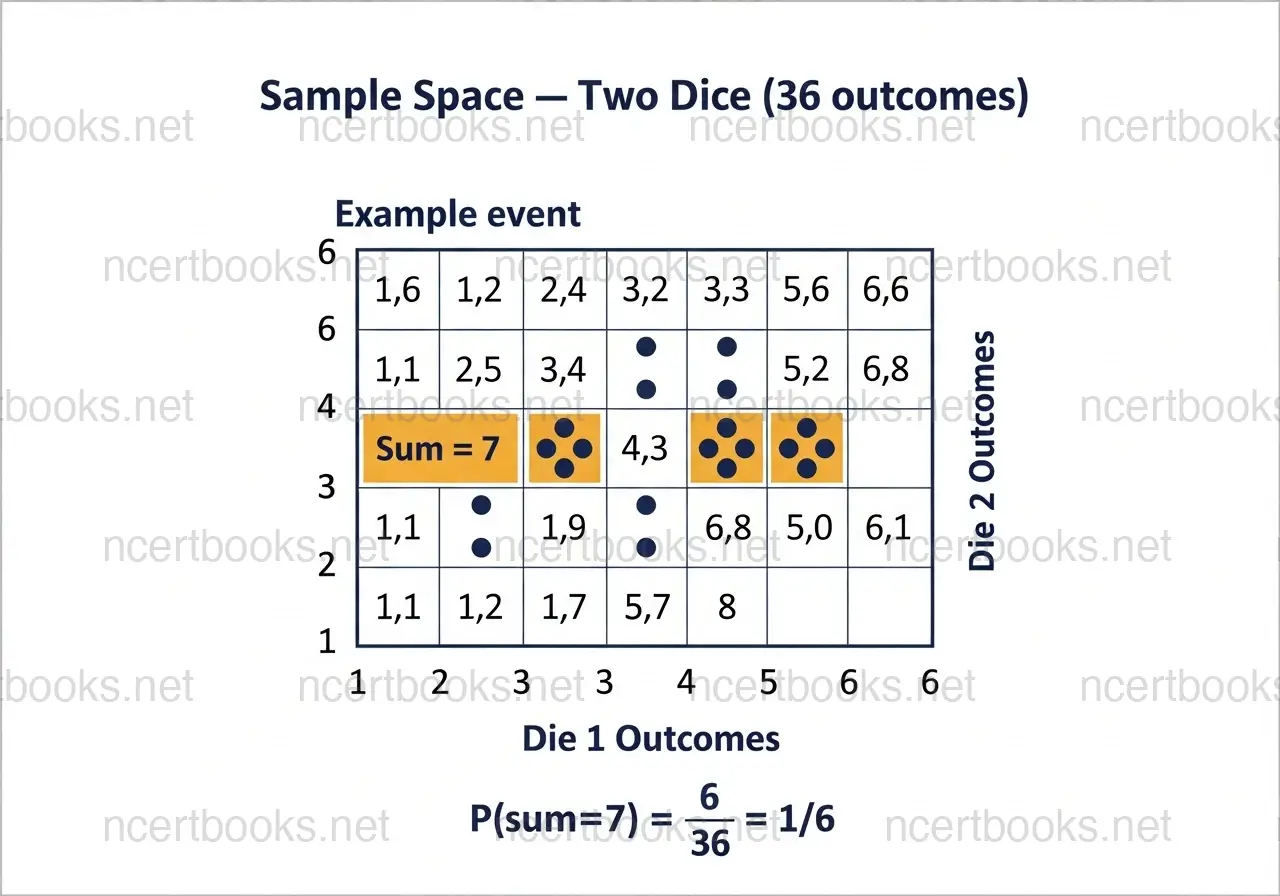
When two dice are thrown, total outcomes = \( 6 \times 6 = 36 \). The table below shows number of ways each sum can occur:
| Sum | 2 | 3 | 4 | 5 | 6 | 7 | 8 | 9 | 10 | 11 | 12 |
|---|---|---|---|---|---|---|---|---|---|---|---|
| No. of outcomes | 1 | 2 | 3 | 4 | 5 | 6 | 5 | 4 | 3 | 2 | 1 |
| Probability | \(\frac{1}{36}\) | \(\frac{2}{36}\) | \(\frac{3}{36}\) | \(\frac{4}{36}\) | \(\frac{5}{36}\) | \(\frac{6}{36}\) | \(\frac{5}{36}\) | \(\frac{4}{36}\) | \(\frac{3}{36}\) | \(\frac{2}{36}\) | \(\frac{1}{36}\) |
The student’s argument is incorrect. Although there are 11 different possible sums (2 through 12), these 11 outcomes are not equally likely. For example, sum = 7 can occur in 6 ways (1+6, 2+5, 3+4, 4+3, 5+2, 6+1), while sum = 2 can occur in only 1 way (1+1).
The theoretical probability formula requires equally likely outcomes. The 36 individual outcomes (ordered pairs) are equally likely, but the 11 sums are not. Therefore, \( P(\text{sum} = 7) = \frac{6}{36} \neq \frac{1}{11} \).
No, the student’s argument is incorrect. The 11 sums are not equally likely. The correct sample space has 36 equally likely outcomes.
Question 23
Medium
A game consists of tossing a one rupee coin 3 times and noting its outcome each time. Hanif wins if all the tosses give the same result, i.e., three heads or three tails, and loses otherwise. Calculate the probability that Hanif will lose the game.
Sample space when a coin is tossed 3 times:
{HHH, HHT, HTH, HTT, THH, THT, TTH, TTT} — Total = 8 equally likely outcomes
Hanif wins when all tosses are same: {HHH, TTT} = 2 outcomes
\[ P(\text{wins}) = \frac{2}{8} = \frac{1}{4} \]
Hanif loses in all other cases:
\[ P(\text{loses}) = 1 – \frac{1}{4} = \frac{3}{4} \]
\( \therefore P(\text{Hanif loses}) = \dfrac{3}{4} \)
Question 24
Medium
A die is thrown twice. What is the probability that (i) 5 will not come up either time? (ii) 5 will come up at least once?
[Hint: Throwing a die twice and throwing two dice simultaneously are treated as the same experiment.]
Total outcomes when a die is thrown twice = \( 6 \times 6 = 36 \)
Outcomes where 5 does NOT appear: each throw can give {1, 2, 3, 4, 6} = 5 choices.
Favourable outcomes = \( 5 \times 5 = 25 \)
\[ P(\text{5 not at all}) = \frac{25}{36} \]
\( P(\text{5 not at all}) = \dfrac{25}{36} \)
Using complement: \( P(\text{at least one 5}) = 1 – P(\text{no 5}) \)
\[ P(\text{at least one 5}) = 1 – \frac{25}{36} = \frac{11}{36} \]
Direct verification: Outcomes with at least one 5: (5,1),(5,2),(5,3),(5,4),(5,5),(5,6),(1,5),(2,5),(3,5),(4,5),(6,5) = 11 outcomes ✓
\( P(\text{5 at least once}) = \dfrac{11}{36} \)
Question 25
Medium
Which of the following arguments are correct and which are not correct? Give reasons for your answer.
(i) If two coins are tossed simultaneously, there are three possible outcomes — two heads, two tails, or one of each. Therefore, for each of these outcomes, the probability is \( \frac{1}{3} \).
(ii) If a die is thrown, there are two possible outcomes — an odd number or an even number. Therefore, the probability of getting an odd number is \( \frac{1}{2} \).
The actual sample space when two coins are tossed: {HH, HT, TH, TT} — Total = 4 equally likely outcomes.
The three described outcomes are NOT equally likely:
P(two heads) = P(HH) = \( \frac{1}{4} \)
P(two tails) = P(TT) = \( \frac{1}{4} \)
P(one of each) = P(HT or TH) = \( \frac{2}{4} = \frac{1}{2} \)
Incorrect argument. The three outcomes are not equally likely. “One of each” is twice as likely as “two heads” or “two tails.”
Sample space = {1, 2, 3, 4, 5, 6}. Odd numbers = {1, 3, 5} = 3 outcomes. Even numbers = {2, 4, 6} = 3 outcomes.
Both groups are equally likely and each has 3 out of 6 outcomes.
\[ P(\text{odd}) = \frac{3}{6} = \frac{1}{2} \]
Correct argument. Odd and even outcomes are equally likely on a fair die, each with probability \( \frac{1}{2} \).
Formula Reference Table — Probability Class 10 Maths
| Formula Name | Formula | Variables Defined |
|---|---|---|
| Theoretical Probability | \( P(E) = \frac{n(E)}{n(S)} \) | n(E) = favourable outcomes, n(S) = total outcomes |
| Complementary Event | \( P(E) + P(\overline{E}) = 1 \) | \( \overline{E} \) = complement of E (“not E”) |
| Impossible Event | \( P(E) = 0 \) | No favourable outcomes |
| Sure/Certain Event | \( P(E) = 1 \) | All outcomes are favourable |
| Range of Probability | \( 0 \leq P(E) \leq 1 \) | Always holds for any event E |
| Geometric Probability | \( P(E) = \frac{\text{Area of favourable region}}{\text{Total area}} \) | Used in Q.20 type problems |
| Sum of Elementary Events | \( \sum P(e_i) = 1 \) | \( e_i \) = each elementary event |
Solved Examples Beyond NCERT — Probability Class 10
Extra Example 1 — Coloured Balls
Easy
A bag has 4 red, 6 blue, and 2 yellow balls. One ball is drawn at random. Find the probability of drawing a blue ball.
Total balls = 4 + 6 + 2 = 12; Blue balls = 6
\[ P(\text{blue}) = \frac{6}{12} = \frac{1}{2} \]
\( P(\text{blue ball}) = \dfrac{1}{2} \)
Extra Example 2 — Numbers Divisible by Both 2 and 3
Medium
A number is selected at random from 1 to 30. Find the probability that it is divisible by both 2 and 3.
Divisible by both 2 and 3 means divisible by LCM(2,3) = 6.
Multiples of 6 from 1–30: {6, 12, 18, 24, 30} = 5 numbers
\[ P = \frac{5}{30} = \frac{1}{6} \]
\( P(\text{divisible by 6}) = \dfrac{1}{6} \)
Extra Example 3 — Two Dice Sum
Hard
Two dice are thrown simultaneously. Find the probability that the sum of the two numbers appearing on the top is less than or equal to 4.
Total outcomes = 36. Favourable outcomes (sum ≤ 4):
Sum = 2: (1,1) → 1 way
Sum = 3: (1,2),(2,1) → 2 ways
Sum = 4: (1,3),(2,2),(3,1) → 3 ways
Total favourable = 1 + 2 + 3 = 6
\[ P(\text{sum} \leq 4) = \frac{6}{36} = \frac{1}{6} \]
\( P(\text{sum} \leq 4) = \dfrac{1}{6} \)
Important Questions for CBSE Board Exam — Probability Class 10
1-Mark Questions (Definition / Fill-in)
- Q1. What is the probability of an impossible event? Ans: 0
- Q2. If P(A) = 0.6, find P(not A). Ans: 0.4
- Q3. What is the range of probability of any event? Ans: 0 to 1 (inclusive)
3-Mark Questions
Q4. A card is drawn from a well-shuffled deck of 52 cards. Find the probability that the card drawn is (a) a red card, (b) a black face card, (c) neither a king nor a queen.
Solution: (a) Red cards = 26; \( P = \frac{26}{52} = \frac{1}{2} \). (b) Black face cards (J, Q, K of Spades + Clubs) = 6; \( P = \frac{6}{52} = \frac{3}{26} \). (c) Kings = 4, Queens = 4, so king or queen = 8; neither = 52 − 8 = 44; \( P = \frac{44}{52} = \frac{11}{13} \).
Q5. A box contains 20 cards numbered 1 to 20. A card is drawn at random. Find the probability that the number on the card is (a) even, (b) a multiple of 3, (c) not divisible by 4.
Solution: Total = 20. (a) Even: {2,4,6,8,10,12,14,16,18,20} = 10; \( P = \frac{10}{20} = \frac{1}{2} \). (b) Multiples of 3: {3,6,9,12,15,18} = 6; \( P = \frac{6}{20} = \frac{3}{10} \). (c) Divisible by 4: {4,8,12,16,20} = 5; not divisible = 15; \( P = \frac{15}{20} = \frac{3}{4} \).
5-Mark Long Answer Question
Q6. Two dice are thrown simultaneously. Find the probability of getting: (a) a doublet, (b) a sum of 8, (c) a sum greater than 10, (d) a sum less than 5.
Solution: Total outcomes = 36. (a) Doublets: (1,1),(2,2),(3,3),(4,4),(5,5),(6,6) = 6; \( P = \frac{6}{36} = \frac{1}{6} \). (b) Sum 8: (2,6),(3,5),(4,4),(5,3),(6,2) = 5; \( P = \frac{5}{36} \). (c) Sum > 10: (5,6),(6,5),(6,6) = 3; \( P = \frac{3}{36} = \frac{1}{12} \). (d) Sum < 5: (1,1),(1,2),(2,1),(1,3),(3,1),(2,2) = 6; \( P = \frac{6}{36} = \frac{1}{6} \).
Common Mistakes Students Make in Probability — Class 10 Maths
Mistake 1: Students include 1 as a prime number when listing prime outcomes on a die.
Why it’s wrong: 1 is not a prime number. Prime numbers start from 2.
Correct approach: Prime numbers on a die = {2, 3, 5} only — 3 outcomes, not 4.
Mistake 2: Students forget to simplify the fraction in the final answer.
Why it’s wrong: CBSE marking scheme requires answers in lowest terms. An unsimplified fraction may lose a mark.
Correct approach: Always divide numerator and denominator by their HCF. E.g., \( \frac{3}{6} = \frac{1}{2} \).
Mistake 3: When a card/ball is removed without replacement, students still use the original total.
Why it’s wrong: The sample space changes after removal. Using the old total gives a wrong denominator.
Correct approach: Subtract 1 from total for each item removed (see Q15, Q17).
Mistake 4: Students write \( P(E) = \frac{1}{11} \) for each sum when two dice are thrown (like the student in Q22).
Why it’s wrong: The 11 sums are not equally likely. The 36 ordered pairs are the correct equally likely outcomes.
Correct approach: Always use the 36 equally likely outcomes as the sample space for two dice.
Mistake 5: Students confuse “between 2 and 6” with “from 2 to 6” on a die.
Why it’s wrong: “Between 2 and 6” means strictly between — it excludes 2 and 6, giving {3, 4, 5}.
Correct approach: Read the question carefully. “Between” = exclusive; “from … to …” = inclusive.
Exam Tips for 2026-27 CBSE Board — Probability Class 10
- Memorise the deck of 52 cards: 4 suits × 13 cards = 52; 12 face cards; 26 red (Hearts + Diamonds), 26 black (Spades + Clubs). Card questions appear almost every year in the CBSE 2026-27 board paper.
- Always write the formula first: CBSE marking scheme awards 1 mark for writing \( P(E) = \frac{\text{favourable}}{\text{total}} \) before substituting. Don’t skip this step.
- Show step-by-step working: For 2-3 mark questions, write: (1) Total outcomes, (2) Favourable outcomes, (3) Probability fraction, (4) Simplified answer. Each step can earn partial marks.
- Use the complement rule smartly: For “not” and “at least once” questions, \( P(\overline{E}) = 1 – P(E) \) is faster and less error-prone than counting directly.
- Perfect squares up to 90: Memorise {1, 4, 9, 16, 25, 36, 49, 64, 81} = 9 values. This list comes up in disc/number-based probability questions.
- Geometric probability: Q20-type questions require area formulas. Leave answer in terms of \( \pi \) unless told to approximate. The 2026-27 CBSE marking scheme accepts \( \frac{\pi}{24} \) as the final answer for Q20.