⚡ Quick Revision Box — Chapter 13 Ex 13.5
- Exercise: 13.5 — Frustum of a Cone (5 questions)
- Chapter: 13 — Surface Areas and Volumes, Class 10 Maths NCERT
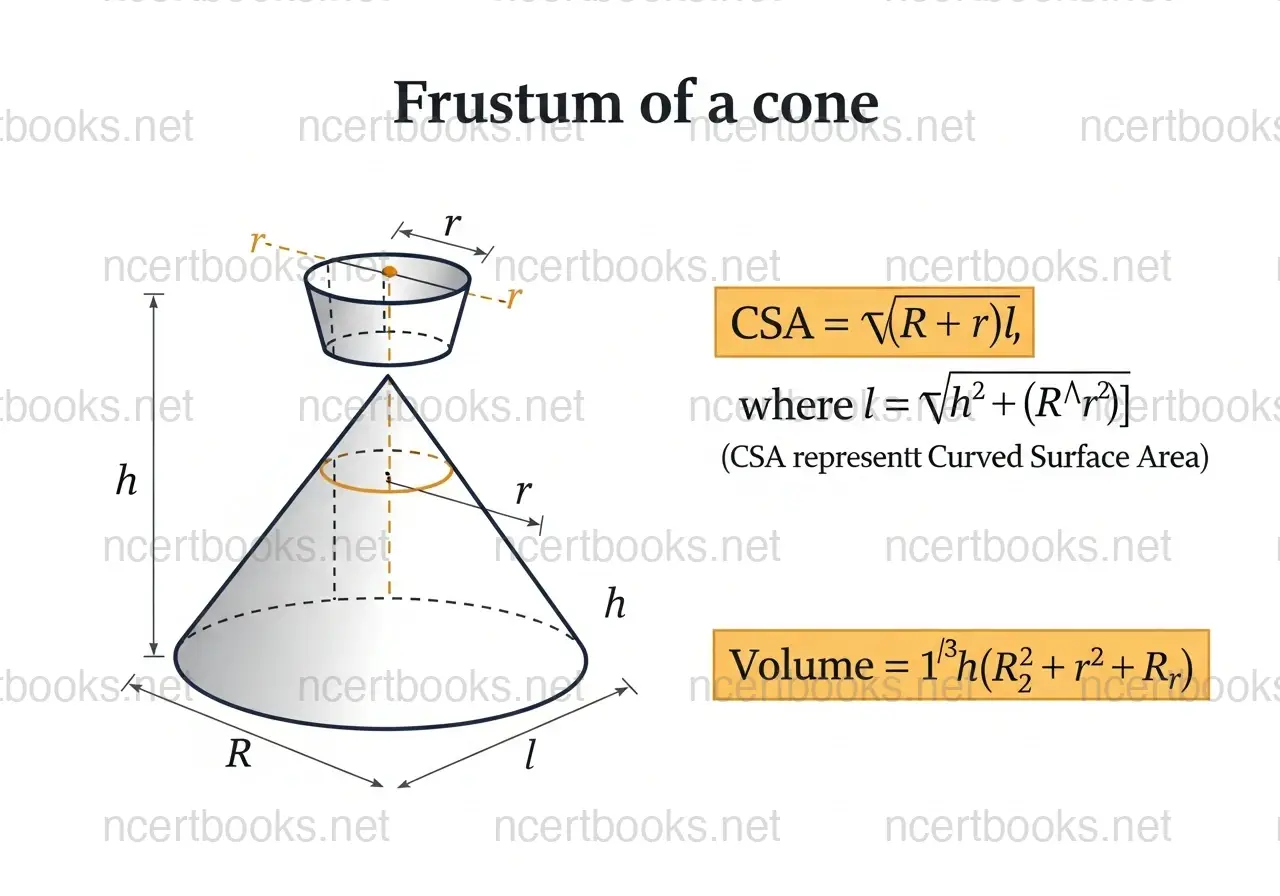
- Frustum CSA: \( \pi(r_1 + r_2)l \) where \( l = \sqrt{h^2 + (r_1 – r_2)^2} \)
- Frustum Volume: \( \frac{1}{3}\pi h(r_1^2 + r_2^2 + r_1 r_2) \)
- Double Cone: Formed when a right triangle revolves about its hypotenuse
- Key Trick: Find perpendicular from right angle to hypotenuse using area method
- Syllabus Note: Ex 13.5 is removed from rationalised 2026-27 CBSE syllabus — useful for state boards and extra practice
- Density Formula: Mass = Volume × Density (used in copper wire problem)
The NCERT Solutions for Class 10 Maths Chapter 13 Ex 13.5 on this page cover all 5 questions from the Surface Areas and Volumes chapter, updated for the 2026-27 academic year. These solutions are part of our complete NCERT Solutions for Class 10 series on ncertbooks.net. Exercise 13.5 deals with the frustum of a cone, double cones, porous brick problems, and real-life applications like rainfall volume and oil funnels. Every solution is explained step by step with LaTeX-rendered formulas so you can follow each calculation clearly. You can also access the full set of NCERT Solutions for all classes on our site. The official textbook is available on the NCERT official website.
- Quick Revision Box
- Chapter Overview — Surface Areas and Volumes Class 10
- Key Concepts and Formulas for Exercise 13.5
- Formula Reference Table
- NCERT Solutions for Class 10 Maths Chapter 13 Ex 13.5 — All Questions
- Extra Reference — Topics Removed from Current Syllabus
- Important Questions for CBSE Board Exam
- Common Mistakes Students Make
- Exam Tips for 2026-27 CBSE Board
- Frequently Asked Questions
Chapter Overview — Surface Areas and Volumes Class 10 Maths
Chapter 13 of the NCERT Class 10 Maths textbook covers Surface Areas and Volumes. It builds on what you learned in Class 9 about basic 3D shapes and extends to combinations of solids, conversion of shapes, and the frustum of a cone. This chapter is part of the Mensuration unit in the CBSE syllabus.
For the 2026-27 CBSE board exam, the Mensuration unit (Chapters 12 and 13) carries significant weightage. Questions from this chapter appear as 2-mark and 3-mark problems. Exercise 13.5 specifically covers the frustum of a cone and its real-world applications — a topic that demands careful formula application and unit conversion skills.
Before attempting Exercise 13.5, make sure you are comfortable with: surface area and volume of cone and cylinder (Class 9), the concept of slant height, and basic algebra. These are the prerequisites for all problems in this exercise.
| Detail | Information |
|---|---|
| Chapter | 13 — Surface Areas and Volumes |
| Textbook | NCERT Mathematics Class 10 |
| Exercise | 13.5 (5 Questions) |
| Subject | Mathematics |
| Syllabus Status | Removed from CBSE 2026-27 rationalised syllabus (useful for state boards) |
| Difficulty Level | Medium to Hard |
Key Concepts and Formulas for Exercise 13.5
Exercise 13.5 is built around the frustum of a cone (शंकु का छिन्नक) — the portion of a cone left when a smaller cone is cut off from the top parallel to the base. Understanding this shape is essential before solving any problem in this exercise.
What is a Frustum? (शंकु का छिन्नक)
A frustum has two circular faces of different radii \( r_1 \) (larger base) and \( r_2 \) (smaller base), a vertical height \( h \), and a slant height \( l \). The slant height connects the edges of the two circular faces along the curved surface.
Slant height: \( l = \sqrt{h^2 + (r_1 – r_2)^2} \)
Double Cone Formed by Revolution
When a right triangle revolves about its hypotenuse, it traces out two cones joined at their bases (a double cone). The key step is finding the perpendicular from the right-angle vertex to the hypotenuse — this perpendicular becomes the common radius of both cones.
If the two legs are \( a \) and \( b \), hypotenuse \( c = \sqrt{a^2 + b^2} \), then the perpendicular \( r = \frac{ab}{c} \).
Density, Mass, and Volume
For the copper wire problem: \( \text{Mass} = \text{Volume} \times \text{Density} \). The wire is a long thin cylinder, so its volume is \( \pi r^2 L \) where \( r \) is the wire radius and \( L \) is its length. This connects geometry with basic physics.
Formula Reference Table — Surface Areas and Volumes
| Formula Name | Formula (LaTeX) | Variables Defined |
|---|---|---|
| Frustum — Curved Surface Area | \( \pi(r_1 + r_2)l \) | \(r_1, r_2\) = radii; \(l\) = slant height |
| Frustum — Total Surface Area | \( \pi(r_1 + r_2)l + \pi r_1^2 + \pi r_2^2 \) | Includes both circular bases |
| Frustum — Volume | \( \frac{1}{3}\pi h(r_1^2 + r_2^2 + r_1 r_2) \) | \(h\) = height of frustum |
| Slant Height of Frustum | \( l = \sqrt{h^2 + (r_1 – r_2)^2} \) | Derived from Pythagoras theorem |
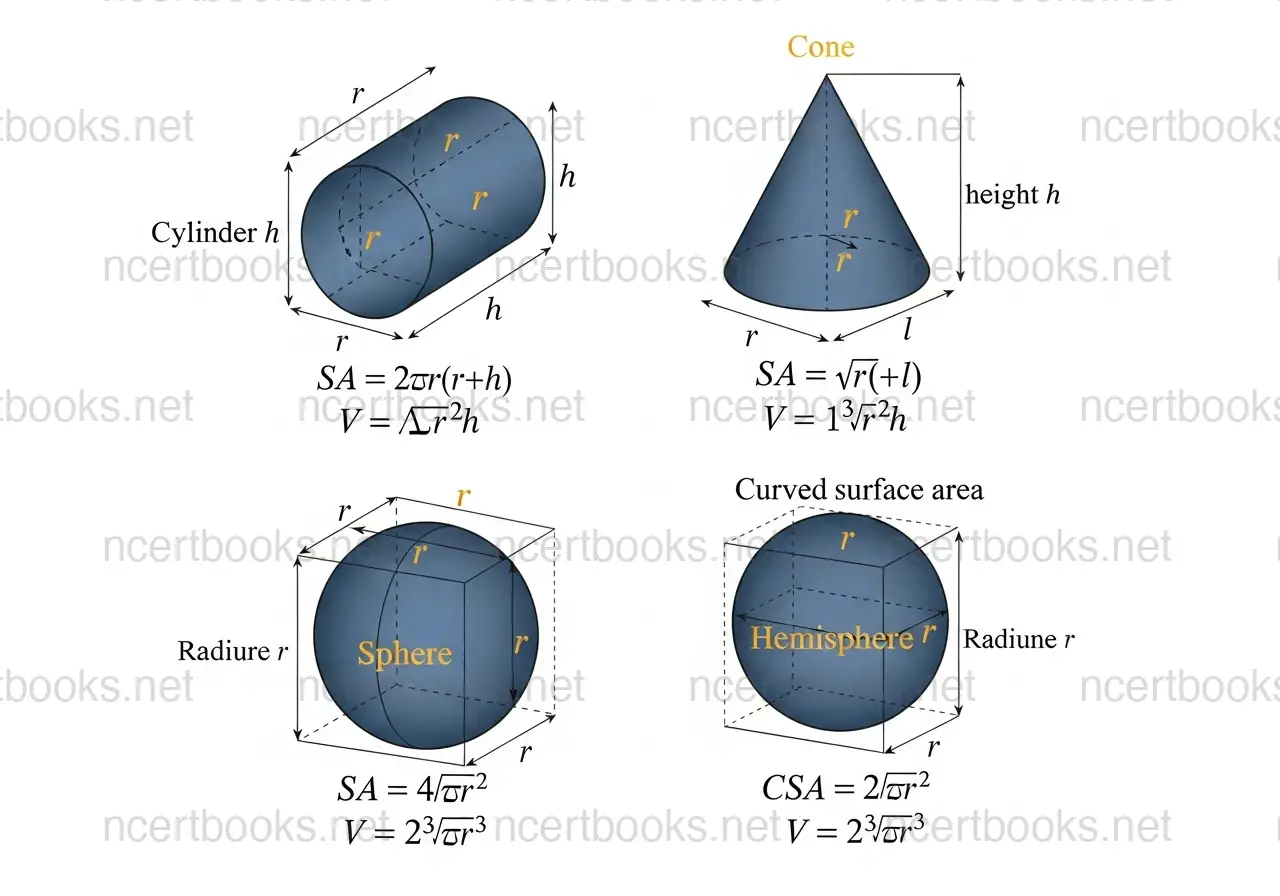
| Volume of Cone | \( \frac{1}{3}\pi r^2 h \) | \(r\) = base radius; \(h\) = height |
| Curved Surface Area of Cone | \( \pi r l \) | \(l\) = slant height of cone |
| Volume of Cylinder | \( \pi r^2 h \) | Standard cylinder formula |
| CSA of Cylinder | \( 2\pi r h \) | Curved surface only |
| Perpendicular to Hypotenuse | \( r = \frac{ab}{c} \) | \(a, b\) = legs; \(c\) = hypotenuse |
| Mass from Density | \( m = V \times d \) | \(V\) = volume; \(d\) = density |
NCERT Solutions for Class 10 Maths Chapter 13 Ex 13.5 — All Questions Solved
Below are complete, step-by-step solutions for all 5 questions in Exercise 13.5. These are the ncert solutions for class 10 maths chapter 13 ex 13 5 as per the NCERT textbook. Each solution shows every calculation clearly so you can follow along and write the same steps in your exam.
Question 1
Medium
A copper wire, 3 mm in diameter is wound about a cylinder whose length is 12 cm, and diameter 10 cm, so as to cover the curved surface of the cylinder. Find the length and mass of the wire, assuming the density of copper to be 8.88 g per cm³.
Key Concept: The wire has a diameter of 3 mm = 0.3 cm. When wound tightly around the cylinder, each turn of wire covers 0.3 cm of the cylinder’s length. The number of turns equals the length of the cylinder divided by the wire’s diameter.
Step 1: Convert wire diameter to cm.
\[ \text{Wire diameter} = 3 \text{ mm} = 0.3 \text{ cm} \]
Step 2: Find the number of turns of wire needed to cover the cylinder’s length of 12 cm.
\[ \text{Number of turns} = \frac{\text{Length of cylinder}}{\text{Diameter of wire}} = \frac{12}{0.3} = 40 \text{ turns} \]
Step 3: Each turn of wire forms one complete circle around the cylinder. The diameter of the cylinder is 10 cm, so the radius is 5 cm. The circumference of one turn equals the circumference of the cylinder’s cross-section.
\[ \text{Length of one turn} = \pi \times d_{\text{cylinder}} = \pi \times 10 = 10\pi \text{ cm} \]
Step 4: Find total length of wire.
\[ L = 40 \times 10\pi = 400\pi \approx 400 \times 3.14 = 1256 \text{ cm} \]
\( \therefore \) Length of wire = 1256 cm ≈ 12.56 m
Step 5: The wire is a cylinder of diameter 3 mm = 0.3 cm, so radius \( r = 0.15 \) cm and length \( L = 1256 \) cm.
\[ \text{Volume of wire} = \pi r^2 L = \pi \times (0.15)^2 \times 1256 \]
\[ = \pi \times 0.0225 \times 1256 = \pi \times 28.26 \approx 88.74 \text{ cm}^3 \]
Step 6: Apply the density formula. Density of copper = 8.88 g/cm³.
\[ \text{Mass} = \text{Volume} \times \text{Density} = 88.74 \times 8.88 \approx 788 \text{ g} \]
Why does this work? The wire is a very long thin cylinder. We calculate its volume using the standard cylinder formula, then multiply by density to get mass.
\( \therefore \) Mass of wire ≈ 788 g
Question 2
Hard
A right triangle, whose sides are 3 cm and 4 cm (other than hypotenuse) is made to revolve about its hypotenuse. Find the volume and surface area of the double cone so formed.
Key Concept: When a right triangle revolves about its hypotenuse, it forms two cones with a common base circle. The perpendicular from the right-angle vertex to the hypotenuse is the radius of this common base.
Step 1: Find the hypotenuse.
\[ c = \sqrt{3^2 + 4^2} = \sqrt{9 + 16} = \sqrt{25} = 5 \text{ cm} \]
Step 2: Find the perpendicular (common radius) from the right-angle vertex to the hypotenuse. Use the area of the triangle in two ways.
\[ \text{Area} = \frac{1}{2} \times 3 \times 4 = 6 \text{ cm}^2 \]
\[ \text{Also, Area} = \frac{1}{2} \times c \times r \Rightarrow 6 = \frac{1}{2} \times 5 \times r \Rightarrow r = \frac{12}{5} = 2.4 \text{ cm} \]
Step 3: Find the heights of the two cones. Let \( h_1 \) be the height of cone 1 (with slant height 3 cm) and \( h_2 \) be the height of cone 2 (with slant height 4 cm).
\[ h_1 = \sqrt{3^2 – r^2} = \sqrt{9 – 5.76} = \sqrt{3.24} = 1.8 \text{ cm} \]
\[ h_2 = \sqrt{4^2 – r^2} = \sqrt{16 – 5.76} = \sqrt{10.24} = 3.2 \text{ cm} \]
Why does this work? The two legs of the triangle (3 cm and 4 cm) become the slant heights of the two cones. The perpendicular to the hypotenuse divides it into two segments, each being the height of one cone.
Step 4: Calculate volume of each cone and add.
\[ V_1 = \frac{1}{3}\pi r^2 h_1 = \frac{1}{3} \times \pi \times (2.4)^2 \times 1.8 = \frac{1}{3} \times \pi \times 5.76 \times 1.8 \]
\[ V_1 = \frac{1}{3} \times \pi \times 10.368 = 3.456\pi \]
\[ V_2 = \frac{1}{3}\pi r^2 h_2 = \frac{1}{3} \times \pi \times (2.4)^2 \times 3.2 = \frac{1}{3} \times \pi \times 5.76 \times 3.2 \]
\[ V_2 = \frac{1}{3} \times \pi \times 18.432 = 6.144\pi \]
\[ V_{\text{total}} = V_1 + V_2 = 3.456\pi + 6.144\pi = 9.6\pi \approx 9.6 \times 3.14 \approx 30.14 \text{ cm}^3 \]
\( \therefore \) Volume of double cone ≈ 30.14 cm³
Step 5: The surface area of a double cone = CSA of cone 1 + CSA of cone 2 (the common base circles are internal and not counted).
\[ \text{CSA}_1 = \pi r l_1 = \pi \times 2.4 \times 3 = 7.2\pi \]
\[ \text{CSA}_2 = \pi r l_2 = \pi \times 2.4 \times 4 = 9.6\pi \]
\[ \text{Total Surface Area} = 7.2\pi + 9.6\pi = 16.8\pi \approx 16.8 \times 3.14 \approx 52.75 \text{ cm}^2 \]
\( \therefore \) Surface area of double cone ≈ 52.75 cm²
Question 3
Hard
A cistern measuring 150 cm × 120 cm × 110 cm has 129600 cm³ water in it. Porous bricks are placed in the water until the cistern is full to the brim. Each brick absorbs one-seventeenth of its own volume of water. How many bricks can be put in without overflowing the water, each brick being 22.5 cm × 7.5 cm × 6.5 cm?
Key Concept: Each porous brick occupies space in the cistern AND absorbs some water. The water absorbed by bricks reduces the effective water volume. We need to balance: (space taken by bricks) + (remaining water) = total cistern volume.
Step 1: Find the total volume of the cistern.
\[ V_{\text{cistern}} = 150 \times 120 \times 110 = 1{,}980{,}000 \text{ cm}^3 \]
Step 2: Find the empty space in the cistern (space available for bricks and remaining water).
\[ \text{Empty space} = 1{,}980{,}000 – 129{,}600 = 1{,}850{,}400 \text{ cm}^3 \]
Step 3: Find the volume of each brick.
\[ V_{\text{brick}} = 22.5 \times 7.5 \times 6.5 = 1096.875 \text{ cm}^3 \]
Step 4: Let the number of bricks = \( n \). The bricks occupy volume \( n \times 1096.875 \) cm³ in the cistern. Each brick absorbs \( \frac{1}{17} \) of its own volume of water, so \( n \) bricks absorb \( \frac{n \times 1096.875}{17} \) cm³ of water.
Step 5: For the cistern to be exactly full, the volume of bricks placed must equal the empty space minus the water absorbed by bricks (because absorbed water no longer occupies space as liquid).
\[ n \times V_{\text{brick}} = \text{Empty space} + \text{Water absorbed by bricks} \]
\[ n \times 1096.875 = 1{,}850{,}400 + \frac{n \times 1096.875}{17} \]
Step 6: Rearrange and solve for \( n \).
\[ n \times 1096.875 – \frac{n \times 1096.875}{17} = 1{,}850{,}400 \]
\[ n \times 1096.875 \left(1 – \frac{1}{17}\right) = 1{,}850{,}400 \]
\[ n \times 1096.875 \times \frac{16}{17} = 1{,}850{,}400 \]
\[ n = \frac{1{,}850{,}400 \times 17}{1096.875 \times 16} = \frac{31{,}456{,}800}{17{,}550} = 1792 \]
Why does this work? The bricks absorb water, which effectively creates more room. So more bricks can be placed than if the bricks were non-porous. The equation accounts for both the physical space the bricks take up and the water they soak in.
\( \therefore \) Number of bricks that can be placed = 1792
Question 4
Medium
In one fortnight of a given month, there was a rainfall of 10 cm in a river valley. If the area of the valley is 7280 km², show that the total rainfall was approximately equivalent to the addition to the normal water of three rivers each 1072 km long, 75 m wide and 3 m deep.
Key Concept: A “show that” question requires you to calculate both sides independently and verify they are approximately equal. Convert all units to the same system (here, cubic metres or cubic kilometres).
Step 1: Find the volume of rainfall over the valley.
\[ \text{Area of valley} = 7280 \text{ km}^2 = 7280 \times 10^6 \text{ m}^2 \]
\[ \text{Rainfall depth} = 10 \text{ cm} = \frac{10}{100} \text{ m} = 0.1 \text{ m} \]
\[ \text{Volume of rainfall} = 7280 \times 10^6 \times 0.1 = 728 \times 10^6 \text{ m}^3 \]
Step 2: Find the volume of water in three rivers.
\[ \text{Length of each river} = 1072 \text{ km} = 1072 \times 1000 \text{ m} = 1{,}072{,}000 \text{ m} \]
\[ \text{Width} = 75 \text{ m}, \quad \text{Depth} = 3 \text{ m} \]
\[ \text{Volume of one river} = 1{,}072{,}000 \times 75 \times 3 = 241{,}200{,}000 \text{ m}^3 = 2.412 \times 10^8 \text{ m}^3 \]
\[ \text{Volume of three rivers} = 3 \times 2.412 \times 10^8 = 7.236 \times 10^8 \text{ m}^3 \]
Step 3: Compare the two volumes.
\[ \text{Rainfall volume} = 728 \times 10^6 = 7.28 \times 10^8 \text{ m}^3 \]
\[ \text{Three rivers volume} = 7.236 \times 10^8 \text{ m}^3 \]
Why does this work? The two values \( 7.28 \times 10^8 \) and \( 7.236 \times 10^8 \) are approximately equal (difference is less than 1%), confirming the statement.
\( \therefore \) Volume of rainfall \( \approx \) Volume of three rivers (both \( \approx 7.28 \times 10^8 \) m³). Hence proved.
Question 5
Hard
An oil funnel made of tin sheet consists of a 10 cm long cylindrical portion attached to a frustum of a cone. If the total height is 22 cm, diameter of the cylindrical portion is 8 cm and the diameter of the top of the funnel is 18 cm, find the area of the tin sheet required to make the funnel.
Key Concept: The funnel has two parts — a cylinder at the bottom and a frustum of a cone at the top. The tin sheet area = CSA of cylinder + CSA of frustum. The bottom circle of the cylinder and the circle where cylinder meets frustum are open (no tin sheet needed there).
Step 1: Identify dimensions.
- Height of cylinder \( h_c = 10 \) cm; diameter = 8 cm; radius \( r = 4 \) cm
- Total height = 22 cm; height of frustum \( h_f = 22 – 10 = 12 \) cm
- Top diameter of funnel = 18 cm; top radius \( R = 9 \) cm
- Bottom radius of frustum = radius of cylinder = \( r = 4 \) cm
Step 2: Calculate the slant height of the frustum.
\[ l = \sqrt{h_f^2 + (R – r)^2} = \sqrt{12^2 + (9 – 4)^2} = \sqrt{144 + 25} = \sqrt{169} = 13 \text{ cm} \]
Step 3: Calculate the Curved Surface Area (CSA) of the cylinder.
\[ \text{CSA}_{\text{cylinder}} = 2\pi r h_c = 2 \times \pi \times 4 \times 10 = 80\pi \text{ cm}^2 \]
Step 4: Calculate the CSA of the frustum.
\[ \text{CSA}_{\text{frustum}} = \pi(R + r)l = \pi \times (9 + 4) \times 13 = 169\pi \text{ cm}^2 \]
Step 5: Total area of tin sheet required.
\[ \text{Total Area} = 80\pi + 169\pi = 249\pi \approx 249 \times 3.14 \approx 782.57 \text{ cm}^2 \]
Why does this work? A funnel is open at both ends, so we only need the curved surfaces. The slant height of the frustum is found using the Pythagorean theorem on the vertical height and the difference in radii.
\( \therefore \) Area of tin sheet required ≈ 782.57 cm²
Extra Reference — Topics Removed from Current Syllabus (State Boards / Old Pattern)
Students preparing for state board exams (UP Board, MP Board, Rajasthan Board, etc.) should practise all 5 questions above thoroughly. The frustum of a cone concept is tested in many state board papers even if it has been removed from the CBSE rationalised syllabus. For CBSE 2026-27 students, focus on Exercises 13.1 to 13.4 for board exam preparation.
For sibling exercises, see: NCERT Solutions Class 10 Maths Chapter 13 Ex 13.4 and NCERT Solutions Class 10 Maths Chapter 13 Ex 13.3.
Important Questions for CBSE Board Exam — Surface Areas and Volumes
1-Mark Questions [1 Mark]
- Q: What is the formula for the slant height of a frustum?
A: \( l = \sqrt{h^2 + (r_1 – r_2)^2} \) - Q: If a right triangle with legs 5 cm and 12 cm revolves about its hypotenuse, what is the hypotenuse length?
A: \( \sqrt{25 + 144} = 13 \) cm - Q: What is the unit of density used in the copper wire problem?
A: g/cm³ (grams per cubic centimetre)
3-Mark Questions [3 Marks]
- Q: A frustum has radii 6 cm and 4 cm and height 8 cm. Find its slant height and curved surface area.
A: \( l = \sqrt{64 + 4} = \sqrt{68} \approx 8.25 \) cm. CSA \( = \pi(6+4)(8.25) = 82.5\pi \approx 259.1 \) cm² - Q: A copper wire of diameter 2 mm is wound around a cylinder of length 8 cm and radius 4 cm. Find the length of the wire.
A: Number of turns \( = 8/0.2 = 40 \). Length \( = 40 \times 2\pi \times 4 = 320\pi \approx 1005 \) cm
5-Mark Question [5 Marks]
Q: A right triangle with sides 6 cm and 8 cm (other than hypotenuse) revolves about its hypotenuse. Find the volume and total surface area of the double cone formed.
A: Hypotenuse \( c = 10 \) cm. Perpendicular \( r = \frac{6 \times 8}{10} = 4.8 \) cm. \( h_1 = \sqrt{36 – 23.04} = \sqrt{12.96} = 3.6 \) cm; \( h_2 = \sqrt{64 – 23.04} = \sqrt{40.96} = 6.4 \) cm. Volume \( = \frac{1}{3}\pi(4.8)^2(3.6 + 6.4) = \frac{1}{3}\pi \times 23.04 \times 10 = 76.8\pi \approx 241.1 \) cm³. Surface Area \( = \pi \times 4.8 \times (6 + 8) = 67.2\pi \approx 211.1 \) cm².
Common Mistakes Students Make in Chapter 13 Exercise 13.5
Mistake 1: Using total surface area instead of curved surface area for the funnel.
❌ Wrong: Adding base areas of cylinder and frustum.
✅ Correct: A funnel is open at both ends — use only CSA of cylinder + CSA of frustum.Mistake 2: Not converting units in the rainfall problem.
❌ Wrong: Using 10 cm as 10 m or keeping km² without converting to m².
✅ Correct: Convert all units consistently — area in m², depth in m, giving volume in m³.Mistake 3: In the double cone problem, using the legs as heights instead of slant heights.
❌ Wrong: Setting h₁ = 3 cm and h₂ = 4 cm directly as heights of cones.
✅ Correct: The legs 3 cm and 4 cm are slant heights. Find the actual heights using \( h = \sqrt{l^2 – r^2} \).Mistake 4: In the porous brick problem, ignoring the water absorbed by bricks.
❌ Wrong: Simply dividing empty space by brick volume.
✅ Correct: Set up the equation accounting for water absorbed: \( n \times V_b = \text{empty space} + \frac{n \times V_b}{17} \).Mistake 5: Forgetting to use \( \pi = 3.14 \) consistently or mixing it with \( \frac{22}{7} \) in the same problem.
❌ Wrong: Using \( \pi = \frac{22}{7} \) for one step and 3.14 for another.
✅ Correct: Use the value of \( \pi \) specified in the question, or use 3.14 throughout if not specified.
Exam Tips for 2026-27 CBSE Board — Chapter 13 Surface Areas and Volumes
- Draw diagrams always: For double cone and frustum problems, a labelled diagram earns you 1 mark in the CBSE 2026-27 marking scheme even if your calculation has a small error.
- Show unit conversions: The CBSE marking scheme awards marks for each step. Writing “3 mm = 0.3 cm” as a separate step ensures you don’t lose marks on the copper wire problem.
- Use \( \pi = 3.14 \) unless told otherwise: NCERT Class 10 problems typically use \( \pi = 3.14 \) or \( \frac{22}{7} \). Check the question and be consistent.
- For “show that” questions: Calculate both sides independently. State clearly that LHS ≈ RHS with the numerical values. Do not just write “hence proved” without showing numbers.
- Frustum formula recall: Memorise \( l = \sqrt{h^2 + (r_1-r_2)^2} \) — this is the most frequently forgotten formula in this chapter. Write it at the top of your rough work.
- Revision checklist for 2026-27: ✅ Frustum CSA and volume formulas ✅ Slant height derivation ✅ Perpendicular to hypotenuse trick ✅ Unit conversion (mm↔cm, km↔m) ✅ Density = Mass/Volume