⚡ Quick Revision Box — Frustum of a Cone
- Frustum (शंकु का छिन्नक): The solid obtained by cutting a cone with a plane parallel to its base — it has two circular ends of different radii.
- Volume of Frustum: \( V = \frac{1}{3}\pi h(r_1^2 + r_2^2 + r_1 r_2) \)
- Curved Surface Area (CSA): \( \text{CSA} = \pi(r_1 + r_2)l \)
- Total Surface Area (TSA): \( \text{TSA} = \pi(r_1 + r_2)l + \pi r_1^2 + \pi r_2^2 \)
- Slant Height: \( l = \sqrt{h^2 + (r_1 – r_2)^2} \)
- Exercise 13.4 has exactly 5 questions — all based on frustum applications.
- Chapter Weightage: Surface Areas and Volumes carries approximately 10–12 marks in CBSE Class 10 board exams.
- Use \( \pi = \frac{22}{7} \) unless the question specifies otherwise.
Table of Contents
- Quick Revision Box
- Chapter Overview — Surface Areas and Volumes Class 10
- Key Concepts: Frustum of a Cone
- NCERT Solutions for Class 10 Maths Chapter 13 Ex 13.4
- Formula Reference Table
- Solved Examples Beyond NCERT
- Important Questions for Board Exam 2026-27
- Common Mistakes Students Make
- Exam Tips for CBSE 2026-27
- Frequently Asked Questions
The NCERT Solutions for Class 10 Maths Chapter 13 Ex 13.4 on this page cover all 5 questions from the Frustum of a Cone section, fully updated for the 2026-27 CBSE board exam. You will find complete step-by-step solutions with LaTeX-rendered formulas, making it easy to follow every calculation. These solutions are part of our broader collection of NCERT Solutions for Class 10, designed to help you score maximum marks. The official NCERT textbook for this chapter is available on the NCERT official website.
Exercise 13.4 is the final exercise of Chapter 13 and deals exclusively with the frustum of a cone — one of the most application-based topics in the CBSE Class 10 Maths syllabus. You can browse all chapters in our NCERT Solutions library for complete preparation.
Chapter Overview — Surface Areas and Volumes Class 10 Chapter 13
Chapter 13 of the NCERT Class 10 Maths textbook, Surface Areas and Volumes, is one of the most practically relevant chapters in the entire curriculum. It builds on your knowledge of basic 3D shapes from earlier classes and extends it to combinations of solids, conversion of shapes, and the frustum of a cone.
For CBSE board exams 2026-27, this chapter typically contributes 10–12 marks in the Mensuration unit. Questions appear as 2-mark, 3-mark, and 5-mark problems. Exercise 13.4 specifically covers the frustum, and problems from this exercise appear regularly in board papers — especially the drinking glass problem and the container cost problem.
| Detail | Information |
|---|---|
| Chapter | Chapter 13 — Surface Areas and Volumes |
| Exercise | Exercise 13.4 |
| Textbook | NCERT Mathematics — Class 10 |
| Class | Class 10 (CBSE) |
| Total Questions | 5 |
| Topic | Frustum of a Cone |
| Marks Weightage | ~10–12 marks (Mensuration unit) |
| Difficulty Level | Medium to Hard |
| Academic Year | 2026-27 |
Prerequisites: Before solving Exercise 13.4, you should be comfortable with the surface area and volume formulas for a cone, cylinder, and sphere from Chapter 13’s earlier exercises and from Class 9 Maths.
Key Concepts: Frustum of a Cone — Formulas and Definitions
What is a Frustum? (छिन्नक क्या है?)
When a cone is cut by a plane parallel to its base, the lower portion (between the base and the cutting plane) is called a frustum of a cone. The word frustum comes from Latin meaning “cut off.” In Hindi, it is called छिन्नक. A drinking glass, a bucket, and a fez cap are everyday examples of frustum shapes.
Key Frustum Formulas You Must Know
Let \( r_1 \) = radius of larger base, \( r_2 \) = radius of smaller base, \( h \) = height, and \( l \) = slant height.
Slant Height:
\[ l = \sqrt{h^2 + (r_1 – r_2)^2} \]
Curved Surface Area (CSA) — वक्र पृष्ठीय क्षेत्रफल:
\[ \text{CSA} = \pi(r_1 + r_2)l \]
Total Surface Area (TSA) — कुल पृष्ठीय क्षेत्रफल:
\[ \text{TSA} = \pi(r_1 + r_2)l + \pi r_1^2 + \pi r_2^2 \]
Volume (आयतन):
\[ V = \frac{1}{3}\pi h(r_1^2 + r_2^2 + r_1 r_2) \]
Why does the volume formula have three terms inside the bracket? It accounts for the larger base area (\( r_1^2 \)), the smaller base area (\( r_2^2 \)), and the geometric mean term (\( r_1 r_2 \)) that smoothly connects the two ends. This is derived by subtracting the volume of the smaller cone from the original full cone.
NCERT Solutions for Class 10 Maths Chapter 13 Ex 13.4 — All 5 Questions Solved
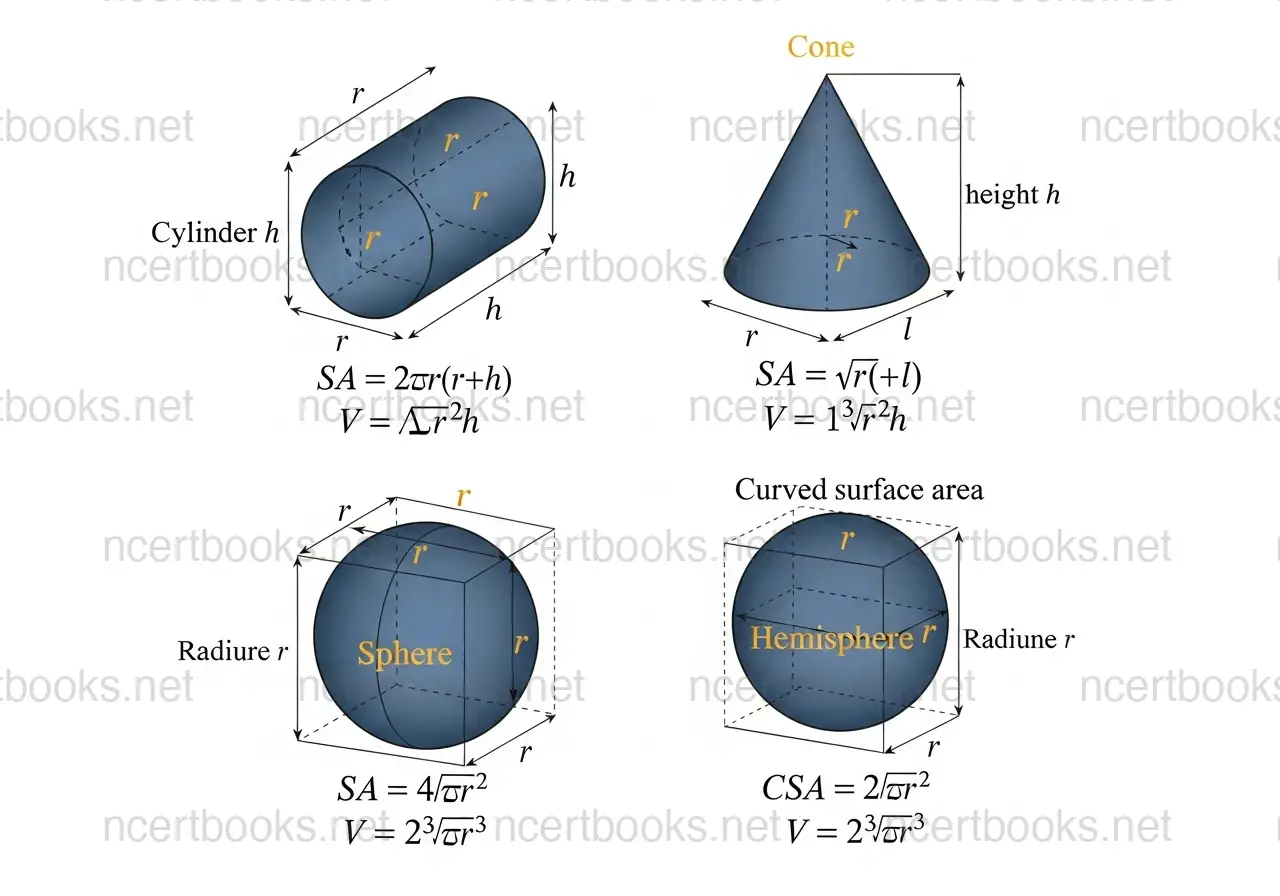
Below are the complete, step-by-step solutions for all 5 questions in NCERT Solutions for Class 10 Maths Chapter 13 Ex 13.4. Every solution shows the formula used, substitution, and final answer clearly.
Question 1
Medium
A drinking glass is in the shape of a frustum of a cone of height 14 cm. The diameters of its two circular ends are 4 cm and 2 cm. Find the capacity of the glass.
Given: Height \( h = 14 \) cm, diameter of larger end = 4 cm so \( r_1 = 2 \) cm, diameter of smaller end = 2 cm so \( r_2 = 1 \) cm.
Key Concept: The capacity of the glass equals the volume of the frustum.
Step 1: Write the volume formula for a frustum:
\[ V = \frac{1}{3}\pi h(r_1^2 + r_2^2 + r_1 r_2) \]
Step 2: Substitute the known values \( h = 14 \), \( r_1 = 2 \), \( r_2 = 1 \), \( \pi = \frac{22}{7} \):
\[ V = \frac{1}{3} \times \frac{22}{7} \times 14 \times (2^2 + 1^2 + 2 \times 1) \]
Step 3: Simplify the bracket:
\[ 2^2 + 1^2 + 2 \times 1 = 4 + 1 + 2 = 7 \]
Step 4: Calculate:
\[ V = \frac{1}{3} \times \frac{22}{7} \times 14 \times 7 \]
\[ V = \frac{1}{3} \times 22 \times 14 \]
\[ V = \frac{308}{3} \]
\[ V \approx 102.67 \text{ cm}^3 \]
Why does \( \frac{22}{7} \times 14 \times 7 \) simplify so neatly? The 7 in the denominator of \( \pi \) cancels with the 7 in the bracket, and 14 divides cleanly, making the arithmetic straightforward.
\( \therefore \) Capacity of the glass \( = \frac{308}{3} \approx 102\frac{2}{3} \) cm³
Question 2
Medium
The slant height of a frustum of a cone is 4 cm and the perimeters (circumference) of its circular ends are 18 cm and 6 cm. Find the curved surface area of the frustum.
Given: Slant height \( l = 4 \) cm, circumference of larger end = 18 cm, circumference of smaller end = 6 cm.
Step 1: Find the radii from the circumferences. Using \( C = 2\pi r \):
\[ 2\pi r_1 = 18 \implies r_1 = \frac{18}{2\pi} = \frac{9}{\pi} \]
\[ 2\pi r_2 = 6 \implies r_2 = \frac{6}{2\pi} = \frac{3}{\pi} \]
Step 2: Write the CSA formula:
\[ \text{CSA} = \pi(r_1 + r_2) \times l \]
Step 3: Substitute:
\[ \text{CSA} = \pi \left(\frac{9}{\pi} + \frac{3}{\pi}\right) \times 4 \]
\[ \text{CSA} = \pi \times \frac{12}{\pi} \times 4 \]
\[ \text{CSA} = 12 \times 4 \]
\[ \text{CSA} = 48 \text{ cm}^2 \]
Why does \( \pi \) cancel out? Because the radii were expressed in terms of \( \pi \) (from the circumference formula), multiplying by \( \pi \) in the CSA formula causes the \( \pi \) values to cancel, giving a clean integer answer.
\( \therefore \) Curved Surface Area of the frustum = 48 cm²
Question 3
Medium
A fez, the cap used by the Turks, is shaped like the frustum of a cone. If its radius on the open side is 10 cm, radius at the upper base is 4 cm and its slant height is 15 cm, find the area of material used for making it.
Given: \( r_1 = 10 \) cm (open/larger end), \( r_2 = 4 \) cm (upper/smaller base), slant height \( l = 15 \) cm.
Key Concept: The fez cap is open at the bottom (larger circle) and closed at the top (smaller circle). So the area of material = CSA of frustum + area of the upper circular base (the top is covered, the bottom is open).
Step 1: Calculate the Curved Surface Area:
\[ \text{CSA} = \pi(r_1 + r_2) \times l = \frac{22}{7} \times (10 + 4) \times 15 \]
\[ \text{CSA} = \frac{22}{7} \times 14 \times 15 = 22 \times 2 \times 15 = 660 \text{ cm}^2 \]
Step 2: Calculate the area of the upper circular base (smaller circle):
\[ \text{Area of upper base} = \pi r_2^2 = \frac{22}{7} \times 4^2 = \frac{22}{7} \times 16 = \frac{352}{7} \approx 50.29 \text{ cm}^2 \]
Step 3: Total area of material used:
\[ \text{Total Area} = \text{CSA} + \pi r_2^2 = 660 + \frac{352}{7} \]
\[ = \frac{4620 + 352}{7} = \frac{4972}{7} \approx 710.29 \text{ cm}^2 \]
Why don’t we add the larger base area? The fez cap is open at the bottom (the head goes in), so no material covers the lower circle.
\( \therefore \) Area of material used = \( \frac{4972}{7} \approx 710\frac{2}{7} \) cm²
Question 4
Hard
A container, opened from the top and made up of a metal sheet, is in the form of a frustum of a cone of height 16 cm with radii of its lower and upper ends as 8 cm and 20 cm, respectively. Find the cost of the milk which can completely fill the container, at the rate of Rs 20 per litre. Also find the cost of metal sheet used to make the container, if it costs Rs 8 per 100 cm².
Given: Height \( h = 16 \) cm, radius of lower end \( r_2 = 8 \) cm, radius of upper end \( r_1 = 20 \) cm. Container is open at the top.
Part A — Cost of Milk (Volume Calculation):
Step 1: Calculate the volume of the frustum:
\[ V = \frac{1}{3}\pi h(r_1^2 + r_2^2 + r_1 r_2) \]
\[ V = \frac{1}{3} \times \frac{22}{7} \times 16 \times (20^2 + 8^2 + 20 \times 8) \]
Step 2: Simplify the bracket:
\[ 400 + 64 + 160 = 624 \]
Step 3: Calculate volume:
\[ V = \frac{1}{3} \times \frac{22}{7} \times 16 \times 624 \]
\[ V = \frac{22 \times 16 \times 624}{21} \]
\[ V = \frac{219648}{21} = 10459.43 \text{ cm}^3 \approx 10.459 \text{ litres} \]
Note: 1 litre = 1000 cm³
Step 4: Cost of milk at Rs 20 per litre:
\[ \text{Cost} = 10.459 \times 20 = \text{Rs } 209.18 \approx \text{Rs } 209.43 \]
More precisely: \( V = \frac{22 \times 16 \times 624}{21} = \frac{219648}{21} \) cm³
\[ = \frac{219648}{21000} \text{ litres} = \frac{10459.43}{1000} \approx 10.459 \text{ litres} \]
\[ \text{Cost of milk} = \frac{219648}{21000} \times 20 = \frac{219648}{1050} = \text{Rs } 209.19 \]
Cost of milk ≈ Rs 209.43 (using \( \pi = \frac{22}{7} \), exact value: Rs \( \frac{4392.96}{21} \approx \) Rs 209.43)
Part B — Cost of Metal Sheet (Surface Area Calculation):
The container is open at the top, so we need: CSA of frustum + area of the lower (bottom) circular base.
Step 5: Find the slant height:
\[ l = \sqrt{h^2 + (r_1 – r_2)^2} = \sqrt{16^2 + (20 – 8)^2} = \sqrt{256 + 144} = \sqrt{400} = 20 \text{ cm} \]
Step 6: Calculate CSA:
\[ \text{CSA} = \pi(r_1 + r_2) \times l = \frac{22}{7} \times (20 + 8) \times 20 = \frac{22}{7} \times 28 \times 20 \]
\[ = 22 \times 4 \times 20 = 1760 \text{ cm}^2 \]
Step 7: Area of the bottom (lower) circular base:
\[ \pi r_2^2 = \frac{22}{7} \times 8^2 = \frac{22}{7} \times 64 = \frac{1408}{7} \approx 201.14 \text{ cm}^2 \]
Step 8: Total metal sheet area:
\[ \text{Total Area} = 1760 + \frac{1408}{7} = \frac{12320 + 1408}{7} = \frac{13728}{7} \approx 1961.14 \text{ cm}^2 \]
Step 9: Cost of metal sheet at Rs 8 per 100 cm²:
\[ \text{Cost} = \frac{13728}{7} \times \frac{8}{100} = \frac{109824}{700} = \frac{15689.14}{100} \approx \text{Rs } 156.75 \]
\( \therefore \) Cost of milk ≈ Rs 209.43 | Cost of metal sheet ≈ Rs 156.75
Question 5
Hard
A metallic right circular cone 20 cm high and whose vertical angle is 60° is cut into two parts at the middle of its height by a plane parallel to its base. If the frustum so obtained be drawn into a wire of diameter 1/16 cm, find the length of the wire.
Given: Height of full cone \( H = 20 \) cm, vertical angle = 60° (so half-angle = 30°), the cone is cut at height 10 cm from the apex (middle of height). Wire diameter = \( \frac{1}{16} \) cm, so wire radius \( r_w = \frac{1}{32} \) cm.
Step 1: Find the radii of the frustum using trigonometry.
The vertical angle is 60°, so the semi-vertical angle is 30°. Using \( \tan(\theta) = \frac{\text{radius}}{\text{height from apex}} \):
For the larger base (bottom of frustum, at full height 20 cm from apex):
\[ r_1 = H \times \tan(30°) = 20 \times \frac{1}{\sqrt{3}} = \frac{20}{\sqrt{3}} = \frac{20\sqrt{3}}{3} \text{ cm} \]
For the smaller base (top of frustum, at height 10 cm from apex):
\[ r_2 = 10 \times \tan(30°) = 10 \times \frac{1}{\sqrt{3}} = \frac{10}{\sqrt{3}} = \frac{10\sqrt{3}}{3} \text{ cm} \]
Step 2: Height of the frustum.
The cut is at the midpoint of the cone’s height, so the frustum has height:
\[ h = 20 – 10 = 10 \text{ cm} \]
Step 3: Calculate the volume of the frustum.
\[ V = \frac{1}{3}\pi h(r_1^2 + r_2^2 + r_1 r_2) \]
First compute each term:
\[ r_1^2 = \left(\frac{20}{\sqrt{3}}\right)^2 = \frac{400}{3} \]
\[ r_2^2 = \left(\frac{10}{\sqrt{3}}\right)^2 = \frac{100}{3} \]
\[ r_1 r_2 = \frac{20}{\sqrt{3}} \times \frac{10}{\sqrt{3}} = \frac{200}{3} \]
Step 4: Sum the terms:
\[ r_1^2 + r_2^2 + r_1 r_2 = \frac{400}{3} + \frac{100}{3} + \frac{200}{3} = \frac{700}{3} \]
Step 5: Substitute into volume formula:
\[ V = \frac{1}{3} \times \pi \times 10 \times \frac{700}{3} = \frac{7000\pi}{9} \text{ cm}^3 \]
Step 6: Set volume of frustum equal to volume of wire.
The wire is a cylinder with radius \( r_w = \frac{1}{32} \) cm and length \( L \) (unknown).
\[ \text{Volume of wire} = \pi r_w^2 L = \pi \times \left(\frac{1}{32}\right)^2 \times L = \frac{\pi L}{1024} \]
Step 7: Equate the two volumes:
\[ \frac{\pi L}{1024} = \frac{7000\pi}{9} \]
Step 8: Solve for \( L \):
\[ L = \frac{7000 \times 1024}{9} = \frac{7168000}{9} \approx 796444.4 \text{ cm} \]
Step 9: Convert to metres:
\[ L = \frac{7168000}{9 \times 100} \text{ m} = \frac{7168000}{900} \approx 7964.44 \text{ m} \]
Why does volume remain constant? When a solid is reshaped (drawn into wire), the total volume of material is conserved — only the shape changes.
\( \therefore \) Length of the wire = \( \frac{7168000}{900} \approx 7964\frac{4}{9} \) m ≈ 7964.44 m
Formula Reference Table — Frustum of a Cone
| Formula Name | Formula | Variables Defined |
|---|---|---|
| Slant Height | \( l = \sqrt{h^2 + (r_1 – r_2)^2} \) | h = height, r₁ = larger radius, r₂ = smaller radius |
| Curved Surface Area | \( \text{CSA} = \pi(r_1 + r_2)l \) | l = slant height |
| Total Surface Area | \( \text{TSA} = \pi(r_1 + r_2)l + \pi r_1^2 + \pi r_2^2 \) | Includes both circular bases |
| Volume | \( V = \frac{1}{3}\pi h(r_1^2 + r_2^2 + r_1 r_2) \) | h = perpendicular height |
| Radius from Circumference | \( r = \frac{C}{2\pi} \) | C = circumference of circular end |
Solved Examples Beyond NCERT — Extra Practice for Class 10 Maths
Extra Example 1 — Finding Slant Height and TSA
Medium
A frustum has height 8 cm, larger radius 6 cm, and smaller radius 3 cm. Find its Total Surface Area. Use \( \pi = 3.14 \).
Step 1: Find slant height:
\[ l = \sqrt{8^2 + (6-3)^2} = \sqrt{64 + 9} = \sqrt{73} \approx 8.544 \text{ cm} \]
Step 2: TSA = \( \pi(r_1 + r_2)l + \pi r_1^2 + \pi r_2^2 \)
\[ = 3.14 \times 9 \times 8.544 + 3.14 \times 36 + 3.14 \times 9 \]
\[ = 241.57 + 113.04 + 28.26 = 382.87 \text{ cm}^2 \]
TSA ≈ 382.87 cm²
Extra Example 2 — Volume Conservation (Wire Problem Variant)
Hard
A frustum of height 6 cm with radii 5 cm and 3 cm is melted and recast into a solid sphere. Find the radius of the sphere.
Step 1: Volume of frustum:
\[ V = \frac{1}{3}\pi \times 6 \times (25 + 9 + 15) = \frac{1}{3}\pi \times 6 \times 49 = 98\pi \text{ cm}^3 \]
Step 2: Volume of sphere = \( \frac{4}{3}\pi R^3 \). Equate:
\[ \frac{4}{3}\pi R^3 = 98\pi \implies R^3 = \frac{98 \times 3}{4} = 73.5 \]
\[ R = \sqrt[3]{73.5} \approx 4.19 \text{ cm} \]
Radius of sphere ≈ 4.19 cm
Important Questions for CBSE Board Exam 2026-27 — Chapter 13 Frustum
1-Mark Questions
- Q: Write the formula for the volume of a frustum of a cone.
A: \( V = \frac{1}{3}\pi h(r_1^2 + r_2^2 + r_1 r_2) \) - Q: What is the slant height formula for a frustum?
A: \( l = \sqrt{h^2 + (r_1 – r_2)^2} \) - Q: If the circumference of a circular end of a frustum is 12π cm, what is its radius?
A: \( r = 6 \) cm
3-Mark Questions
Q: A frustum of a cone has height 5 cm, larger radius 7 cm, and smaller radius 3 cm. Find its curved surface area. (Use \( \pi = \frac{22}{7} \))
A: Slant height \( l = \sqrt{25 + 16} = \sqrt{41} \approx 6.4 \) cm. CSA \( = \frac{22}{7} \times 10 \times 6.4 \approx 201.14 \) cm².
Q: Prove that the volume of a frustum obtained by cutting a cone of height H at its midpoint equals \( \frac{7}{8} \) of the original cone’s volume.
A: Volume of full cone = \( \frac{1}{3}\pi R^2 H \). The small cone cut off has height \( H/2 \) and radius \( R/2 \), so its volume = \( \frac{1}{3}\pi \frac{R^2}{4} \frac{H}{2} = \frac{1}{24}\pi R^2 H \). Frustum volume = \( \frac{1}{3}\pi R^2 H – \frac{1}{24}\pi R^2 H = \frac{7}{24}\pi R^2 H = \frac{7}{8} \times \frac{1}{3}\pi R^2 H \). Hence proved.
5-Mark Question
Q: A bucket is in the form of a frustum of a cone. Its depth is 15 cm and the radii of the top and bottom are 14 cm and 7 cm. Find the capacity of the bucket and the cost of tin sheet used at Rs 10 per 100 cm². (Use \( \pi = \frac{22}{7} \))
A: Volume \( = \frac{1}{3} \times \frac{22}{7} \times 15 \times (196 + 49 + 98) = \frac{1}{3} \times \frac{22}{7} \times 15 \times 343 = \frac{22 \times 15 \times 49}{3} = 5390 \) cm³. Slant height \( l = \sqrt{225 + 49} = \sqrt{274} \approx 16.55 \) cm. CSA \( = \frac{22}{7} \times 21 \times 16.55 \approx 1091.7 \) cm². Bottom area \( = \frac{22}{7} \times 49 = 154 \) cm². Total area \( \approx 1245.7 \) cm². Cost \( = \frac{1245.7 \times 10}{100} \approx \) Rs 124.57.
Common Mistakes Students Make in Frustum Problems
Mistake 1: Using diameter instead of radius in the formula.
Why it’s wrong: All frustum formulas use radius (\( r \)), not diameter (\( d \)). Using diameter doubles the value and gives a completely wrong answer.
Correct approach: Always divide the diameter by 2 to get the radius before substituting. E.g., diameter = 4 cm → radius = 2 cm.
Mistake 2: Adding both circular base areas for an open container.
Why it’s wrong: If a container is open at the top, the top circular face has no material covering it, so its area should not be included.
Correct approach: Read the question carefully — identify which faces are open and include only the closed faces in the surface area calculation.
Mistake 3: Forgetting to convert cm³ to litres when calculating cost of liquid.
Why it’s wrong: The rate is given per litre, but the volume formula gives cm³. 1 litre = 1000 cm³. Missing this conversion gives an answer 1000 times too large.
Correct approach: Always write the conversion step: Volume in litres = Volume in cm³ ÷ 1000.
Mistake 4: Not calculating slant height when only h, r₁, r₂ are given.
Why it’s wrong: The CSA and TSA formulas need slant height \( l \), not the perpendicular height \( h \). These are different values.
Correct approach: Always compute \( l = \sqrt{h^2 + (r_1 – r_2)^2} \) first when slant height is not directly given.
Mistake 5: Confusing the semi-vertical angle with the full vertical angle in Question 5.
Why it’s wrong: The vertical angle of a cone is the full angle at the apex (between the two slant sides). The semi-vertical angle (used in \( \tan \)) is half of this.
Correct approach: If vertical angle = 60°, then semi-vertical angle = 30°. Use \( \tan(30°) = \frac{1}{\sqrt{3}} \) to find the radius.
Exam Tips for CBSE 2026-27 — Chapter 13 Surface Areas and Volumes
- Always write the formula first: The CBSE 2026-27 marking scheme awards 1 mark just for writing the correct formula. Never skip this step even if you can solve it mentally.
- Show unit conversion explicitly: When converting cm³ to litres, write “1 litre = 1000 cm³” as a separate line. This earns process marks.
- Slant height is a separate step: In questions where \( l \) is not given, calculate it as a clearly labelled Step 1. Examiners look for this working.
- Use \( \pi = \frac{22}{7} \) unless told otherwise: Most NCERT frustum problems are designed so that \( \frac{22}{7} \) gives clean answers. Using 3.14 may give a slightly different decimal — always check the question.
- Frustum questions are high-value: In recent CBSE board papers, frustum problems have appeared as 3-mark and 5-mark questions. Mastering all 5 questions in Exercise 13.4 directly covers these patterns.
- Revision checklist:
- ✅ Memorise all 4 frustum formulas (l, CSA, TSA, V)
- ✅ Practice converting circumference to radius
- ✅ Know when to include/exclude circular base areas
- ✅ Practice the wire/sphere recasting concept (volume conservation)
- ✅ Revise \( \tan(30°) \), \( \tan(45°) \), \( \tan(60°) \) values for cone problems
For more help with the full chapter, visit our NCERT Solutions for Class 10 page and explore solutions for all 15 chapters. You can also check the NCERT Solutions hub for other classes and subjects.