- Exercise: 12.3 — Areas of Combinations of Plane Figures
- Total Questions: 16 (all involve shaded region / composite area problems)
- Default value of π: 22/7 (unless stated otherwise)
- Area of sector: \( \frac{\theta}{360} \times \pi r^2 \)
- Area of equilateral triangle: \( \frac{\sqrt{3}}{4} a^2 \)
- Key technique: Shaded area = Total area − Unshaded area
- Quadrant area: \( \frac{1}{4} \pi r^2 \); Semicircle area: \( \frac{1}{2} \pi r^2 \)
- Board exam weightage: Chapter 12 carries approximately 6–7 marks in CBSE Class 10 Maths
The NCERT Solutions for Class 10 Maths Chapter 12 Ex 12.3 on this page cover all 16 questions from the exercise on Areas of Combinations of Plane Figures, fully updated for the 2026-27 CBSE board exam. These solutions are part of our complete NCERT Solutions for Class 10 series. Every answer includes step-by-step working with proper mathematical reasoning so you can understand the method, not just memorise the answer. You can also refer to the NCERT official textbook for the original figures and diagrams.
This exercise is part of our broader collection of NCERT Solutions across all classes and subjects. Exercise 12.3 is the most calculation-intensive exercise in Chapter 12 and is a favourite source of 3-mark and 5-mark questions in CBSE board papers.
Table of Contents
Chapter Overview — Areas Related to Circles (Class 10 Maths Chapter 12)
Chapter 12 of the NCERT Class 10 Maths textbook deals with Areas Related to Circles. Exercise 12.3 specifically focuses on finding areas of regions formed by combinations of circles with other plane figures such as squares, triangles, rectangles, and other circles. This is Section 12.4 of the textbook — Areas of Combinations of Plane Figures.
For CBSE board exams 2026-27, this chapter typically carries 6–7 marks. Questions from Exercise 12.3 appear as 3-mark or 5-mark problems requiring complete step-by-step working. You need a strong understanding of area formulas for circles, sectors, segments, and basic polygons before attempting this exercise.
| Detail | Information |
|---|---|
| Class | 10 |
| Subject | Mathematics |
| Chapter | 12 — Areas Related to Circles |
| Exercise | 12.3 |
| Number of Questions | 16 |
| Key Topic | Areas of Combinations of Plane Figures |
| Difficulty Level | Medium to Hard |
| Academic Year | 2026-27 |
Key Concepts and Formulas for Exercise 12.3
Before solving the questions, make sure you know these core concepts. Every question in this exercise applies one or more of these ideas.
Area of a Sector
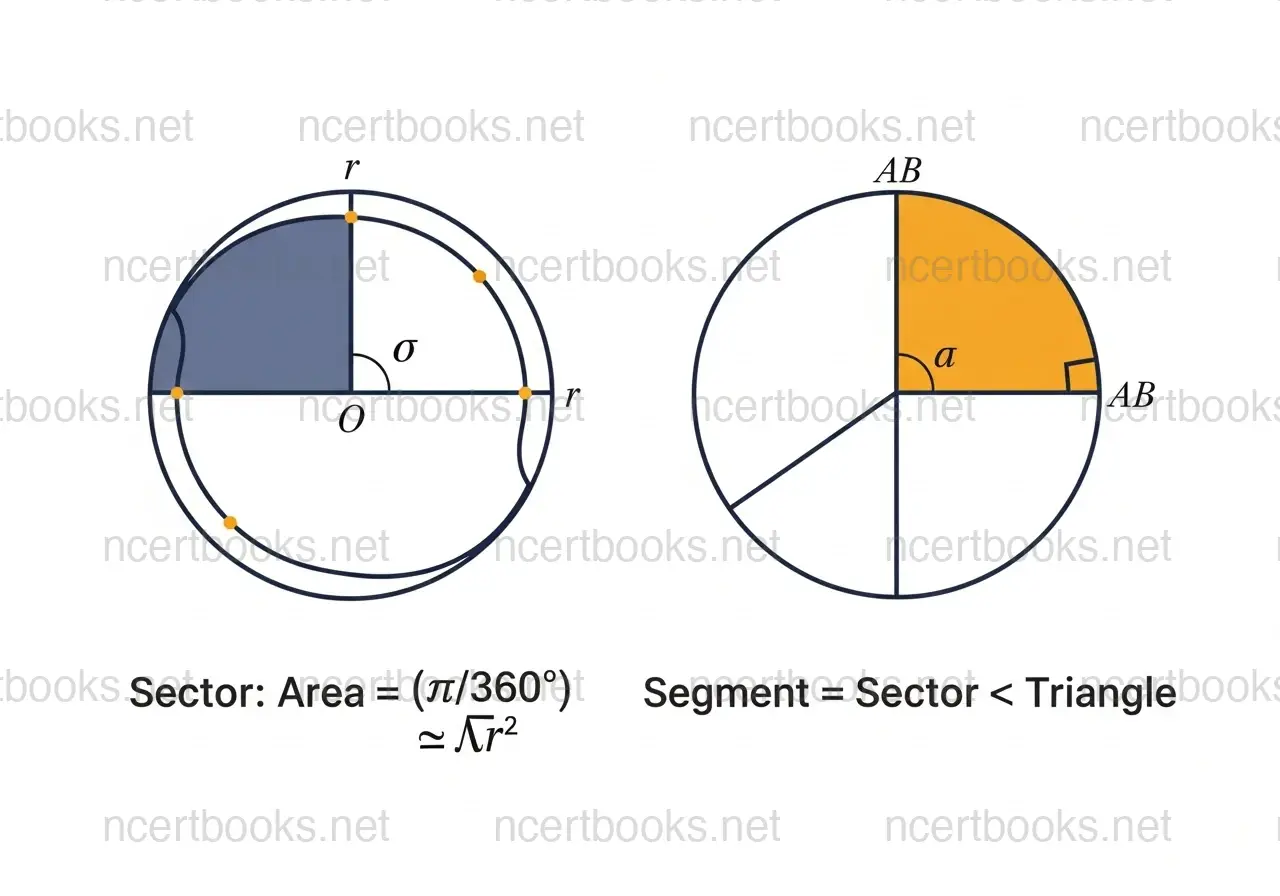
A sector is the “pizza slice” region of a circle bounded by two radii and an arc. If the central angle is \( \theta \) degrees and radius is \( r \):
\[ \text{Area of sector} = \frac{\theta}{360} \times \pi r^2 \]
Area of a Segment
A segment is the region between a chord and the arc. To find it, subtract the triangle area from the sector area:
\[ \text{Area of segment} = \text{Area of sector} – \text{Area of triangle} \]
Shaded Region Technique
The most important technique in this exercise: Shaded area = (Area of outer shape) − (Area of inner/unshaded shape). Sometimes you add areas of multiple parts. Always draw or visualise the figure before calculating.
Equilateral Triangle Formulas
For an equilateral triangle of side \( a \):
\[ \text{Area} = \frac{\sqrt{3}}{4} a^2 \]
Each interior angle of an equilateral triangle is 60°. This is used when a circle is drawn from a vertex of an equilateral triangle — the sector angle is always 60°.
Formula Reference Table — Areas Related to Circles
| Formula Name | Formula | Variables |
|---|---|---|
| Area of Circle | \( \pi r^2 \) | r = radius |
| Circumference | \( 2\pi r \) | r = radius |
| Area of Sector | \( \frac{\theta}{360} \times \pi r^2 \) | θ = central angle, r = radius |
| Length of Arc | \( \frac{\theta}{360} \times 2\pi r \) | θ = central angle, r = radius |
| Area of Semicircle | \( \frac{1}{2} \pi r^2 \) | r = radius |
| Area of Quadrant | \( \frac{1}{4} \pi r^2 \) | r = radius |
| Area of Equilateral Triangle | \( \frac{\sqrt{3}}{4} a^2 \) | a = side length |
| Area of Square | \( a^2 \) | a = side length |
| Area of Rectangle | \( l \times b \) | l = length, b = breadth |
| Area of Right Triangle | \( \frac{1}{2} \times base \times height \) | — |
NCERT Solutions for Class 10 Maths Chapter 12 Ex 12.3 — All 16 Questions
Below are complete, step-by-step solutions for all 16 questions of ncert solutions for class 10 maths chapter 12 ex 12 3. Unless stated otherwise, \( \pi = \frac{22}{7} \).
Question 1
Medium
Find the area of the shaded region in the given figure, if PQ = 24 cm, PR = 7 cm and O is the centre of the circle.
Key Concept: Since O is the centre and QR is a diameter, angle QPR = 90° (angle in a semicircle). So triangle QPR is right-angled at P.
Step 1: Find the diameter QR using Pythagoras theorem.
\[ QR = \sqrt{PQ^2 + PR^2} = \sqrt{24^2 + 7^2} = \sqrt{576 + 49} = \sqrt{625} = 25 \text{ cm} \]
Step 2: Find the radius of the circle.
\[ r = \frac{QR}{2} = \frac{25}{2} = 12.5 \text{ cm} \]
Step 3: Find the area of the semicircle (upper half).
\[ \text{Area of semicircle} = \frac{1}{2} \pi r^2 = \frac{1}{2} \times \frac{22}{7} \times 12.5^2 = \frac{1}{2} \times \frac{22}{7} \times 156.25 = \frac{3437.5}{7} \approx 245.54 \text{ cm}^2 \]
Step 4: Find the area of triangle QPR.
\[ \text{Area of } \triangle QPR = \frac{1}{2} \times PQ \times PR = \frac{1}{2} \times 24 \times 7 = 84 \text{ cm}^2 \]
Step 5: Area of shaded region = Area of semicircle − Area of triangle QPR.
\[ \text{Shaded area} = 245.54 – 84 = 161.54 \text{ cm}^2 \]
\( \therefore \) Area of shaded region ≈ 161.54 cm²
Question 2
Medium
Find the area of the shaded region in the given figure, if radii of the two concentric circles with centre O are 7 cm and 14 cm respectively and ∠AOC = 40°.
Key Concept: The shaded region is the area of the larger sector minus the area of the smaller sector, plus the area of the two triangles (the unshaded region in the minor sector area). Actually, the shaded region = Area of larger sector + Area of smaller sector subtracted from the ring, which simplifies to: Shaded area = Area of ring − Area of minor sector of ring + Area of minor sectors. Re-reading: shaded region = (Area of larger sector with angle 360°−40°) + (Area of smaller sector with angle 40°). Let us use the standard approach: shaded = (Area of large sector, angle 320°) + (Area of small sector, angle 40°).
Step 1: Identify radii. \( r_1 = 7 \) cm (inner), \( r_2 = 14 \) cm (outer), \( \angle AOC = 40° \).
Step 2: The unshaded region is the minor sector of the annulus (ring) with angle 40°. The shaded region = Total area of ring − Unshaded region area. Alternatively, shaded = Area of large sector (angle 320°) + Area of small sector (angle 40°).
Step 3: Area of larger sector (outer circle, angle 320°):
\[ = \frac{320}{360} \times \pi \times 14^2 = \frac{8}{9} \times \frac{22}{7} \times 196 = \frac{8}{9} \times 616 = \frac{4928}{9} \approx 547.56 \text{ cm}^2 \]
Step 4: Area of smaller sector (inner circle, angle 40°):
\[ = \frac{40}{360} \times \pi \times 7^2 = \frac{1}{9} \times \frac{22}{7} \times 49 = \frac{1}{9} \times 154 = \frac{154}{9} \approx 17.11 \text{ cm}^2 \]
Step 5: Total shaded area:
\[ = \frac{4928}{9} + \frac{154}{9} = \frac{5082}{9} = 564.67 \text{ cm}^2 \]
\( \therefore \) Area of shaded region = 564.67 cm²
Question 3
Easy
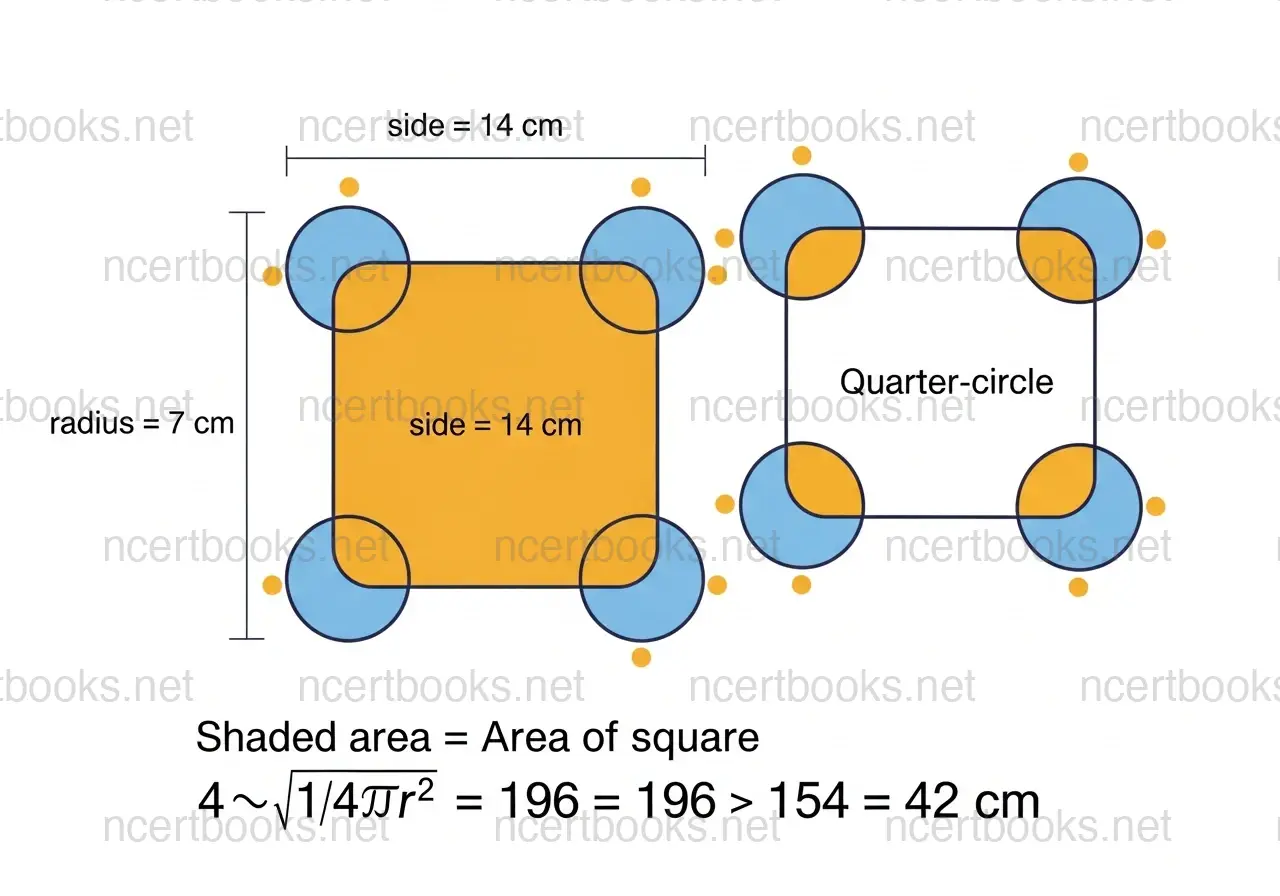
Find the area of the shaded region in the given figure, if ABCD is a square of side 14 cm and APD and BPC are semicircles.
Key Concept: The shaded region = Area of square − Area of two semicircles.
Step 1: Area of square ABCD with side 14 cm:
\[ \text{Area of square} = 14^2 = 196 \text{ cm}^2 \]
Step 2: Each semicircle has diameter = side of square = 14 cm, so radius = 7 cm.
\[ \text{Area of one semicircle} = \frac{1}{2} \pi r^2 = \frac{1}{2} \times \frac{22}{7} \times 49 = \frac{1}{2} \times 154 = 77 \text{ cm}^2 \]
Step 3: Total area of two semicircles = \( 2 \times 77 = 154 \) cm².
Step 4: Shaded area = Area of square − Area of two semicircles:
\[ = 196 – 154 = 42 \text{ cm}^2 \]
\( \therefore \) Area of shaded region = 42 cm²
Question 4
Medium
Find the area of the shaded region in the figure, where a circular arc of radius 6 cm has been drawn with vertex O of an equilateral triangle OAB of side 12 cm as centre.
Key Concept: The shaded region = Area of equilateral triangle + Area of major sector (outside triangle). Since OAB is equilateral, ∠AOB = 60°. The sector cut inside the triangle has angle 60°. The major sector has angle = 360° − 60° = 300°.
Step 1: Area of equilateral triangle OAB with side 12 cm:
\[ = \frac{\sqrt{3}}{4} \times 12^2 = \frac{\sqrt{3}}{4} \times 144 = 36\sqrt{3} = 36 \times 1.732 = 62.35 \text{ cm}^2 \]
Step 2: Area of sector with angle 60° and radius 6 cm (this is inside the triangle, unshaded):
\[ = \frac{60}{360} \times \frac{22}{7} \times 6^2 = \frac{1}{6} \times \frac{22}{7} \times 36 = \frac{1}{6} \times \frac{792}{7} = \frac{132}{7} = 18.86 \text{ cm}^2 \]
Step 3: Area of major sector with angle 300° and radius 6 cm:
\[ = \frac{300}{360} \times \frac{22}{7} \times 36 = \frac{5}{6} \times \frac{792}{7} = \frac{3960}{42} = \frac{660}{7} = 94.29 \text{ cm}^2 \]
Step 4: Shaded area = Area of triangle + Area of major sector − Area of minor sector (already outside). Wait — the shaded region is the triangle area (excluding the 60° sector inside) plus the major sector area outside the triangle.
\[ \text{Shaded} = (\text{Area of triangle} – \text{Area of minor sector}) + \text{Area of major sector} \]
\[ = (62.35 – 18.86) + 94.29 = 43.49 + 94.29 = 137.78 \text{ cm}^2 \]
\( \therefore \) Area of shaded region ≈ 137.78 cm²
Question 5
Medium
From each corner of a square of side 4 cm a quadrant of a circle of radius 1 cm is cut and also a circle of diameter 2 cm is cut as shown in the figure. Find the area of the remaining portion of the square.
Step 1: Area of square with side 4 cm:
\[ = 4^2 = 16 \text{ cm}^2 \]
Step 2: There are 4 corners, each with a quadrant of radius 1 cm. Total area of 4 quadrants = 1 full circle of radius 1 cm:
\[ = \pi r^2 = \frac{22}{7} \times 1^2 = \frac{22}{7} \text{ cm}^2 \]
Step 3: Area of the circle cut from the middle (diameter = 2 cm, radius = 1 cm):
\[ = \pi r^2 = \frac{22}{7} \times 1^2 = \frac{22}{7} \text{ cm}^2 \]
Step 4: Remaining area = Area of square − Area of 4 quadrants − Area of middle circle:
\[ = 16 – \frac{22}{7} – \frac{22}{7} = 16 – \frac{44}{7} = \frac{112 – 44}{7} = \frac{68}{7} = 9.71 \text{ cm}^2 \]
\( \therefore \) Area of remaining portion = \( \frac{68}{7} \approx 9.71 \) cm²
Question 6
Hard
In a circular table cover of radius 32 cm, a design is formed leaving an equilateral triangle ABC in the middle as shown in the figure. Find the area of the design (shaded region).
Key Concept: For an equilateral triangle inscribed in a circle of radius R, the side of the triangle \( a = R\sqrt{3} \).
Step 1: Find the side of the equilateral triangle inscribed in a circle of radius 32 cm.
\[ a = R\sqrt{3} = 32\sqrt{3} \text{ cm} \]
Step 2: Area of the circle:
\[ = \pi R^2 = \frac{22}{7} \times 32^2 = \frac{22}{7} \times 1024 = \frac{22528}{7} = 3218.29 \text{ cm}^2 \]
Step 3: Area of equilateral triangle ABC:
\[ = \frac{\sqrt{3}}{4} a^2 = \frac{\sqrt{3}}{4} \times (32\sqrt{3})^2 = \frac{\sqrt{3}}{4} \times 3072 = 768\sqrt{3} = 768 \times 1.732 = 1330.18 \text{ cm}^2 \]
Step 4: Area of shaded design = Area of circle − Area of triangle:
\[ = 3218.29 – 1330.18 = 1888.11 \text{ cm}^2 \]
\( \therefore \) Area of design ≈ 1888.11 cm²
Question 7
Medium
In the figure, ABCD is a square of side 14 cm. With centres A, B, C and D, four circles are drawn such that each circle touches externally two of the remaining three circles. Find the area of the shaded region.
Key Concept: Each circle has radius = half the side of the square = 7 cm. Each corner contributes a quadrant (90°) inside the square. Total area of 4 quadrants = 1 full circle.
Step 1: Area of square ABCD:
\[ = 14^2 = 196 \text{ cm}^2 \]
Step 2: Radius of each circle = 7 cm. Area of 4 quadrants (each of angle 90°):
\[ = 4 \times \frac{1}{4} \pi r^2 = \pi r^2 = \frac{22}{7} \times 49 = 154 \text{ cm}^2 \]
Step 3: Shaded area = Area of square − Area of 4 quadrants:
\[ = 196 – 154 = 42 \text{ cm}^2 \]
Question 8
Hard
The given figure depicts a racing track whose left and right ends are semicircular. The distance between the two inner parallel line segments is 60 m and they are each 106 m long. If the track is 10 m wide, find: (i) the distance around the track along its inner edge. (ii) the area of the track.
Step 1: Inner radius of semicircular ends = half of 60 m = 30 m.
Step 2: Inner circumference = 2 straight sections + 2 semicircles (= 1 full circle):
\[ = 2 \times 106 + 2 \times \pi \times 30 = 212 + 2 \times \frac{22}{7} \times 30 = 212 + \frac{1320}{7} = 212 + 188.57 = 400.57 \text{ m} \]
\( \therefore \) Distance along inner edge ≈ 400.57 m
Step 1: Inner radius \( r = 30 \) m, outer radius \( R = 30 + 10 = 40 \) m.
Step 2: Area of two rectangular strips:
\[ = 2 \times 106 \times 10 = 2120 \text{ m}^2 \]
Step 3: Area of two semicircular rings (annular ring) = Area of outer circle − Area of inner circle:
\[ = \pi R^2 – \pi r^2 = \pi (R^2 – r^2) = \frac{22}{7} \times (40^2 – 30^2) = \frac{22}{7} \times (1600 – 900) = \frac{22}{7} \times 700 = 2200 \text{ m}^2 \]
Step 4: Total area of track:
\[ = 2120 + 2200 = 4320 \text{ m}^2 \]
\( \therefore \) Area of track = 4320 m²
Question 9
Hard
In the figure, AB and CD are two diameters of a circle (with centre O) perpendicular to each other and OD is the diameter of the smaller circle. If OA = 7 cm, find the area of the shaded region.
Step 1: OA = 7 cm = radius of larger circle. Diameter of smaller circle = OD = 7 cm, so radius of smaller circle = 3.5 cm.
Step 2: Area of larger circle:
\[ = \pi \times 7^2 = \frac{22}{7} \times 49 = 154 \text{ cm}^2 \]
Step 3: Area of smaller circle:
\[ = \pi \times 3.5^2 = \frac{22}{7} \times 12.25 = 38.5 \text{ cm}^2 \]
Step 4: The shaded region = Area of smaller circle + Area of semicircle of larger circle (above AB) − Area of triangle AOC (or the semicircle on one side). More precisely, the shaded region consists of: (a) the small circle, and (b) the semicircle of the large circle on the side of B (below AB), minus the two unshaded triangular sectors.
Why does this work? The shaded region = (Area of small circle) + (Area of large semicircle on OB side) − (Area of triangle AOC). Since the diameters are perpendicular, the triangle formed is a right triangle with legs OA = OC = 7 cm.
\[ \text{Area of } \triangle AOC = \frac{1}{2} \times OA \times OC = \frac{1}{2} \times 7 \times 7 = 24.5 \text{ cm}^2 \]
Step 5: Area of large semicircle (one half) = \( \frac{154}{2} = 77 \) cm².
Step 6: Shaded area = Area of small circle + Area of large semicircle − Area of triangle:
\[ = 38.5 + 77 – 24.5 = 91 \text{ cm}^2 \]
\( \therefore \) Area of shaded region = 91 cm²
Question 10
Hard
The area of an equilateral triangle ABC is 17320.5 cm². With each vertex of the triangle as centre, a circle is drawn with radius equal to half the length of the side of the triangle. Find the area of the shaded region. (Use π = 3.14 and √3 = 1.73205)
Step 1: Find the side of the equilateral triangle.
\[ \frac{\sqrt{3}}{4} a^2 = 17320.5 \]
\[ a^2 = \frac{17320.5 \times 4}{\sqrt{3}} = \frac{69282}{1.73205} = 40000 \]
\[ a = 200 \text{ cm} \]
Step 2: Radius of each circle = \( \frac{a}{2} = \frac{200}{2} = 100 \) cm.
Step 3: Each angle of an equilateral triangle = 60°. Each vertex contributes a sector of angle 60° and radius 100 cm. Total area of 3 sectors = area of 1 full circle × (3 × 60°/360°) = area of half a circle.
\[ \text{Area of 3 sectors} = 3 \times \frac{60}{360} \times \pi r^2 = \frac{1}{2} \times 3.14 \times 100^2 = \frac{1}{2} \times 3.14 \times 10000 = 15700 \text{ cm}^2 \]
Step 4: Shaded area = Area of triangle − Area of 3 sectors:
\[ = 17320.5 – 15700 = 1620.5 \text{ cm}^2 \]
\( \therefore \) Area of shaded region = 1620.5 cm²
Question 11
Medium
On a square handkerchief, nine circular designs each of radius 7 cm are made. Find the area of the remaining portion of the handkerchief.
Step 1: The 9 circles are arranged in a 3×3 grid. The side of the square = 3 × diameter = 3 × 14 = 42 cm.
Step 2: Area of square handkerchief:
\[ = 42^2 = 1764 \text{ cm}^2 \]
Step 3: Area of 9 circles:
\[ = 9 \times \pi r^2 = 9 \times \frac{22}{7} \times 49 = 9 \times 154 = 1386 \text{ cm}^2 \]
Step 4: Remaining area = Area of square − Area of 9 circles:
\[ = 1764 – 1386 = 378 \text{ cm}^2 \]
\( \therefore \) Area of remaining portion = 378 cm²
Question 12
Medium
In the figure, OACB is a quadrant of a circle with centre O and radius 3.5 cm. If OD = 2 cm, find the area of the (i) quadrant OACB, (ii) shaded region.
Step 1: Radius = 3.5 cm. Area of quadrant:
\[ = \frac{1}{4} \pi r^2 = \frac{1}{4} \times \frac{22}{7} \times 3.5^2 = \frac{1}{4} \times \frac{22}{7} \times 12.25 = \frac{1}{4} \times 38.5 = 9.625 \text{ cm}^2 \]
\( \therefore \) Area of quadrant OACB = 9.625 cm²
Step 1: The shaded region = Area of quadrant − Area of triangle ODB. Triangle ODB has OD = 2 cm (height) and OB = 3.5 cm (base).
\[ \text{Area of } \triangle ODB = \frac{1}{2} \times OB \times OD = \frac{1}{2} \times 3.5 \times 2 = 3.5 \text{ cm}^2 \]
Step 2: Shaded area = 9.625 − 3.5 = 6.125 cm².
\( \therefore \) Area of shaded region = 6.125 cm²
Question 13
Hard
In the figure, a square OABC is inscribed in a quadrant OPBQ. If OA = 20 cm, find the area of the shaded region. (Use π = 3.14)
Step 1: Side of square OA = 20 cm. The diagonal of the square = radius of the quadrant.
\[ \text{Diagonal} = OB = \sqrt{OA^2 + AB^2} = \sqrt{20^2 + 20^2} = \sqrt{800} = 20\sqrt{2} \text{ cm} \]
Step 2: Radius of quadrant \( R = 20\sqrt{2} \) cm. Area of quadrant OPBQ:
\[ = \frac{1}{4} \pi R^2 = \frac{1}{4} \times 3.14 \times (20\sqrt{2})^2 = \frac{1}{4} \times 3.14 \times 800 = \frac{2512}{4} = 628 \text{ cm}^2 \]
Step 3: Area of square OABC:
\[ = 20^2 = 400 \text{ cm}^2 \]
Step 4: Shaded area = Area of quadrant − Area of square:
\[ = 628 – 400 = 228 \text{ cm}^2 \]
\( \therefore \) Area of shaded region = 228 cm²
Question 14
Medium
AB and CD are respectively arcs of two concentric circles of radii 21 cm and 7 cm and centre O. If ∠AOB = 30°, find the area of the shaded region.
Step 1: Outer radius \( R = 21 \) cm, inner radius \( r = 7 \) cm, angle \( \theta = 30° \).
Step 2: Area of sector with outer radius (angle 30°):
\[ = \frac{30}{360} \times \pi \times 21^2 = \frac{1}{12} \times \frac{22}{7} \times 441 = \frac{1}{12} \times 1386 = 115.5 \text{ cm}^2 \]
Step 3: Area of sector with inner radius (angle 30°):
\[ = \frac{30}{360} \times \pi \times 7^2 = \frac{1}{12} \times \frac{22}{7} \times 49 = \frac{1}{12} \times 154 = 12.83 \text{ cm}^2 \]
Step 4: Shaded area = Outer sector − Inner sector:
\[ = 115.5 – 12.83 = 102.67 \text{ cm}^2 \]
Alternative using formula:
\[ = \frac{\theta}{360} \times \pi (R^2 – r^2) = \frac{1}{12} \times \frac{22}{7} \times (441 – 49) = \frac{1}{12} \times \frac{22}{7} \times 392 = \frac{1}{12} \times \frac{8624}{7} = \frac{8624}{84} = \frac{2156}{21} \approx 102.67 \text{ cm}^2 \]
\( \therefore \) Area of shaded region = \( \frac{2156}{21} \approx 102.67 \) cm²
Question 15
Hard
In the figure, ABC is a quadrant of a circle of radius 14 cm and a semicircle is drawn with BC as diameter. Find the area of the shaded region.
Step 1: ABC is a quadrant with radius = AB = AC = 14 cm. BC is the chord (hypotenuse of right triangle ABC).
\[ BC = \sqrt{AB^2 + AC^2} = \sqrt{14^2 + 14^2} = \sqrt{392} = 14\sqrt{2} \text{ cm} \]
Step 2: Radius of semicircle drawn on BC as diameter:
\[ r = \frac{BC}{2} = \frac{14\sqrt{2}}{2} = 7\sqrt{2} \text{ cm} \]
Step 3: Area of quadrant ABC (radius 14 cm):
\[ = \frac{1}{4} \pi \times 14^2 = \frac{1}{4} \times \frac{22}{7} \times 196 = \frac{1}{4} \times 616 = 154 \text{ cm}^2 \]
Step 4: Area of triangle ABC:
\[ = \frac{1}{2} \times AB \times AC = \frac{1}{2} \times 14 \times 14 = 98 \text{ cm}^2 \]
Step 5: Area of segment (region between arc BC and chord BC) = Area of quadrant − Area of triangle:
\[ = 154 – 98 = 56 \text{ cm}^2 \]
Step 6: Area of semicircle on BC:
\[ = \frac{1}{2} \pi r^2 = \frac{1}{2} \times \frac{22}{7} \times (7\sqrt{2})^2 = \frac{1}{2} \times \frac{22}{7} \times 98 = \frac{1}{2} \times 308 = 154 \text{ cm}^2 \]
Step 7: Shaded area = Area of semicircle − Area of segment:
\[ = 154 – 56 = 98 \text{ cm}^2 \]
\( \therefore \) Area of shaded region = 98 cm²
Question 16
Hard
Calculate the area of the designed region in the figure common between the two quadrants of the circles of radius 8 cm each.
Key Concept: The designed (common) region is the intersection of two quadrants. Each quadrant has radius 8 cm and they share a square of side 8 cm.
Step 1: Area of the square with side 8 cm:
\[ = 8^2 = 64 \text{ cm}^2 \]
Step 2: Area of each quadrant with radius 8 cm:
\[ = \frac{1}{4} \pi r^2 = \frac{1}{4} \times \frac{22}{7} \times 64 = \frac{1408}{28} = \frac{352}{7} \text{ cm}^2 \]
Step 3: Area of 2 quadrants:
\[ = 2 \times \frac{352}{7} = \frac{704}{7} \text{ cm}^2 \]
Step 4: Using inclusion-exclusion: Area of common region = Area of 2 quadrants − Area of square:
\[ = \frac{704}{7} – 64 = \frac{704 – 448}{7} = \frac{256}{7} \approx 36.57 \text{ cm}^2 \]
\( \therefore \) Area of designed region = \( \frac{256}{7} \approx 36.57 \) cm²
Solved Examples Beyond NCERT — Areas Related to Circles
These extra examples help you practise for the 2026-27 CBSE board exam at a slightly higher difficulty level.
Extra Example 1
Medium
A chord of a circle of radius 10 cm subtends a right angle at the centre. Find the area of the minor segment.
Step 1: Area of minor sector (θ = 90°, r = 10 cm):
\[ = \frac{90}{360} \times \frac{22}{7} \times 100 = \frac{1}{4} \times \frac{2200}{7} = \frac{550}{7} = 78.57 \text{ cm}^2 \]
Step 2: Area of right triangle (legs = 10 cm each):
\[ = \frac{1}{2} \times 10 \times 10 = 50 \text{ cm}^2 \]
Step 3: Area of minor segment = 78.57 − 50 = 28.57 cm².
\( \therefore \) Area of minor segment ≈ 28.57 cm²
Extra Example 2
Hard
A park is in the shape of a circle of diameter 28 m. A path 3.5 m wide runs around the outside. Find the area of the path.
Step 1: Inner radius = 14 m. Outer radius = 14 + 3.5 = 17.5 m.
Step 2: Area of path = \( \pi(R^2 – r^2) = \frac{22}{7}(17.5^2 – 14^2) = \frac{22}{7}(306.25 – 196) = \frac{22}{7} \times 110.25 = 346.5 \) m².
\( \therefore \) Area of path = 346.5 m²
Topic-wise Important Questions for CBSE Board Exam 2026-27
1-Mark Questions
- What is the area of a sector of a circle with radius 7 cm and central angle 90°? Ans: 38.5 cm²
- If the diameter of a circle is 14 cm, what is the area of a semicircle? Ans: 77 cm²
- Four quadrants of radius 3 cm are cut from a square. What is the total area of the quadrants? Ans: \( \pi \times 9 = \frac{198}{7} \) cm²
3-Mark Questions
Q: A square of side 10 cm has a semicircle drawn on each side outward. Find the total area of the figure.
Ans: Area of square = 100 cm². Area of 4 semicircles = 2 × π × 5² = 2 × (22/7) × 25 = 1100/7 = 157.14 cm². Total = 257.14 cm².
Q: Find the area of a ring whose outer radius is 14 cm and inner radius is 7 cm.
Ans: Area = π(R² − r²) = (22/7)(196 − 49) = (22/7)(147) = 462 cm².
5-Mark Questions
Q: A horse is tied to a peg at one corner of a square shaped grass field of side 15 m by means of a 5 m long rope. Find the area of that part of the field in which the horse can graze. Also find the increase in the grazing area if the rope were 10 m long instead of 5 m. (Use π = 3.14)
Ans: With 5 m rope: Area = quadrant = (1/4) × 3.14 × 25 = 19.625 m². With 10 m rope: Area = (1/4) × 3.14 × 100 = 78.5 m². Increase = 78.5 − 19.625 = 58.875 m².
Common Mistakes Students Make in NCERT Class 10 Maths Chapter 12 Ex 12.3
Mistake 1: Using π = 3.14 when the question says to use π = 22/7.
Why it’s wrong: Different values of π give different answers and examiners check the value used.
Correct approach: Always check whether the question specifies a value of π. Default in NCERT is 22/7.
Mistake 2: Forgetting that 4 quadrants of equal radius = 1 full circle.
Why it’s wrong: Students calculate 4 × (1/4)πr² correctly but write it as 4 separate steps, wasting time and risking errors.
Correct approach: State directly: “4 quadrants = 1 circle” and use πr².
Mistake 3: Not finding the radius from the diameter before applying the area formula.
Why it’s wrong: Using diameter instead of radius in πr² gives an answer 4 times too large.
Correct approach: Always write r = d/2 as a separate step before substituting.
Mistake 4: Confusing sector area with segment area.
Why it’s wrong: Sector includes the triangle; segment does not. Using sector area where segment is required gives the wrong shaded region.
Correct approach: Segment = Sector − Triangle. Always subtract the triangle area.
Mistake 5: Forgetting to use Pythagoras theorem when the angle in a semicircle is involved (Q1 type).
Why it’s wrong: Without finding QR, you cannot find the radius of the circle.
Correct approach: Use the theorem: angle in a semicircle = 90°, then apply Pythagoras to find the hypotenuse (diameter).
Exam Tips for 2026-27 CBSE Board — Chapter 12 Areas Related to Circles
- Show all steps: The 2026-27 CBSE marking scheme awards marks for method. Even if your final answer is wrong, you can score partial marks by showing correct working.
- State the formula first: Write the formula before substituting values. Examiners look for this in 3-mark and 5-mark answers.
- Label your answer: Always write the unit (cm² or m²) with your final answer. Missing units costs 0.5 marks in some marking schemes.
- Draw a rough figure: For shaded region problems, quickly sketch the figure and shade/label regions. This helps you identify which areas to add or subtract.
- Memorise key results: Area of equilateral triangle with side a = (√3/4)a²; side of equilateral triangle inscribed in circle of radius R = R√3; diagonal of square with side a = a√2.
- Chapter weightage: Chapter 12 (Mensuration group) typically carries 6–7 marks in the CBSE Class 10 Maths board paper. Exercise 12.3 questions are the most commonly tested.
- Practice with cbse class 10 maths ncert solutions: Revise all 16 questions of this exercise at least twice before the board exam. Time yourself — each question should take no more than 5–7 minutes.