⚡ Quick Revision Box — Chapter 12 Ex 12.2
- Area of Sector: \( \frac{\theta}{360} \times \pi r^2 \) where \(\theta\) is the central angle in degrees
- Arc Length: \( \frac{\theta}{360} \times 2\pi r \)
- Area of Minor Segment: Area of Sector − Area of Triangle \( = \frac{\theta}{360} \times \pi r^2 – \frac{1}{2} r^2 \sin\theta \)
- Area of Major Segment: \( \pi r^2 – \) Area of Minor Segment
- Quadrant: A sector with \(\theta = 90°\); area \( = \frac{1}{4}\pi r^2 \)
- Total Questions in Ex 12.2: 14 questions covering sector, segment, arc, and real-life applications
- Key Values: Use \(\pi = \frac{22}{7}\) unless the question specifies \(\pi = 3.14\)
- Chapter Weightage: Mensuration (including Chapter 12) typically carries 10–12 marks in CBSE Class 10 boards
- Quick Revision Box
- Chapter Overview — Areas Related to Circles
- Key Concepts and Formulas for Exercise 12.2
- Formula Reference Table
- NCERT Solutions for Class 10 Maths Chapter 12 Ex 12.2 — All 14 Questions
- Solved Examples Beyond NCERT
- Important Questions for CBSE Board Exam
- Common Mistakes Students Make
- Exam Tips for 2026-27 CBSE Board
- Frequently Asked Questions
Chapter Overview — Areas Related to Circles (Class 10 Maths, 2026-27)
The NCERT Solutions for Class 10 Maths Chapter 12 Ex 12.2 cover one of the most application-rich topics in the CBSE Class 10 syllabus — areas of sectors and segments of circles. This page provides fully worked, step-by-step solutions to all 14 questions in Exercise 12.2, updated for the 2026-27 academic year. You can also access the complete NCERT Solutions for Class 10 from our hub page.
Exercise 12.2 is part of Chapter 12 — Areas Related to Circles — from the NCERT official textbook for Class 10 Mathematics. The chapter builds on your knowledge of basic circle properties (circumference, area) from earlier classes and extends it to sectors, segments, and combinations of plane figures. These concepts directly connect to Chapter 11 (Constructions) and Chapter 13 (Surface Areas and Volumes).
In CBSE board exams, questions from this chapter appear as 2-mark, 3-mark, and 5-mark problems. The NCERT Solutions on this page follow the official CBSE marking scheme so your answers earn full marks. The chapter is also part of the Mensuration unit which carries significant weightage in the board paper.
| Detail | Information |
|---|---|
| Class | 10 |
| Subject | Mathematics |
| Chapter | Chapter 12 — Areas Related to Circles |
| Exercise | Exercise 12.2 |
| Textbook | NCERT Mathematics (Standard) |
| Number of Questions | 14 |
| Difficulty Level | Easy to Hard |
| Academic Year | 2026-27 |
Key Concepts and Formulas for Exercise 12.2
What is a Sector? (सेक्टर)
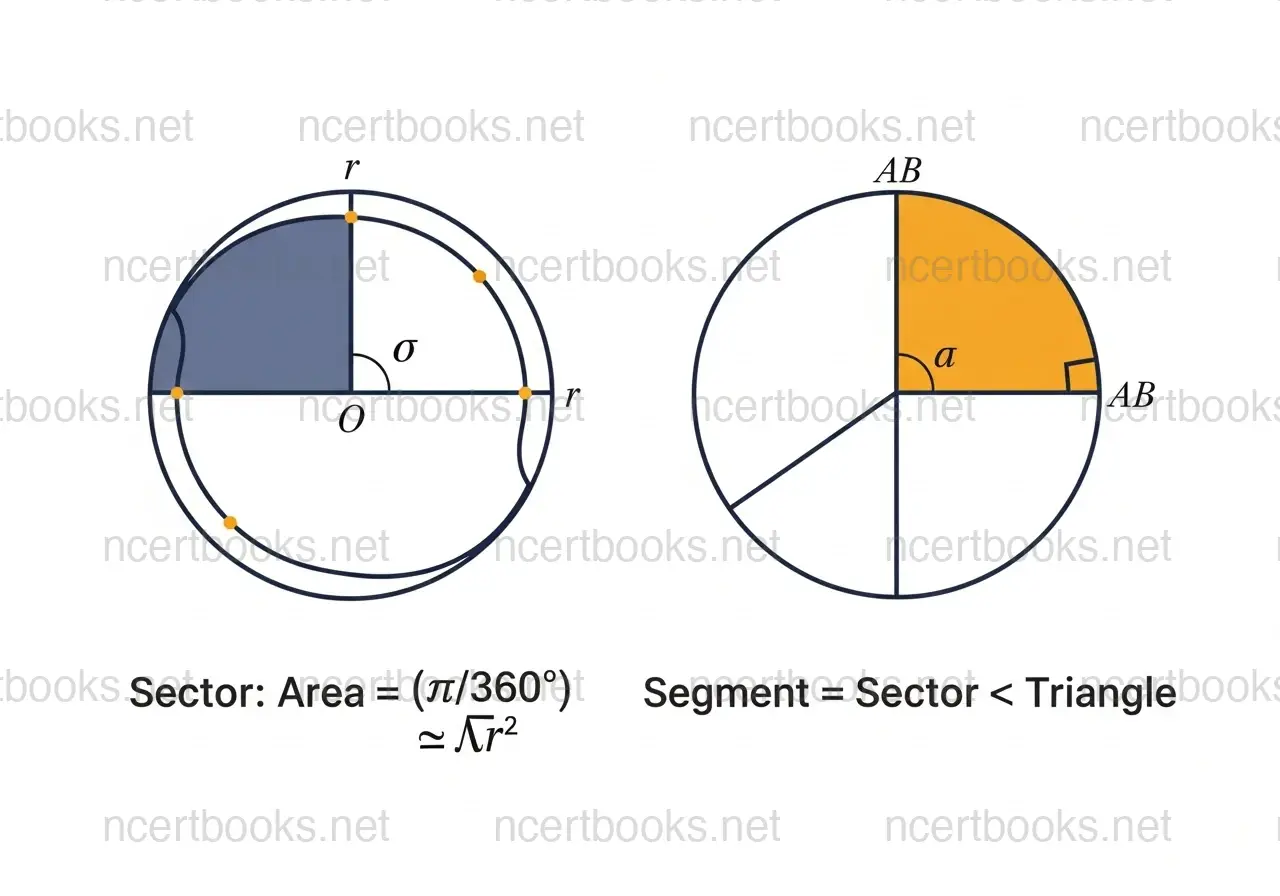
A sector is the region enclosed between two radii of a circle and the arc between them — like a slice of pizza. The angle between the two radii is called the central angle (केंद्रीय कोण). A minor sector has a central angle less than 180°; a major sector has a central angle greater than 180°.
Area of a Sector:
\[ \text{Area of Sector} = \frac{\theta}{360} \times \pi r^2 \]
Length of Arc:
\[ \text{Arc Length} = \frac{\theta}{360} \times 2\pi r \]
What is a Segment? (खंड)
A segment is the region between a chord and the arc it cuts off. The minor segment is the smaller region; the major segment is the larger region. To find the segment area, subtract the triangle area from the sector area.
Area of Minor Segment:
\[ \text{Area of Minor Segment} = \frac{\theta}{360} \times \pi r^2 – \frac{1}{2} r^2 \sin\theta \]
Area of Major Segment:
\[ \text{Area of Major Segment} = \pi r^2 – \text{Area of Minor Segment} \]
Special Cases to Remember
- A quadrant is a sector with \(\theta = 90°\). Its area \( = \frac{1}{4}\pi r^2 \).
- A semicircle is a sector with \(\theta = 180°\). Its area \( = \frac{1}{2}\pi r^2 \).
- When \(\theta = 90°\), the triangle in the segment is a right-angled isosceles triangle with area \( = \frac{1}{2} r^2 \).
- When \(\theta = 60°\) and the two radii are equal, the triangle formed is equilateral with area \( = \frac{\sqrt{3}}{4} r^2 \).
Formula Reference Table — Areas Related to Circles
| Formula Name | Formula | Variables |
|---|---|---|
| Area of Circle | \( \pi r^2 \) | r = radius |
| Circumference of Circle | \( 2\pi r \) | r = radius |
| Area of Sector | \( \frac{\theta}{360} \times \pi r^2 \) | \(\theta\) = central angle (degrees), r = radius |
| Arc Length | \( \frac{\theta}{360} \times 2\pi r \) | \(\theta\) = central angle (degrees), r = radius |
| Area of Minor Segment | \( \frac{\theta}{360} \times \pi r^2 – \frac{1}{2} r^2 \sin\theta \) | \(\theta\) = central angle, r = radius |
| Area of Major Segment | \( \pi r^2 – \text{Area of Minor Segment} \) | r = radius |
| Area of Equilateral Triangle | \( \frac{\sqrt{3}}{4} a^2 \) | a = side length |
NCERT Solutions for Class 10 Maths Chapter 12 Ex 12.2 — All 14 Questions
Below are complete, step-by-step solutions to all 14 questions in Exercise 12.2. Every solution follows the CBSE marking scheme pattern so you know exactly what to write in your board exam.
Question 1
Easy
Find the area of a sector of a circle with radius 6 cm if angle of the sector is 60°.
Key Concept: Area of sector \( = \frac{\theta}{360} \times \pi r^2 \)
Step 1: Identify the given values: radius \( r = 6 \) cm, central angle \( \theta = 60° \).
Step 2: Substitute into the formula:
\[ \text{Area} = \frac{60}{360} \times \frac{22}{7} \times 6^2 \]
Step 3: Simplify step by step:
\[ = \frac{1}{6} \times \frac{22}{7} \times 36 = \frac{1}{6} \times \frac{792}{7} = \frac{792}{42} = \frac{132}{7} \]
\( \therefore \) Area of the sector \( = \frac{132}{7} \approx 18.86 \) cm²
Question 2
Easy
Find the area of a quadrant of a circle whose circumference is 22 cm.
Key Concept: A quadrant is a sector with \(\theta = 90°\). First find r from the circumference.
Step 1: Use circumference formula to find radius:
\[ 2\pi r = 22 \implies r = \frac{22}{2 \times \frac{22}{7}} = \frac{22 \times 7}{44} = \frac{7}{2} \text{ cm} \]
Step 2: Area of quadrant \( = \frac{90}{360} \times \pi r^2 = \frac{1}{4} \times \frac{22}{7} \times \left(\frac{7}{2}\right)^2 \)
Step 3: Calculate:
\[ = \frac{1}{4} \times \frac{22}{7} \times \frac{49}{4} = \frac{1}{4} \times \frac{22 \times 49}{28} = \frac{1}{4} \times \frac{1078}{28} = \frac{1078}{112} = \frac{77}{8} \]
\( \therefore \) Area of the quadrant \( = \frac{77}{8} = 9.625 \) cm²
Question 3
Easy
The length of the minute hand of a clock is 14 cm. Find the area swept by the minute hand in 5 minutes.
Key Concept: The minute hand sweeps 360° in 60 minutes, so in 5 minutes it sweeps \( \frac{360}{60} \times 5 = 30° \).
Step 1: Find the angle swept in 5 minutes:
\[ \theta = \frac{360°}{60} \times 5 = 30° \]
Step 2: The minute hand acts as the radius: \( r = 14 \) cm.
Step 3: Area swept = Area of sector:
\[ \text{Area} = \frac{30}{360} \times \frac{22}{7} \times 14^2 = \frac{1}{12} \times \frac{22}{7} \times 196 \]
\[ = \frac{1}{12} \times \frac{22 \times 196}{7} = \frac{1}{12} \times \frac{4312}{7} = \frac{1}{12} \times 616 = \frac{616}{12} = \frac{154}{3} \]
\( \therefore \) Area swept by the minute hand in 5 minutes \( = \frac{154}{3} \approx 51.33 \) cm²
Question 4
Medium
A chord of a circle of radius 10 cm subtends a right angle at the centre. Find the area of the corresponding: (i) minor segment (ii) major segment. (Use \(\pi = 3.14\))
Step 1: Given: \( r = 10 \) cm, \( \theta = 90° \), \( \pi = 3.14 \).
Step 2: Area of sector (minor):
\[ = \frac{90}{360} \times 3.14 \times 10^2 = \frac{1}{4} \times 3.14 \times 100 = 78.5 \text{ cm}^2 \]
Step 3: Area of right-angled triangle (with both legs = r = 10 cm, since \(\theta = 90°\)):
\[ = \frac{1}{2} \times 10 \times 10 = 50 \text{ cm}^2 \]
Step 4: Area of minor segment:
\[ = 78.5 – 50 = 28.5 \text{ cm}^2 \]
\( \therefore \) Area of minor segment = 28.5 cm²
Step 1: Area of full circle:
\[ = \pi r^2 = 3.14 \times 100 = 314 \text{ cm}^2 \]
Step 2: Area of major segment:
\[ = 314 – 28.5 = 285.5 \text{ cm}^2 \]
\( \therefore \) Area of major segment = 285.5 cm²
Question 5
Medium
In a circle of radius 21 cm, an arc subtends an angle of 60° at the centre. Find: (i) length of the arc. (ii) area of the sector formed by the arc. (iii) area of the segment formed by the corresponding chord.
Step 1: Given \( r = 21 \) cm, \( \theta = 60° \).
Step 2: Arc length formula:
\[ l = \frac{\theta}{360} \times 2\pi r = \frac{60}{360} \times 2 \times \frac{22}{7} \times 21 = \frac{1}{6} \times 2 \times \frac{22}{7} \times 21 \]
\[ = \frac{1}{6} \times \frac{924}{7} = \frac{1}{6} \times 132 = 22 \text{ cm} \]
\( \therefore \) Length of arc = 22 cm
Step 1: Area of sector:
\[ = \frac{\theta}{360} \times \pi r^2 = \frac{60}{360} \times \frac{22}{7} \times 21^2 = \frac{1}{6} \times \frac{22}{7} \times 441 \]
\[ = \frac{1}{6} \times \frac{9702}{7} = \frac{1}{6} \times 1386 = 231 \text{ cm}^2 \]
\( \therefore \) Area of sector = 231 cm²
Key Concept: When \(\theta = 60°\) and both sides are equal to r, the triangle OAB is equilateral with side = 21 cm.
Step 1: Area of equilateral triangle with side 21 cm:
\[ = \frac{\sqrt{3}}{4} \times 21^2 = \frac{\sqrt{3}}{4} \times 441 = \frac{441\sqrt{3}}{4} \text{ cm}^2 \]
Step 2: Area of segment = Area of sector − Area of triangle:
\[ = 231 – \frac{441\sqrt{3}}{4} = 231 – \frac{441 \times 1.732}{4} \approx 231 – \frac{763.81}{4} \approx 231 – 190.95 \approx 40.05 \text{ cm}^2 \]
Why is the triangle equilateral? When the central angle is 60° and both radii are equal (r = 21 cm), all three sides of triangle OAB equal 21 cm, making it equilateral.
\( \therefore \) Area of segment \( = \left(231 – \frac{441\sqrt{3}}{4}\right) \approx 40.05 \) cm²
Question 6
Medium
A chord of a circle of radius 15 cm subtends an angle of 60° at the centre. Find the areas of the corresponding minor and major segments of the circle. (Use \(\pi = 3.14\) and \(\sqrt{3} = 1.73\))
Step 1: Given \( r = 15 \) cm, \( \theta = 60° \). Since \(\theta = 60°\), the triangle is equilateral with side = 15 cm.
Step 2: Area of sector:
\[ = \frac{60}{360} \times 3.14 \times 15^2 = \frac{1}{6} \times 3.14 \times 225 = \frac{706.5}{6} = 117.75 \text{ cm}^2 \]
Step 3: Area of equilateral triangle (side = 15 cm):
\[ = \frac{\sqrt{3}}{4} \times 15^2 = \frac{1.73}{4} \times 225 = \frac{389.25}{4} = 97.3125 \text{ cm}^2 \]
Step 4: Area of minor segment:
\[ = 117.75 – 97.3125 = 20.4375 \approx 20.44 \text{ cm}^2 \]
\( \therefore \) Area of minor segment ≈ 20.44 cm²
Step 1: Area of full circle:
\[ = 3.14 \times 15^2 = 3.14 \times 225 = 706.5 \text{ cm}^2 \]
Step 2: Area of major segment:
\[ = 706.5 – 20.44 = 686.06 \text{ cm}^2 \]
\( \therefore \) Area of major segment ≈ 686.06 cm²
Question 7
Hard
A chord of a circle of radius 12 cm subtends an angle of 120° at the centre. Find the area of the corresponding segment of the circle. (Use \(\pi = 3.14\) and \(\sqrt{3} = 1.73\))
Step 1: Given \( r = 12 \) cm, \( \theta = 120° \).
Step 2: Area of sector:
\[ = \frac{120}{360} \times 3.14 \times 12^2 = \frac{1}{3} \times 3.14 \times 144 = \frac{452.16}{3} = 150.72 \text{ cm}^2 \]
Step 3: For the triangle with \(\theta = 120°\), draw perpendicular OM from centre O to chord AB. Then \( \angle AOM = 60° \).
In triangle OAM: \( OM = r\cos 60° = 12 \times \frac{1}{2} = 6 \) cm and \( AM = r\sin 60° = 12 \times \frac{\sqrt{3}}{2} = 6\sqrt{3} \) cm.
So \( AB = 2 \times AM = 12\sqrt{3} \) cm.
Step 4: Area of triangle OAB:
\[ = \frac{1}{2} \times AB \times OM = \frac{1}{2} \times 12\sqrt{3} \times 6 = 36\sqrt{3} = 36 \times 1.73 = 62.28 \text{ cm}^2 \]
Step 5: Area of segment:
\[ = 150.72 – 62.28 = 88.44 \text{ cm}^2 \]
\( \therefore \) Area of the segment = 88.44 cm²
Question 8
Medium
A horse is tied to a peg at one corner of a square shaped grass field of side 15 m by means of a 5 m long rope. Find: (i) the area of that part of the field in which the horse can graze. (ii) the increase in the grazing area if the rope were 10 m long instead of 5 m. (Use \(\pi = 3.14\))
Key Concept: The horse is at a corner of a square, so the angle available to it is 90° (the interior angle of the square). It sweeps a quarter circle of radius 5 m.
Step 1: Area grazed = area of sector with \( r = 5 \) m, \( \theta = 90° \):
\[ = \frac{90}{360} \times 3.14 \times 5^2 = \frac{1}{4} \times 3.14 \times 25 = \frac{78.5}{4} = 19.625 \text{ m}^2 \]
\( \therefore \) Grazing area = 19.625 m²
Step 1: With a 10 m rope, the horse sweeps a quarter circle of radius 10 m:
\[ \text{New area} = \frac{1}{4} \times 3.14 \times 10^2 = \frac{1}{4} \times 314 = 78.5 \text{ m}^2 \]
Step 2: Increase in grazing area:
\[ = 78.5 – 19.625 = 58.875 \text{ m}^2 \]
\( \therefore \) Increase in grazing area = 58.875 m²
Question 9
Medium
A brooch is made with silver wire in the form of a circle with diameter 35 mm. The wire is also used in making 5 diameters which divide the circle into 10 equal sectors. Find: (i) the total length of the silver wire required. (ii) the area of each sector of the brooch.
Step 1: Diameter = 35 mm, so radius \( r = 17.5 \) mm.
Step 2: Circumference of circle:
\[ = 2\pi r = 2 \times \frac{22}{7} \times 17.5 = \frac{2 \times 22 \times 17.5}{7} = \frac{770}{7} = 110 \text{ mm} \]
Step 3: Length of 5 diameters \( = 5 \times 35 = 175 \) mm.
Step 4: Total wire \( = 110 + 175 = 285 \) mm.
\( \therefore \) Total length of silver wire = 285 mm
Step 1: 5 diameters divide the circle into 10 equal sectors, so each sector has angle \( = \frac{360°}{10} = 36° \).
Step 2: Area of each sector:
\[ = \frac{36}{360} \times \frac{22}{7} \times (17.5)^2 = \frac{1}{10} \times \frac{22}{7} \times 306.25 \]
\[ = \frac{1}{10} \times \frac{6737.5}{7} = \frac{1}{10} \times 962.5 = 96.25 \text{ mm}^2 \]
\( \therefore \) Area of each sector = 96.25 mm²
Question 10
Easy
An umbrella has 8 ribs which are equally spaced. Assuming the umbrella to be a flat circle of radius 45 cm, find the area between the two consecutive ribs of the umbrella.
Step 1: 8 equally spaced ribs divide the circle into 8 equal sectors. Angle of each sector:
\[ \theta = \frac{360°}{8} = 45° \]
Step 2: Area of each sector (area between two consecutive ribs):
\[ = \frac{45}{360} \times \frac{22}{7} \times 45^2 = \frac{1}{8} \times \frac{22}{7} \times 2025 \]
\[ = \frac{1}{8} \times \frac{44550}{7} = \frac{44550}{56} = \frac{6364.28…}{8} = \frac{22275}{28} \approx 795.54 \text{ cm}^2 \]
Exact value: \( \frac{22275}{28} \) cm²
\( \therefore \) Area between two consecutive ribs \( = \frac{22275}{28} \approx 795.54 \) cm²
Question 11
Medium
A car has two wipers which do not overlap. Each wiper has a blade of length 25 cm sweeping through an angle of 115°. Find the total area cleaned at each sweep of the blades.
Step 1: Each wiper sweeps a sector of radius \( r = 25 \) cm and angle \( \theta = 115° \).
Step 2: Area cleaned by one wiper:
\[ = \frac{115}{360} \times \frac{22}{7} \times 25^2 = \frac{115}{360} \times \frac{22}{7} \times 625 \]
\[ = \frac{115 \times 22 \times 625}{360 \times 7} = \frac{1581250}{2520} = \frac{158125}{252} \]
Step 3: Total area cleaned by two wipers (they do not overlap):
\[ = 2 \times \frac{158125}{252} = \frac{316250}{252} = \frac{158125}{126} \approx 1254.96 \text{ cm}^2 \]
Simplified exact value: \( \frac{158125}{126} \) cm²
\( \therefore \) Total area cleaned \( = \frac{158125}{126} \approx 1254.96 \) cm²
Question 12
Easy
To warn ships for underwater rocks, a lighthouse spreads a red coloured light over a sector of angle 80° to a distance of 16.5 km. Find the area of the sea over which the ships are warned. (Use \(\pi = 3.14\))
Step 1: Given \( \theta = 80° \), \( r = 16.5 \) km, \( \pi = 3.14 \).
Step 2: Area of the sector (sea area warned):
\[ = \frac{80}{360} \times 3.14 \times (16.5)^2 \]
\[ = \frac{2}{9} \times 3.14 \times 272.25 \]
\[ = \frac{2}{9} \times 854.865 = \frac{1709.73}{9} = 189.97 \text{ km}^2 \]
\( \therefore \) Area of sea over which ships are warned ≈ 189.97 km²
Question 13
Hard
A round table cover has six equal designs as shown in the figure. If the radius of the cover is 28 cm, find the cost of making the designs at the rate of ₹0.35 per cm². (Use \(\sqrt{3} = 1.7\))
Key Concept: Six equal designs means the circle is divided into 6 equal sectors. Each design is the segment of one sector. The central angle for each sector \( = \frac{360°}{6} = 60° \).
Step 1: Area of one sector (\( r = 28 \) cm, \( \theta = 60° \)):
\[ = \frac{60}{360} \times \frac{22}{7} \times 28^2 = \frac{1}{6} \times \frac{22}{7} \times 784 = \frac{1}{6} \times \frac{17248}{7} = \frac{1}{6} \times 2464 = \frac{2464}{6} = \frac{1232}{3} \text{ cm}^2 \]
Step 2: Since \(\theta = 60°\), the triangle formed is equilateral with side = 28 cm. Area of equilateral triangle:
\[ = \frac{\sqrt{3}}{4} \times 28^2 = \frac{1.7}{4} \times 784 = \frac{1332.8}{4} = 333.2 \text{ cm}^2 \]
Step 3: Area of one segment (one design):
\[ = \frac{1232}{3} – 333.2 = 410.67 – 333.2 = 77.47 \text{ cm}^2 \]
Step 4: Total area of 6 designs:
\[ = 6 \times 77.47 = 464.82 \text{ cm}^2 \]
Step 5: Cost of making designs:
\[ = 464.82 \times 0.35 = ₹162.69 \]
\( \therefore \) Cost of making the designs ≈ ₹162.69
Question 14
Easy
Tick the correct answer in the following: Area of a sector of angle p (in degrees) of a circle with radius R is:
(A) \( \frac{p}{180} \times 2\pi R \) (B) \( \frac{p}{180} \times \pi R^2 \) (C) \( \frac{p}{360} \times 2\pi R \) (D) \( \frac{p}{720} \times 2\pi R^2 \)
Key Concept: The standard formula for area of a sector is \( \frac{\theta}{360} \times \pi R^2 \).
Analysis of Option (D):
\[ \frac{p}{720} \times 2\pi R^2 = \frac{2p\pi R^2}{720} = \frac{p\pi R^2}{360} = \frac{p}{360} \times \pi R^2 \]
This matches the standard formula exactly.
Why other options are wrong:
- Option (A) and (C) give arc length (with \(2\pi R\)), not area.
- Option (B) uses 180 instead of 360 in the denominator, which is incorrect.
\( \therefore \) Correct Answer: (D) \( \frac{p}{720} \times 2\pi R^2 \)
Solved Examples Beyond NCERT — Areas Related to Circles
Extra Example 1 — Sector with Perimeter Given
Medium
The perimeter of a sector of a circle with radius 7 cm is 30 cm. Find the area of the sector.
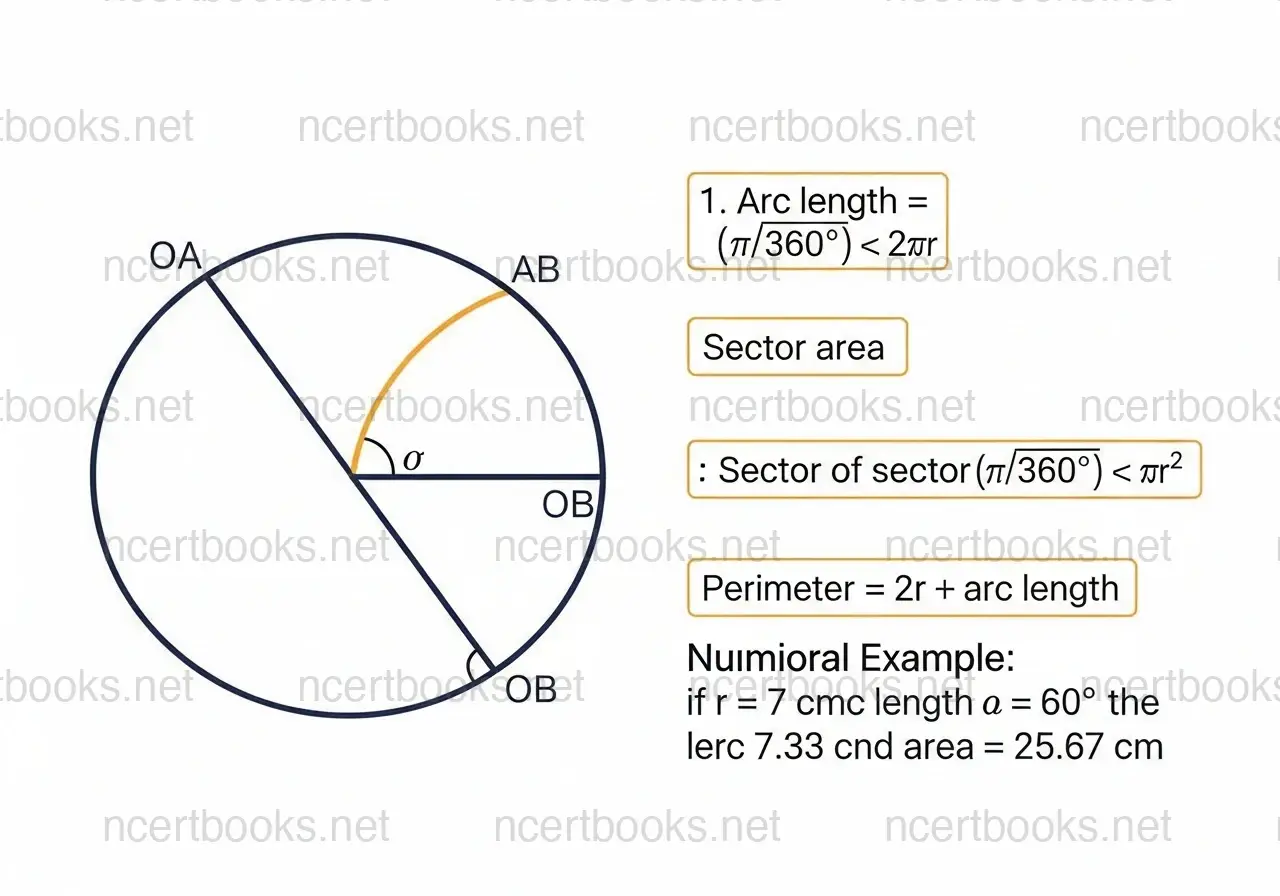
Step 1: Perimeter of sector = 2r + arc length. So arc length \( = 30 – 2 \times 7 = 16 \) cm.
Step 2: Area of sector \( = \frac{1}{2} \times r \times l = \frac{1}{2} \times 7 \times 16 = 56 \) cm².
\( \therefore \) Area of sector = 56 cm²
Extra Example 2 — Segment Area with 90° Angle
Medium
Find the area of the minor segment of a circle of radius 14 cm, when the angle of the corresponding sector is 90°. (Use \(\pi = \frac{22}{7}\))
Step 1: Area of sector: \( \frac{90}{360} \times \frac{22}{7} \times 196 = \frac{1}{4} \times \frac{22 \times 196}{7} = \frac{1}{4} \times 616 = 154 \) cm².
Step 2: Area of right-angled triangle: \( \frac{1}{2} \times 14 \times 14 = 98 \) cm².
Step 3: Area of segment \( = 154 – 98 = 56 \) cm².
\( \therefore \) Area of minor segment = 56 cm²
Extra Example 3 — Real-Life Application (Sprinkler)
Hard
A sprinkler covers a sector of angle 120° up to a distance of 6 m. Find the area irrigated. (Use \(\pi = 3.14\))
Step 1: Area \( = \frac{120}{360} \times 3.14 \times 6^2 = \frac{1}{3} \times 3.14 \times 36 = \frac{113.04}{3} = 37.68 \) m².
\( \therefore \) Area irrigated = 37.68 m²
Important Questions for CBSE Board Exam — Chapter 12 Areas Related to Circles
1-Mark Questions
- Q: What is the formula for the area of a sector? A: \( \frac{\theta}{360} \times \pi r^2 \)
- Q: What fraction of a circle’s area is a quadrant? A: \( \frac{1}{4} \)
- Q: If a sector has angle 180°, what shape does it form? A: A semicircle.
3-Mark Questions
- Q: Find the area of the sector of a circle with radius 4 cm and angle 90°. Show full working.
A: Area \( = \frac{90}{360} \times \frac{22}{7} \times 16 = \frac{1}{4} \times \frac{352}{7} = \frac{88}{7} \approx 12.57 \) cm². - Q: A chord of a circle of radius 7 cm subtends 60° at the centre. Find the area of the minor segment.
A: Sector area \( = \frac{60}{360} \times \frac{22}{7} \times 49 = \frac{1}{6} \times 154 = \frac{77}{3} \) cm². Triangle area (equilateral, side 7) \( = \frac{\sqrt{3}}{4} \times 49 \approx 21.22 \) cm². Segment \( \approx \frac{77}{3} – 21.22 \approx 25.67 – 21.22 = 4.45 \) cm².
5-Mark Questions
- Q: In a circle of radius 21 cm, a chord subtends 120° at the centre. Find the area of (i) the minor sector, (ii) the minor segment, (iii) the major segment. (Use \(\pi = \frac{22}{7}\), \(\sqrt{3} = 1.73\))
A: (i) Minor sector \( = \frac{120}{360} \times \frac{22}{7} \times 441 = 462 \) cm². (ii) Triangle area \( = \frac{1}{2} \times 21^2 \times \sin 120° = \frac{1}{2} \times 441 \times \frac{\sqrt{3}}{2} = \frac{441 \times 1.73}{4} \approx 190.67 \) cm². Minor segment \( \approx 462 – 190.67 = 271.33 \) cm². (iii) Circle area \( = \frac{22}{7} \times 441 = 1386 \) cm². Major segment \( = 1386 – 271.33 = 1114.67 \) cm².
Common Mistakes Students Make — Chapter 12 Ex 12.2
Mistake 1: Using the wrong value of \(\pi\).
Why it’s wrong: Some questions specify \(\pi = 3.14\) while others expect \(\pi = \frac{22}{7}\). Using the wrong value loses marks.
Correct approach: Always read the question carefully. Use \(\pi = \frac{22}{7}\) by default unless the question specifies \(\pi = 3.14\).
Mistake 2: Forgetting to subtract the triangle area when finding segment area.
Why it’s wrong: Area of segment ≠ Area of sector. Students often write sector area as the final answer for segment questions.
Correct approach: Area of segment = Area of sector − Area of triangle formed by the chord and the two radii.
Mistake 3: Not identifying the triangle type correctly for \(\theta = 60°\).
Why it’s wrong: When \(\theta = 60°\) and both sides are equal to r, the triangle is equilateral — students sometimes treat it as a general triangle and use a wrong formula.
Correct approach: For \(\theta = 60°\), use area of equilateral triangle \( = \frac{\sqrt{3}}{4} r^2 \).
Mistake 4: Wrong angle for the horse/grazing problems.
Why it’s wrong: Students use 360° or 180° instead of 90° for the corner angle of a square.
Correct approach: The interior angle of a square is 90°. The horse at a corner can only graze a quarter circle (90° sector).
Mistake 5: Forgetting to multiply by 2 for two wipers in Question 11.
Why it’s wrong: The question asks for total area cleaned by both wipers, not just one.
Correct approach: Since the wipers do not overlap, total area = 2 × area of one wiper’s sector.
Exam Tips for 2026-27 CBSE Board — Chapter 12 Areas Related to Circles
- Show all steps: In the 2026-27 CBSE marking scheme, method marks are awarded for each step. Even if your final answer is slightly off due to rounding, you earn marks for correct working.
- Formula first: Always write the formula before substituting values. CBSE examiners award 1 mark specifically for writing the correct formula.
- Units matter: Write cm² for area, cm for length. Missing units can cost you half a mark in board exams.
- MCQ strategy: For Question 14-type MCQs, verify your answer by simplifying all options to the standard form \( \frac{\theta}{360} \times \pi R^2 \).
- Segment vs Sector: Draw a quick sketch to identify whether the shaded region is a sector or segment. This avoids the most common error in this chapter.
- Chapter weightage: Mensuration (Chapters 12 and 13 combined) typically carries 10–12 marks in the CBSE Class 10 board paper. Mastering Exercise 12.2 gives you a strong advantage.
- Last-minute checklist: Memorise the 7 formulas in the reference table above. Practise Questions 5, 7, and 13 — they are the most frequently asked in past board papers.