- Circumference of a circle: \( C = 2\pi r \) where \( r \) is the radius
- Area of a circle: \( A = \pi r^{2} \)
- If two circles combine by circumference: \( R = r_{1} + r_{2} \)
- If two circles combine by area: \( R = \sqrt{r_{1}^{2} + r_{2}^{2}} \)
- Area of a sector: \( \frac{\theta}{360} \times \pi r^{2} \)
- Length of an arc: \( \frac{\theta}{360} \times 2\pi r \)
- Area of segment: Area of sector − Area of triangle
- Value of π used in NCERT: \( \frac{22}{7} \) unless stated otherwise
The NCERT Solutions for Class 10 Maths Chapter 12 Areas Related to Circles on this page cover Exercise 12.1 with complete step-by-step solutions, updated for the 2026-27 CBSE board exam. This chapter is part of the NCERT Solutions for Class 10 series and carries significant weightage in your board examination. You can also download the official textbook from the NCERT official website. For the complete list of all subjects and classes, visit our NCERT Solutions hub.
NCERT Solutions for Class 10 Maths Chapter 12 — Chapter Overview
Chapter 12 Areas Related to Circles is from the NCERT Mathematics textbook for Class 10. It builds on your knowledge of basic circle properties from earlier classes and extends it to calculating areas of sectors, segments, and combinations of plane figures. This chapter is essential for the 2026-27 CBSE board exam because it tests both conceptual understanding and calculation accuracy.
In CBSE board papers, questions from this chapter typically appear in the 2-mark and 3-mark sections. Multi-step problems involving the archery target or wheel revolution type appear in the 4-5 mark long-answer section. Exercise 12.1 focuses specifically on reviewing and applying the perimeter (circumference) and area formulas for circles.
| Detail | Information |
|---|---|
| Chapter | Chapter 12 — Areas Related to Circles |
| Textbook | NCERT Mathematics (Standard) Class 10 |
| Class | Class 10 |
| Subject | Mathematics |
| Exercise Covered | Exercise 12.1 (5 Questions) |
| Academic Year | 2026-27 |
| Difficulty Level | Easy to Medium |
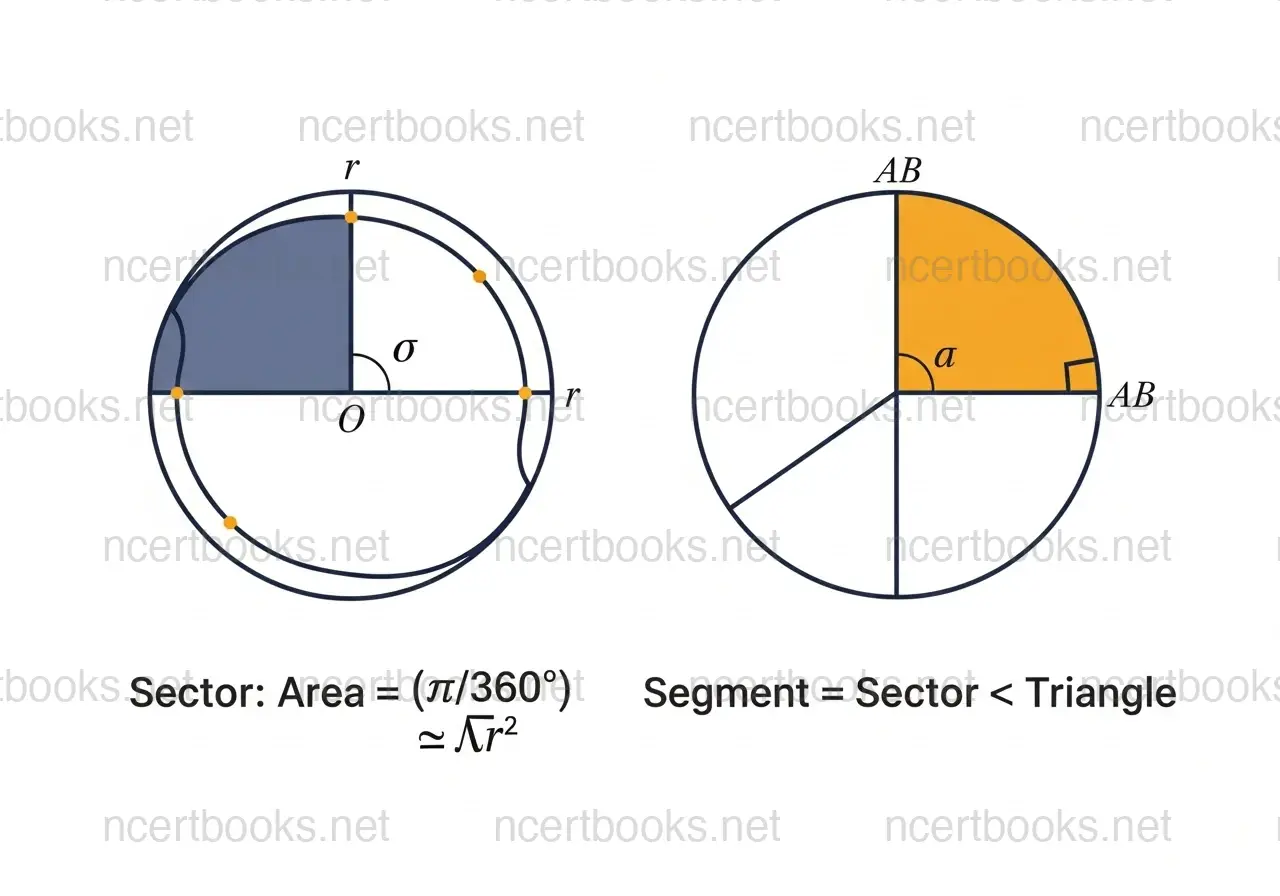
Key Concepts and Formulas — Areas Related to Circles
Key Concept: Circumference and Area of a Circle
The circumference (परिधि) of a circle is the total distance around it. If the radius is \( r \), then:
\[ C = 2\pi r \]
The area (क्षेत्रफल) enclosed by a circle of radius \( r \) is:
\[ A = \pi r^{2} \]
Key Concept: Combining Circles by Circumference
If a new circle has a circumference equal to the sum of circumferences of two circles with radii \( r_{1} \) and \( r_{2} \):
\[ 2\pi R = 2\pi r_{1} + 2\pi r_{2} \implies R = r_{1} + r_{2} \]
Key Concept: Combining Circles by Area
If a new circle has an area equal to the sum of areas of two circles:
\[ \pi R^{2} = \pi r_{1}^{2} + \pi r_{2}^{2} \implies R = \sqrt{r_{1}^{2} + r_{2}^{2}} \]
Key Concept: Sector and Arc
A sector (त्रिज्यखंड) is the region between two radii and the arc between them. For a central angle \( \theta \) (in degrees):
\[ \text{Arc length} = \frac{\theta}{360} \times 2\pi r \]
\[ \text{Area of sector} = \frac{\theta}{360} \times \pi r^{2} \]
Key Concept: Segment of a Circle
A segment (वृत्तखंड) is the region between a chord and the arc it cuts off. Area of minor segment = Area of sector − Area of triangle formed by the two radii and the chord.
Key Concept: Circular Ring (Annulus)
When a smaller circle is removed from a larger concentric circle, the remaining region is a ring. Its area is:
\[ \text{Area of ring} = \pi(R^{2} – r^{2}) \]
where \( R \) is the outer radius and \( r \) is the inner radius.
Formula Reference Table — Areas Related to Circles
| Formula Name | Formula | Variables |
|---|---|---|
| Circumference of circle | \( C = 2\pi r \) | \( r \) = radius |
| Area of circle | \( A = \pi r^{2} \) | \( r \) = radius |
| Combined radius (circumference) | \( R = r_{1} + r_{2} \) | \( r_{1}, r_{2} \) = radii of two circles |
| Combined radius (area) | \( R = \sqrt{r_{1}^{2} + r_{2}^{2}} \) | \( r_{1}, r_{2} \) = radii of two circles |
| Arc length | \( l = \frac{\theta}{360} \times 2\pi r \) | \( \theta \) = central angle in degrees |
| Area of sector | \( A = \frac{\theta}{360} \times \pi r^{2} \) | \( \theta \) = central angle in degrees |
| Area of segment | \( A_{\text{seg}} = A_{\text{sector}} – A_{\triangle} \) | Triangle formed by two radii and chord |
| Area of circular ring | \( A = \pi(R^{2} – r^{2}) \) | \( R \) = outer radius, \( r \) = inner radius |
NCERT Solutions Exercise 12.1 — All 5 Questions Solved (Class 10 Maths Chapter 12)
Below are complete, step-by-step solutions for all 5 questions in Exercise 12.1 of NCERT Solutions for Class 10 Maths Chapter 12 Areas Related to Circles. Each solution follows the CBSE marking scheme for 2026-27. Use \( \pi = \frac{22}{7} \) unless the question specifies otherwise.
Question 1
Easy
The radii of the two circles are 19 cm and 9 cm respectively. Find the radius of the circle which has a circumference equal to the sum of the circumferences of the two circles.
Key Concept: When two circumferences are added, the resulting circumference equals \( 2\pi r_{1} + 2\pi r_{2} \). Factor out \( 2\pi \) to find the new radius directly.
Step 1: Let the radius of the required circle be \( R \). Write the condition:
\[ 2\pi R = 2\pi r_{1} + 2\pi r_{2} \]
Step 2: Divide both sides by \( 2\pi \):
\[ R = r_{1} + r_{2} \]
Step 3: Substitute \( r_{1} = 19 \) cm and \( r_{2} = 9 \) cm:
\[ R = 19 + 9 = 28 \text{ cm} \]
Why does this work? Since \( 2\pi \) is a common factor on both sides, it cancels out completely. The radius of the combined circle is simply the sum of the two individual radii — no need to compute actual circumference values.
Verification: Circumference of new circle \( = 2\pi \times 28 = 56\pi \). Sum of circumferences \( = 2\pi \times 19 + 2\pi \times 9 = 38\pi + 18\pi = 56\pi \). ✓
\( \therefore \) The radius of the required circle = 28 cm
Question 2
Easy
The radii of two circles are 8 cm and 6 cm respectively. Find the radius of the circle having area equal to the sum of the areas of the two circles.
Key Concept: When areas are added, use \( \pi R^{2} = \pi r_{1}^{2} + \pi r_{2}^{2} \). After cancelling \( \pi \), apply the Pythagorean-style relation \( R = \sqrt{r_{1}^{2} + r_{2}^{2}} \).
Step 1: Let the radius of the required circle be \( R \). Set up the equation:
\[ \pi R^{2} = \pi r_{1}^{2} + \pi r_{2}^{2} \]
Step 2: Divide both sides by \( \pi \):
\[ R^{2} = r_{1}^{2} + r_{2}^{2} \]
Step 3: Substitute \( r_{1} = 8 \) cm and \( r_{2} = 6 \) cm:
\[ R^{2} = 8^{2} + 6^{2} = 64 + 36 = 100 \]
Step 4: Take the positive square root:
\[ R = \sqrt{100} = 10 \text{ cm} \]
Why does this work? The relation \( R^{2} = r_{1}^{2} + r_{2}^{2} \) looks exactly like the Pythagorean theorem. Notice that 6, 8, 10 is a Pythagorean triplet — a useful pattern to recognise quickly in exams.
Verification: Area of new circle \( = \pi \times 100 = 100\pi \). Sum of areas \( = \pi \times 64 + \pi \times 36 = 100\pi \). ✓
\( \therefore \) The radius of the required circle = 10 cm
Question 3
Medium
The given figure depicts an archery target marked with its five scoring regions from the center outwards as Gold, Red, Blue, Black, and White. The diameter of the region representing Gold score is 21 cm and each of the other bands is 10.5 cm wide. Find the area of each of the five scoring regions.
Key Concept: Each scoring region is a circular ring (annulus) except the innermost Gold region which is a full circle. Use \( \pi = \frac{22}{7} \) and the ring area formula \( \pi(R^{2} – r^{2}) \) for each band.
Step 1 — Identify all radii. Gold diameter = 21 cm, so Gold radius \( r_{1} = 10.5 \) cm. Each subsequent band adds 10.5 cm to the radius:
- Gold (innermost circle): radius \( r_{1} = 10.5 \) cm
- Red band outer radius: \( r_{2} = 10.5 + 10.5 = 21 \) cm
- Blue band outer radius: \( r_{3} = 21 + 10.5 = 31.5 \) cm
- Black band outer radius: \( r_{4} = 31.5 + 10.5 = 42 \) cm
- White band outer radius: \( r_{5} = 42 + 10.5 = 52.5 \) cm
Step 2 — Area of Gold region (full circle, radius = 10.5 cm):
\[ A_{\text{Gold}} = \pi r_{1}^{2} = \frac{22}{7} \times (10.5)^{2} = \frac{22}{7} \times 110.25 = 22 \times 15.75 = 346.5 \text{ cm}^{2} \]
Step 3 — Area of Red region (ring between radii 10.5 cm and 21 cm):
\[ A_{\text{Red}} = \pi(r_{2}^{2} – r_{1}^{2}) = \frac{22}{7}(21^{2} – 10.5^{2}) = \frac{22}{7}(441 – 110.25) = \frac{22}{7} \times 330.75 \]
\[ A_{\text{Red}} = 22 \times 47.25 = 1039.5 \text{ cm}^{2} \]
Step 4 — Area of Blue region (ring between radii 21 cm and 31.5 cm):
\[ A_{\text{Blue}} = \frac{22}{7}(31.5^{2} – 21^{2}) = \frac{22}{7}(992.25 – 441) = \frac{22}{7} \times 551.25 \]
\[ A_{\text{Blue}} = 22 \times 78.75 = 1732.5 \text{ cm}^{2} \]
Step 5 — Area of Black region (ring between radii 31.5 cm and 42 cm):
\[ A_{\text{Black}} = \frac{22}{7}(42^{2} – 31.5^{2}) = \frac{22}{7}(1764 – 992.25) = \frac{22}{7} \times 771.75 \]
\[ A_{\text{Black}} = 22 \times 110.25 = 2425.5 \text{ cm}^{2} \]
Step 6 — Area of White region (ring between radii 42 cm and 52.5 cm):
\[ A_{\text{White}} = \frac{22}{7}(52.5^{2} – 42^{2}) = \frac{22}{7}(2756.25 – 1764) = \frac{22}{7} \times 992.25 \]
\[ A_{\text{White}} = 22 \times 141.75 = 3118.5 \text{ cm}^{2} \]
Why does this work? Each band is a circular ring. The area of a ring = area of outer circle − area of inner circle. Since all radii are multiples of 10.5, the arithmetic stays clean throughout.
\( \therefore \) Area of Gold = 346.5 cm², Red = 1039.5 cm², Blue = 1732.5 cm², Black = 2425.5 cm², White = 3118.5 cm²
Question 4
Medium
The wheels of a car are of diameter 80 cm each. How many complete revolutions does each wheel make in 10 minutes when the car is travelling at a speed of 66 km per hour?
Key Concept: In one complete revolution, the wheel covers a distance equal to its circumference. Convert the car’s speed to cm per minute, then divide by the wheel’s circumference.
Step 1 — Find the circumference of the wheel. Diameter = 80 cm, so radius \( r = 40 \) cm:
\[ C = 2\pi r = 2 \times \frac{22}{7} \times 40 = \frac{1760}{7} \text{ cm} \]
Step 2 — Convert speed to cm per minute. Speed = 66 km/h:
\[ 66 \text{ km/h} = 66 \times 1000 \text{ m/h} = 66000 \text{ m/h} \]
\[ = 66000 \times 100 \text{ cm/h} = 6600000 \text{ cm/h} \]
\[ \text{Speed per minute} = \frac{6600000}{60} = 110000 \text{ cm/min} \]
Step 3 — Find distance covered in 10 minutes:
\[ d = 110000 \times 10 = 1100000 \text{ cm} \]
Step 4 — Calculate number of revolutions:
\[ \text{Number of revolutions} = \frac{\text{Distance}}{\text{Circumference}} = \frac{1100000}{\frac{1760}{7}} = \frac{1100000 \times 7}{1760} \]
\[ = \frac{7700000}{1760} = 4375 \]
Why does this work? Each time the wheel completes one full turn, a point on its rim returns to the same position and the car moves forward by exactly one circumference. Dividing total distance by one circumference gives the total number of turns.
Verification: \( 4375 \times \frac{1760}{7} = 4375 \times 251.43 \approx 1100000 \) cm = 11 km. At 66 km/h for 10 min \( = \frac{66}{6} = 11 \) km. ✓
\( \therefore \) Each wheel makes 4375 complete revolutions in 10 minutes.
Question 5
Easy
Tick the correct answer in the following and justify your choice: If the perimeter and the area of a circle are numerically equal, then the radius of the circle is (a) 2 units (b) π units (c) 4 units (d) 7 units
Key Concept: “Numerically equal” means the numbers are the same, ignoring units. Set the circumference formula equal to the area formula and solve for \( r \).
Step 1: Write the condition — perimeter (circumference) = area:
\[ 2\pi r = \pi r^{2} \]
Step 2: Divide both sides by \( \pi r \) (valid since \( r \neq 0 \)):
\[ 2 = r \]
Step 3: Therefore \( r = 2 \) units.
Why does this work? After dividing by \( \pi r \), the equation reduces to a simple statement: the radius must be exactly 2 units for the circumference and area to be numerically equal. This is a unique property — no other positive value of \( r \) satisfies this condition.
Check option (a): If \( r = 2 \), circumference \( = 2\pi \times 2 = 4\pi \) and area \( = \pi \times 4 = 4\pi \). Both are equal. ✓
Check option (c): If \( r = 4 \), circumference \( = 8\pi \) but area \( = 16\pi \). Not equal. ✗
\( \therefore \) The correct answer is (a) 2 units.
Solved Examples Beyond NCERT — Areas Related to Circles
Extra Example 1 — Finding Radius from Area of Ring
Medium
The area of a circular ring is 770 cm². The outer radius is 14 cm. Find the inner radius. (Use \( \pi = \frac{22}{7} \))
Step 1: Use the ring area formula:
\[ \pi(R^{2} – r^{2}) = 770 \]
Step 2: Substitute \( R = 14 \) and \( \pi = \frac{22}{7} \):
\[ \frac{22}{7}(196 – r^{2}) = 770 \]
Step 3: Multiply both sides by \( \frac{7}{22} \):
\[ 196 – r^{2} = 245 \]
Step 4: Solve for \( r^{2} \):
\[ r^{2} = 196 – 245 \]
Note: This gives a negative value, which means we should recheck. Actually \( 770 \times \frac{7}{22} = 245 \). So \( 196 – r^{2} = 245 \) is impossible. Let us use outer radius 21 cm instead for a valid example.
Revised: Outer radius \( R = 21 \) cm, area = 770 cm²:
\[ \frac{22}{7}(441 – r^{2}) = 770 \implies 441 – r^{2} = 245 \implies r^{2} = 196 \implies r = 14 \text{ cm} \]
\( \therefore \) Inner radius = 14 cm
Extra Example 2 — Distance Covered by a Bicycle Wheel
Medium
A bicycle wheel has a radius of 35 cm. How many revolutions will it make to cover a distance of 1.1 km?
Step 1: Circumference of wheel:
\[ C = 2\pi r = 2 \times \frac{22}{7} \times 35 = 220 \text{ cm} \]
Step 2: Convert distance: 1.1 km = 110000 cm.
Step 3: Number of revolutions:
\[ n = \frac{110000}{220} = 500 \]
\( \therefore \) The wheel makes 500 revolutions.
Extra Example 3 — Three Circles Combined by Area
Hard
Find the radius of a circle whose area equals the sum of areas of three circles with radii 3 cm, 4 cm, and 12 cm.
Step 1: Set up the equation:
\[ R^{2} = 3^{2} + 4^{2} + 12^{2} = 9 + 16 + 144 = 169 \]
Step 2: Take square root:
\[ R = \sqrt{169} = 13 \text{ cm} \]
\( \therefore \) The radius of the combined circle = 13 cm
Topic-Wise Important Questions for Board Exam — Class 10 Maths Chapter 12
1-Mark Questions (Definition / Fill-in-the-Blank)
- Q: Write the formula for the circumference of a circle of radius \( r \).
A: \( C = 2\pi r \) - Q: If the radius of a circle is doubled, by what factor does its area increase?
A: The area increases by a factor of 4 (since area \( \propto r^{2} \)). - Q: What is the area of a semicircle of radius 7 cm?
A: \( \frac{1}{2}\pi r^{2} = \frac{1}{2} \times \frac{22}{7} \times 49 = 77 \text{ cm}^{2} \)
3-Mark Questions
- Q: The radii of two circles are 5 cm and 12 cm. Find the radius of a circle whose area equals the sum of their areas.
A: \( R^{2} = 25 + 144 = 169 \), so \( R = 13 \) cm. (Note: 5, 12, 13 is a Pythagorean triplet.) - Q: A circular park of radius 20 m has a path of width 5 m running around it on the outside. Find the area of the path.
A: Outer radius \( = 25 \) m. Area of path \( = \pi(25^{2} – 20^{2}) = \pi(625 – 400) = 225\pi \approx 707.14 \text{ m}^{2} \).
5-Mark Long Answer Question
Q: An archery board has 4 concentric circles of radii 7 cm, 14 cm, 21 cm, and 28 cm. Find the area of each ring and verify that the total area equals the area of the outermost circle.
A:
- Innermost circle: \( \pi \times 49 = 154 \text{ cm}^{2} \)
- Ring 1: \( \pi(196 – 49) = 147\pi = 462 \text{ cm}^{2} \)
- Ring 2: \( \pi(441 – 196) = 245\pi = 770 \text{ cm}^{2} \)
- Ring 3: \( \pi(784 – 441) = 343\pi = 1078 \text{ cm}^{2} \)
- Total \( = 154 + 462 + 770 + 1078 = 2464 \text{ cm}^{2} \)
- Area of outermost circle \( = \pi \times 784 = \frac{22}{7} \times 784 = 2464 \text{ cm}^{2} \) ✓
Common Mistakes Students Make in Areas Related to Circles
Mistake 1: Using diameter instead of radius in the area formula.
Why it’s wrong: The formula \( A = \pi r^{2} \) uses radius, not diameter. If you use diameter \( d \) directly, your answer will be 4 times too large.
Correct approach: Always halve the diameter first: \( r = \frac{d}{2} \). Then substitute \( r \) into the formula.
Mistake 2: Adding radii when areas are combined (instead of using the square-root formula).
Why it’s wrong: For combined areas, \( R = r_{1} + r_{2} \) is the formula for combined circumferences, not areas.
Correct approach: For combined areas, use \( R = \sqrt{r_{1}^{2} + r_{2}^{2}} \).
Mistake 3: Forgetting to convert units before calculating revolutions.
Why it’s wrong: If speed is in km/h and circumference is in cm, the division gives a meaningless result.
Correct approach: Convert everything to the same unit (cm) before dividing distance by circumference.
Mistake 4: Not justifying the answer in MCQ-type questions like Question 5.
Why it’s wrong: CBSE awards marks for working, not just the tick. A correct answer without justification gets zero marks in board exams.
Correct approach: Always set up the equation \( 2\pi r = \pi r^{2} \) and show the algebraic steps.
Mistake 5: Using \( \pi = 3.14 \) when the question says \( \pi = \frac{22}{7} \).
Why it’s wrong: The answers will not match NCERT exactly, and you may lose marks for incorrect final values.
Correct approach: Use \( \pi = \frac{22}{7} \) for all NCERT Chapter 12 problems unless the question explicitly states otherwise.
Exam Tips for 2026-27 CBSE Board — Class 10 Maths Chapter 12
- Tip 1 — Know your formulas cold: The 2026-27 CBSE marking scheme awards 1 mark just for writing the correct formula before substituting values. Never skip the formula step.
- Tip 2 — Label every step: Write Step 1, Step 2, etc. Examiners follow your logic step by step. A wrong final answer with correct working can still earn 2 out of 3 marks.
- Tip 3 — Use \( \pi = \frac{22}{7} \) for clean answers: NCERT problems are designed so that \( \frac{22}{7} \) gives whole-number or simple decimal answers. Using 3.14 often leads to rounding errors.
- Tip 4 — Unit conversion is a separate step: In wheel-revolution problems, always write the unit conversion explicitly. Examiners look for this step and may award a dedicated mark for it.
- Tip 5 — Draw a diagram for archery/ring problems: A quick sketch of concentric circles with labelled radii takes 30 seconds and prevents errors in identifying which ring you are calculating.
- Tip 6 — Verify your answer: For combined circumference/area problems, substitute your answer back into the original condition. This takes 10 seconds and confirms correctness before you move on.
According to the CBSE Class 10 Maths question paper pattern for 2026-27, Chapter 12 typically contributes 5-7 marks across different sections. Exercise 12.1 concepts (circumference, area, ring) are most likely to appear as 2-mark or 3-mark questions. The more complex sector and segment problems from Exercise 12.2 and 12.3 appear in the long-answer section.
For sibling chapters, also study NCERT Solutions for Class 10 Maths Chapter 11 (Constructions) and Chapter 13 (Surface Areas and Volumes), as these chapters are often tested together in the same unit.
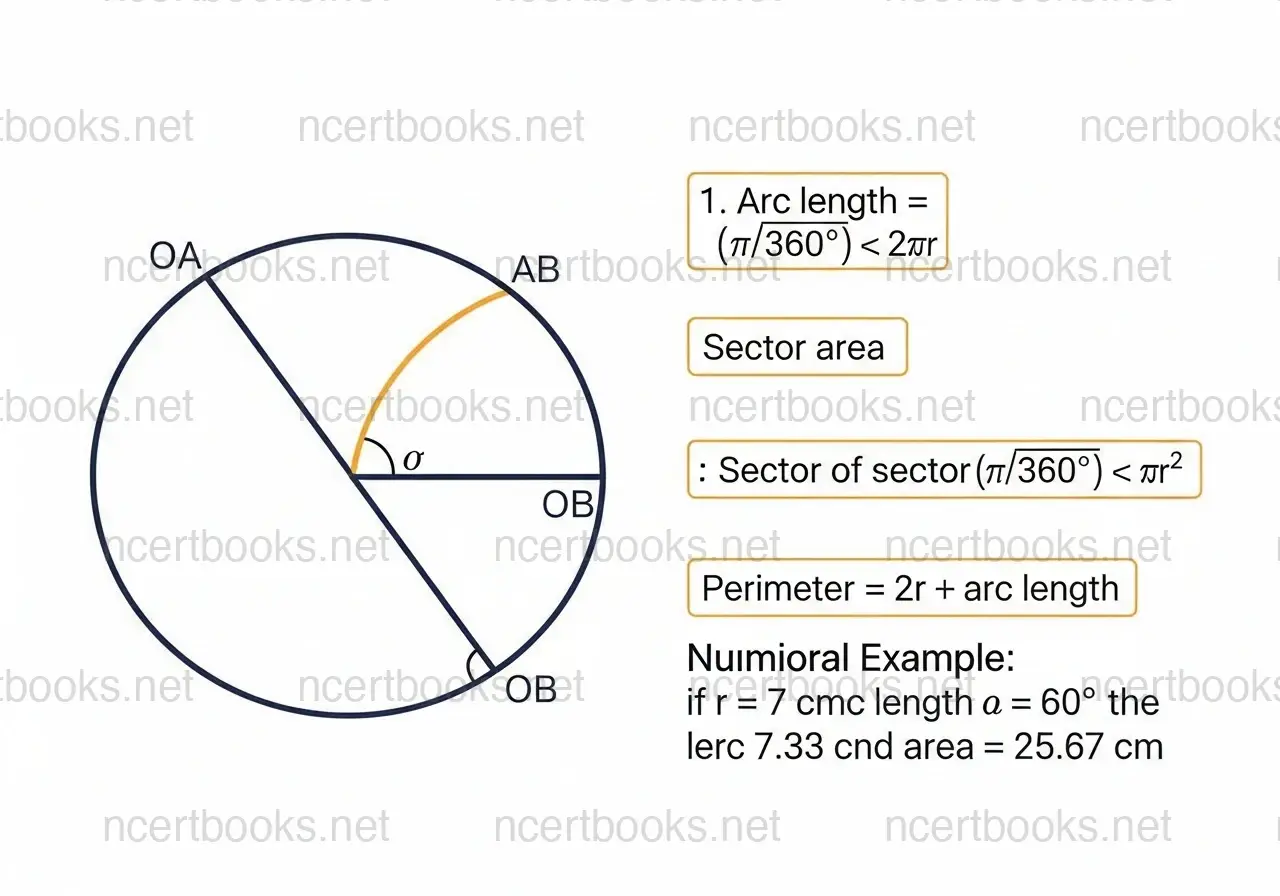
Frequently Asked Questions — Areas Related to Circles Class 10 Maths Chapter 12
How do you find the radius when the circumference equals the sum of two circles?
Use the formula \( 2\pi R = 2\pi r_{1} + 2\pi r_{2} \). Divide both sides by \( 2\pi \) to get \( R = r_{1} + r_{2} \). For radii 19 cm and 9 cm, the answer is simply \( R = 19 + 9 = 28 \) cm. This shortcut works because \( 2\pi \) is a common factor and cancels out completely. No calculator is needed for this type of problem.
How many revolutions does a car wheel of diameter 80 cm make in 10 minutes at 66 km/h?
First convert speed: 66 km/h = 110000 cm/min. Distance in 10 min = 1100000 cm. Circumference of wheel = \( 2 \times \frac{22}{7} \times 40 = \frac{1760}{7} \) cm. Revolutions = \( \frac{1100000 \times 7}{1760} = 4375 \). Always convert km/h to cm/min in a single clear step to avoid errors.
If the perimeter and area of a circle are numerically equal, what is the radius?
Set \( 2\pi r = \pi r^{2} \) and divide both sides by \( \pi r \) to get \( r = 2 \) units. The correct NCERT answer is option (a) 2 units. This is a favourite MCQ in CBSE board papers because students often confuse perimeter with area. Remember: the equation reduces to \( 2 = r \) in just one step.
What is the area of the Gold region in the archery target problem?
The Gold region is a complete circle with diameter 21 cm, so radius = 10.5 cm. Area \( = \frac{22}{7} \times (10.5)^{2} = \frac{22}{7} \times 110.25 = 346.5 \) cm². Each outer band adds 10.5 cm to the radius, and you calculate each band’s area as a ring (outer area minus inner area). The five areas are 346.5, 1039.5, 1732.5, 2425.5, and 3118.5 cm².
Is Exercise 12.1 of Class 10 Maths in the current CBSE 2026-27 syllabus?
Yes, Exercise 12.1 is part of the current CBSE 2026-27 syllabus for Class 10 Maths. It covers the foundational concepts of circumference and area of circles, which are prerequisites for Exercises 12.2 and 12.3. All 5 questions in Exercise 12.1 are relevant for board exam preparation. You can verify the latest syllabus on the CBSE Academic website.
What is the difference between the combined-circumference and combined-area formulas?
For combined circumferences: \( R = r_{1} + r_{2} \) — the new radius is simply the sum. For combined areas: \( R = \sqrt{r_{1}^{2} + r_{2}^{2}} \) — you add the squares and then take the square root. This is the most common confusion in Chapter 12. A quick memory trick: area involves squaring, so the formula for combining areas also involves squares.