⚡ Quick Revision Box — Chapter 11 Ex 11.2
- Chapter: 11 — Constructions | Exercise: 11.2 | Class: 10 Maths (NCERT)
- Topic: Construction of Tangents to a Circle using compass and ruler
- Key Theorem: Tangent ⊥ Radius at point of contact → angle OAP = 90°
- Tangent Length Formula: \( l = \sqrt{d^2 – r^2} \) where \(d\) = distance from external point to centre, \(r\) = radius
- Number of Tangents: Exactly 2 tangents from any external point; 1 tangent if point is on circle; 0 if inside
- Key Construction Step: Bisect OP → draw semicircle with OP as diameter → intersection points are tangent points
- Angle Relationship: If tangents are inclined at angle \(\theta\), then angle between radii = \(180° – \theta\)
- Total Questions in Ex 11.2: 7 (all require justification of construction)
The NCERT Solutions for Class 10 Maths Chapter 11 Ex 11.2 on this page cover all 7 construction questions from the Constructions chapter of your NCERT Maths textbook, fully updated for the 2026-27 CBSE board exam. You can find complete NCERT Solutions for Class 10 across all subjects on our site. These solutions are part of our broader collection of NCERT Solutions for all classes. Each answer includes a step-by-step construction procedure and justification, exactly as required by the CBSE marking scheme. The NCERT official textbook requires students to justify every construction — our answers do this in full.
- Quick Revision Box
- Chapter Overview — Constructions Class 10 Maths
- Key Concepts and Theorems for Tangent Construction
- NCERT Solutions for Class 10 Maths Chapter 11 Ex 11.2 — All 7 Questions
- Formula Reference Table
- Solved Examples Beyond NCERT
- Important Questions for Board Exam
- Common Mistakes Students Make
- Exam Tips for 2026-27
- Key Points to Remember
- FAQ — Constructions Tangents Class 10
Chapter Overview — Constructions Class 10 Maths (NCERT 2026-27)
Chapter 11 of the Class 10 NCERT Maths textbook is titled Constructions. It has two exercises: Exercise 11.1 covers division of a line segment in a given ratio, and Exercise 11.2 covers construction of tangents to a circle. This page focuses entirely on Exercise 11.2.
In CBSE board exams, the Constructions chapter typically carries 4 marks in the form of one construction question. These questions appear in the long-answer section and require you to draw accurately with a compass and ruler, then write a justification. Marks are awarded for both the diagram and the written justification.
To do well in Exercise 11.2, you need to be comfortable with the Pythagoras theorem (Chapter 6), properties of circles and tangents (Chapter 10), and basic compass-ruler constructions from earlier classes.
| Detail | Information |
|---|---|
| Chapter | 11 — Constructions |
| Exercise | 11.2 |
| Textbook | NCERT Mathematics — Class 10 |
| Class | 10 |
| Subject | Mathematics |
| Marks Weightage | 4 marks (1 construction question in board exam) |
| Difficulty Level | Medium to Hard |
| Academic Year | 2026-27 |
Key Concepts and Theorems for Tangent Construction
Tangent-Radius Perpendicularity Theorem
Key Concept: The tangent to a circle at any point is perpendicular to the radius drawn to that point. If O is the centre and A is the point of tangency, then \( \angle OAP = 90° \). This is the single most important fact for all constructions in this exercise.
Tangents from an External Point
From any external point, exactly two tangents can be drawn to a circle, and they are equal in length. If P is the external point and PA, PB are the two tangents, then \( PA = PB \).
The length of the tangent is calculated using Pythagoras theorem:
\[ l = \sqrt{d^2 – r^2} \]
where \(d\) is the distance from the external point to the centre and \(r\) is the radius of the circle.
Angle Between Tangents and Radii
If two tangents from an external point P are inclined to each other at angle \(\theta\), then the angle between the two radii drawn to the points of tangency is \( 180° – \theta \). This relationship is used directly in Question 4.
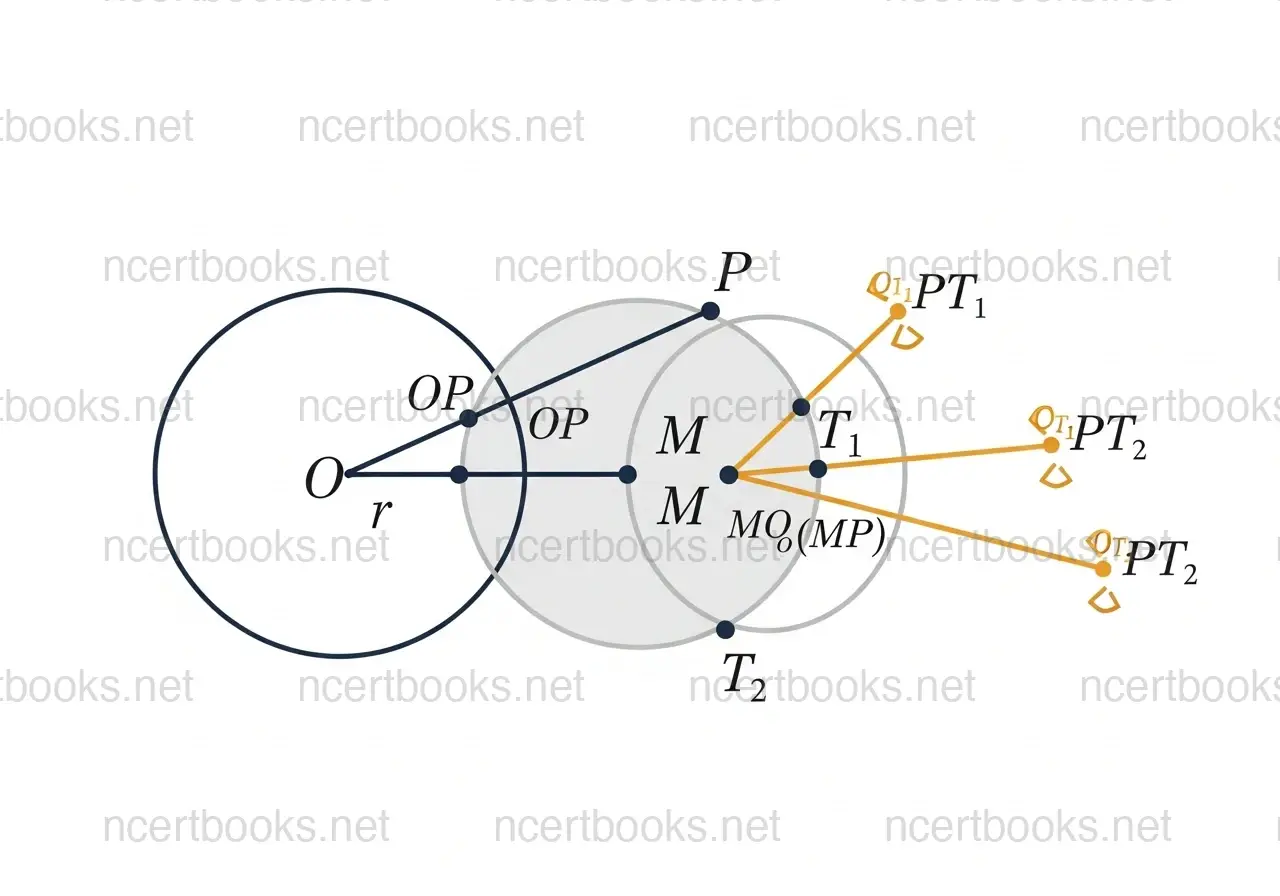
The Semicircle Method for Tangent Construction
To construct tangents from external point P to a circle with centre O:
- Join O and P. Find midpoint M of OP.
- Draw a circle with M as centre and MO (= MP) as radius.
- This circle intersects the original circle at points A and B.
- PA and PB are the required tangents.
Why does this work? Since OP is a diameter of the new circle, any angle inscribed in a semicircle is 90°. So \( \angle OAP = 90° \), confirming PA is a tangent.
NCERT Solutions for Class 10 Maths Chapter 11 Ex 11.2 — All 7 Questions
Below are complete, step-by-step solutions for all 7 questions from NCERT Solutions for Class 10 Maths Chapter 11 Ex 11.2. Every answer includes the construction steps and the required justification.
Question 1
Medium
Draw a circle of radius 6 cm. From a point 10 cm away from its centre, construct the pair of tangents to the circle and measure their lengths.
Step 1: Draw a circle with centre O and radius 6 cm using a compass.
Step 2: Mark a point P such that OP = 10 cm (measure carefully with a ruler).
Step 3: Find the midpoint M of OP by drawing the perpendicular bisector of OP.
Step 4: Draw a circle with centre M and radius MO = MP = 5 cm.
Step 5: Let this new circle intersect the original circle at points A and B.
Step 6: Join PA and PB. These are the required pair of tangents.
Measurement: On measuring, PA = PB ≈ 8 cm.
Verification using Pythagoras theorem:
\[ PA = \sqrt{OP^2 – OA^2} = \sqrt{10^2 – 6^2} = \sqrt{100 – 36} = \sqrt{64} = 8 \text{ cm} \]
Justification: Since OP is the diameter of the circle with centre M, angle OAP = 90° (angle in a semicircle). In right triangle OAP, OA is the radius = 6 cm and OP = 10 cm, so PA is indeed a tangent to the original circle. Similarly, PB is a tangent.
\( \therefore \) Length of each tangent = 8 cm
Question 2
Medium
Construct a tangent to a circle of radius 4 cm from a point on the concentric circle of radius 6 cm and measure its length. Also verify the measurement by actual calculation.
Key Concept: Two concentric circles share the same centre O. A point P on the larger circle (radius 6 cm) is at distance 6 cm from O. We need to draw a tangent from P to the inner circle (radius 4 cm).
Step 1: Draw a circle C₁ with centre O and radius 4 cm.
Step 2: Draw a concentric circle C₂ with centre O and radius 6 cm.
Step 3: Take any point P on C₂.
Step 4: Join OP. Find midpoint M of OP by drawing the perpendicular bisector of OP.
Step 5: Draw a circle with centre M and radius MO = 3 cm.
Step 6: Let this circle intersect C₁ at points A and B.
Step 7: Join PA and PB. These are the two required tangents from P to the inner circle.
Measurement: On measuring, PA = PB ≈ 4.47 cm.
Verification:
\[ PA = \sqrt{OP^2 – OA^2} = \sqrt{6^2 – 4^2} = \sqrt{36 – 16} = \sqrt{20} = 2\sqrt{5} \approx 4.47 \text{ cm} \]
Justification: OP is the diameter of the circle with centre M, so \( \angle OAP = 90° \). Therefore OA ⊥ PA, which means PA is a tangent to circle C₁. The measured length matches the calculated value of \( 2\sqrt{5} \) cm.
\( \therefore \) Length of tangent = \( 2\sqrt{5} \approx 4.47 \) cm
Question 3
Medium
Draw a circle of radius 3 cm. Take two points P and Q on one of its extended diameter each at a distance of 7 cm from its centre. Draw tangents to the circle from these two points P and Q.
Step 1: Draw a circle with centre O and radius 3 cm.
Step 2: Draw a diameter of the circle and extend it on both sides.
Step 3: Mark point P on one side of O such that OP = 7 cm, and point Q on the other side such that OQ = 7 cm.
Step 4 (Tangents from P): Find midpoint M₁ of OP. Draw a circle with centre M₁ and radius M₁O = 3.5 cm. Let it intersect the original circle at A and B. Join PA and PB — these are the tangents from P.
Step 5 (Tangents from Q): Find midpoint M₂ of OQ. Draw a circle with centre M₂ and radius M₂O = 3.5 cm. Let it intersect the original circle at C and D. Join QC and QD — these are the tangents from Q.
Verification of tangent lengths:
\[ PA = \sqrt{OP^2 – OA^2} = \sqrt{7^2 – 3^2} = \sqrt{49 – 9} = \sqrt{40} = 2\sqrt{10} \approx 6.32 \text{ cm} \]
By symmetry, QC = QD = \( 2\sqrt{10} \approx 6.32 \) cm as well.
Justification: In each case, OP (or OQ) acts as the diameter of the auxiliary circle. The angle subtended by this diameter at A (or C) is 90°, so OA ⊥ PA, confirming PA is a tangent. The same applies to all four tangent lines.
\( \therefore \) Four tangents are drawn: PA, PB from P and QC, QD from Q. Each tangent length = \( 2\sqrt{10} \approx 6.32 \) cm.
Question 4
Hard
Draw a pair of tangents to a circle of radius 5 cm which are inclined to each other at an angle of 60°.
Key Concept: If the two tangents from external point P are inclined at \( \angle APB = 60° \), then since OAPB is a cyclic quadrilateral (O, A, P, B lie on a circle), we have:
\[ \angle AOB = 180° – 60° = 120° \]
So we need to draw two radii OA and OB with \( \angle AOB = 120° \), then draw tangents at A and B.
Step 1: Draw a circle with centre O and radius 5 cm.
Step 2: Draw any radius OA.
Step 3: Draw another radius OB such that \( \angle AOB = 120° \) (use a protractor).
Step 4: At point A, draw a line perpendicular to OA (i.e., tangent at A).
Step 5: At point B, draw a line perpendicular to OB (i.e., tangent at B).
Step 6: Let these two tangent lines meet at point P. PA and PB are the required tangents.
Justification: \( \angle OAP = \angle OBP = 90° \) (tangent ⊥ radius). In quadrilateral OAPB, the sum of angles = 360°. So \( \angle APB = 360° – 90° – 90° – 120° = 60° \). This confirms the tangents are inclined at 60°.
\( \therefore \) The pair of tangents PA and PB are drawn, inclined to each other at 60°.
Question 5
Hard
Draw a line segment AB of length 8 cm. Taking A as centre, draw a circle of radius 4 cm and taking B as centre, draw another circle of radius 3 cm. Construct tangents to each circle from the centre of the other circle.
Step 1: Draw a line segment AB = 8 cm.
Step 2: Draw circle C₁ with centre A and radius 4 cm.
Step 3: Draw circle C₂ with centre B and radius 3 cm.
Step 4 (Tangents from B to circle C₁): Find midpoint M₁ of AB. Draw a circle with centre M₁ and radius M₁A = 4 cm. Let it intersect circle C₁ at points P and Q. Join BP and BQ — these are the tangents from B to circle C₁.
Step 5 (Tangents from A to circle C₂): The midpoint of AB is M₁ (same point). Draw a circle with centre M₁ and radius M₁B = 4 cm. Let it intersect circle C₂ at points R and S. Join AR and AS — these are the tangents from A to circle C₂.
Why does this work? For tangents from B to C₁: AB is the diameter of the auxiliary circle, so \( \angle APB = 90° \), confirming BP ⊥ AP, i.e., BP is tangent to C₁. Similarly for the other tangents.
Tangent lengths:
\[ BP = \sqrt{AB^2 – AP^2} = \sqrt{8^2 – 4^2} = \sqrt{64 – 16} = \sqrt{48} = 4\sqrt{3} \approx 6.93 \text{ cm} \]
\[ AR = \sqrt{AB^2 – BR^2} = \sqrt{8^2 – 3^2} = \sqrt{64 – 9} = \sqrt{55} \approx 7.42 \text{ cm} \]
Justification: In both cases, AB serves as the diameter of the auxiliary circle. The angle at the intersection point is 90° (angle in a semicircle), confirming the lines are tangents to the respective circles.
\( \therefore \) Tangents from B to circle C₁: length = \( 4\sqrt{3} \approx 6.93 \) cm. Tangents from A to circle C₂: length = \( \sqrt{55} \approx 7.42 \) cm.
Question 6
Hard
Let ABC be a right triangle in which AB = 6 cm, BC = 8 cm and ∠B = 90°. BD is the perpendicular from B on AC. The circle through B, C, D is drawn. Construct the tangents from A to this circle.
Key Concept: First, construct the right triangle ABC. Then find D (foot of perpendicular from B to AC). Then find the circumcircle of triangle BCD. Finally, draw tangents from A to this circle.
Step 1: Draw BC = 8 cm. At B, draw a perpendicular. Mark A on this perpendicular such that AB = 6 cm. Join AC.
Step 2: From B, draw BD perpendicular to AC. D is the foot of the perpendicular on AC.
Step 3: Find the circumcircle of triangle BCD. Since \( \angle BDC = 90° \), BC is the diameter of this circumcircle. Find midpoint O of BC — this is the centre of the required circle. Radius = OB = OC = 4 cm.
Step 4: Now draw tangents from A to this circle (centre O, radius 4 cm). Find midpoint M of AO. Draw a circle with centre M and radius MA = MO. Let it intersect the circle at points P and Q.
Step 5: Join AP and AQ. These are the required tangents from A to the circle through B, C, D.
Why is BC the diameter? Since \( \angle BDC = 90° \) (BD ⊥ AC), D lies on the circle with BC as diameter (angle in a semicircle = 90°). B and C also lie on this circle. So the circle through B, C, D has BC as its diameter.
Verification: AO can be calculated. In right triangle ABC, AC = \( \sqrt{AB^2 + BC^2} = \sqrt{36 + 64} = 10 \) cm. O is midpoint of BC, so AO can be found using coordinate geometry. Place B at origin, C at (8, 0), A at (0, 6). O = (4, 0).
\[ AO = \sqrt{(4-0)^2 + (0-6)^2} = \sqrt{16 + 36} = \sqrt{52} = 2\sqrt{13} \text{ cm} \]
\[ \text{Tangent length} = \sqrt{AO^2 – r^2} = \sqrt{52 – 16} = \sqrt{36} = 6 \text{ cm} \]
Justification: Since OP is a diameter of the auxiliary circle, \( \angle OPA = 90° \), confirming AP is tangent to the circle through B, C, D. The tangent length equals AB = 6 cm, which is consistent with the geometry.
\( \therefore \) Tangents from A to the circle through B, C, D are constructed. Tangent length = 6 cm.
Question 7
Medium
Draw a circle with the help of a bangle. Take a point outside the circle. Construct the pair of tangents from this point to the circle.
Key Challenge: When a circle is drawn using a bangle, its centre is not known. You must first locate the centre using the perpendicular bisector method.
Step 1 (Find the centre): Place the bangle on paper and trace the circle. Draw any two chords AB and CD of this circle.
Step 2: Draw the perpendicular bisector of chord AB.
Step 3: Draw the perpendicular bisector of chord CD.
Step 4: The two perpendicular bisectors meet at point O. This is the centre of the circle.
Step 5: Measure the radius r = OA (distance from O to any point on the circle).
Step 6 (Construct tangents): Take a point P outside the circle. Join OP. Find midpoint M of OP.
Step 7: Draw a circle with centre M and radius MO = MP.
Step 8: Let this circle intersect the original circle at points X and Y. Join PX and PY. These are the required tangents.
Justification: The perpendicular bisector of a chord always passes through the centre of the circle (standard theorem). So the intersection of two perpendicular bisectors gives the centre O. Once O is known, the standard tangent construction applies: since OP is a diameter of the auxiliary circle, \( \angle OXP = 90° \), so OX ⊥ XP, confirming PX is a tangent.
\( \therefore \) The centre O is found using perpendicular bisectors of two chords, and the pair of tangents PX and PY are constructed from external point P.
Formula Reference Table — Constructions Chapter 11
| Formula Name | Formula | Variables Defined |
|---|---|---|
| Tangent Length from External Point | \( l = \sqrt{d^2 – r^2} \) | \(l\) = tangent length, \(d\) = distance from point to centre, \(r\) = radius |
| Angle Between Radii (given tangent angle) | \( \angle AOB = 180° – \theta \) | \(\theta\) = angle between the two tangents from external point P |
| Angle in Semicircle | \( \angle \text{ in semicircle} = 90° \) | Angle subtended by diameter at any point on the circle |
| Tangent-Radius Angle | \( \angle OAP = 90° \) | O = centre, A = point of tangency, P = external point |
| Equal Tangents | \( PA = PB \) | PA and PB are tangents from same external point P |
Solved Examples Beyond NCERT — Extra Practice for CBSE Class 10 Maths
Extra Example 1 — Tangent Length Calculation
Easy
A point P is at a distance of 13 cm from the centre of a circle of radius 5 cm. Find the length of the tangent from P to the circle.
Step 1: Use the tangent length formula.
\[ l = \sqrt{d^2 – r^2} = \sqrt{13^2 – 5^2} = \sqrt{169 – 25} = \sqrt{144} = 12 \text{ cm} \]
\( \therefore \) Tangent length = 12 cm
Extra Example 2 — Angle Between Tangents
Medium
Two tangents PA and PB are drawn from an external point P to a circle. If ∠APB = 80°, find ∠AOB.
Step 1: Use the relationship between the angle at the external point and the angle at the centre.
\[ \angle AOB = 180° – \angle APB = 180° – 80° = 100° \]
Why? In quadrilateral OAPB, \( \angle OAP = \angle OBP = 90° \). Sum of all angles = 360°. So \( \angle AOB + \angle APB = 180° \).
\( \therefore \) ∠AOB = 100°
Extra Example 3 — Concentric Circle Tangent
Medium
Two concentric circles have radii 5 cm and 13 cm. Find the length of the chord of the outer circle that is tangent to the inner circle.
Step 1: Let O be the common centre. The chord of the outer circle is tangent to the inner circle, so the perpendicular from O to the chord = 5 cm (radius of inner circle).
Step 2: Half-length of chord = \( \sqrt{13^2 – 5^2} = \sqrt{169 – 25} = \sqrt{144} = 12 \) cm.
Step 3: Full chord length = \( 2 \times 12 = 24 \) cm.
\( \therefore \) Chord length = 24 cm
Topic-Wise Important Questions for CBSE Board Exam — Constructions Tangents
1-Mark Questions (Definition / Fill in the Blank)
- A tangent to a circle is perpendicular to the __________ drawn to the point of contact. Answer: radius
- How many tangents can be drawn from a point outside a circle? Answer: 2
- If PA and PB are tangents from P to a circle, then PA __ PB. Answer: = (PA = PB)
3-Mark Questions
- Q: Prove that the tangent at any point of a circle is perpendicular to the radius through the point of contact.
A: Let O be the centre and P be the point of tangency. Assume the tangent is not perpendicular to OP. Then there exists a point Q on the tangent closer to O than P, meaning OQ < OP. But Q is outside the circle (tangent touches at only one point), so OQ > r = OP — a contradiction. Therefore, the tangent must be perpendicular to the radius OP. - Q: Draw a circle of radius 4 cm. From a point 7 cm away from its centre, construct a pair of tangents and find their length.
A: Use the standard semicircle method. Tangent length = \( \sqrt{7^2 – 4^2} = \sqrt{49 – 16} = \sqrt{33} \approx 5.74 \) cm.
5-Mark (Long Answer) Questions
- Q: Draw a pair of tangents to a circle of radius 4 cm which are inclined to each other at an angle of 45°. Give justification.
A: Since the tangents are inclined at 45°, the angle between the radii = 180° − 45° = 135°. Draw two radii OA and OB with ∠AOB = 135°. Draw perpendiculars at A and B. They intersect at P, giving the required tangents. Justification: In quadrilateral OAPB, ∠OAP = ∠OBP = 90°, so ∠APB = 360° − 90° − 90° − 135° = 45°. ✓
Common Mistakes Students Make in Class 10 Maths Constructions
Mistake 1: Students draw the auxiliary circle with the wrong radius — using OP instead of OP/2.
Why it’s wrong: The auxiliary circle must have OP as its diameter, not radius. So the radius of the auxiliary circle is OP/2 (i.e., OM where M is the midpoint of OP).
Correct approach: Always find the midpoint M of OP first, then draw the circle with centre M and radius MO.
Mistake 2: Students skip the justification and only draw the diagram.
Why it’s wrong: The NCERT exercise explicitly says “give also the justification of the construction.” CBSE examiners deduct marks if justification is missing.
Correct approach: Always write 2–3 lines explaining why the construction works, referencing the theorem that angle in a semicircle = 90°.
Mistake 3: In Question 4, students use ∠AOB = 60° instead of 120°.
Why it’s wrong: The angle between the radii is supplementary to the angle between the tangents: ∠AOB = 180° − ∠APB = 180° − 60° = 120°, not 60°.
Correct approach: Always apply the formula ∠AOB = 180° − θ before drawing.
Mistake 4: In Question 7, students guess the centre of the bangle circle instead of finding it geometrically.
Why it’s wrong: Guessing introduces error. The examiner checks whether you used the perpendicular bisector method.
Correct approach: Draw two chords and their perpendicular bisectors. Their intersection is the exact centre.
Mistake 5: Students draw tangent lines that do not actually touch the circle at exactly one point.
Why it’s wrong: Inaccurate compass work leads to lines that cut the circle at two points (secants) instead of tangents.
Correct approach: Use a sharp pencil, set the compass width accurately, and double-check that the tangent line touches the circle at exactly the point where the auxiliary circle intersects the original circle.
Exam Tips for 2026-27 CBSE Board Exam — Chapter 11 Constructions
- Always write justification: The 2026-27 CBSE marking scheme awards separate marks for justification in construction questions. Never skip it.
- Use sharp pencil and compass: Construction marks depend on accuracy. A blunt pencil or loose compass loses you marks even if the method is correct.
- Label all points: Mark O (centre), P (external point), A and B (tangent points), M (midpoint) clearly. Examiners check labelling.
- Know the angle formula: ∠AOB = 180° − ∠APB is a frequently tested concept in both MCQ and construction questions in the 2026-27 pattern.
- Verify with Pythagoras: After drawing, always calculate the expected tangent length using \( l = \sqrt{d^2 – r^2} \) and compare with your measured length. This shows the examiner you understand the concept.
- Bangle question: If asked to draw a circle with a bangle, finding the centre using perpendicular bisectors is a guaranteed step — practise this separately.
For more practice on cbse class 10 maths ncert solutions across all chapters, visit our NCERT Solutions for Class 10 hub page. You can also explore NCERT Solutions for all classes on our site.
Key Points to Remember — Chapter 11 Constructions (Class 10 Maths)
- A tangent to a circle is perpendicular to the radius at the point of contact: \( \angle OAP = 90° \).
- From an external point, exactly two tangents can be drawn to a circle, and they are equal in length.
- Tangent length formula: \( l = \sqrt{d^2 – r^2} \) where \(d\) = distance from point to centre.
- The angle between the two radii to the tangent points = 180° minus the angle between the tangents.
- To find the centre of a circle: draw perpendicular bisectors of any two chords; their intersection is the centre.
- The construction method relies on the theorem: angle in a semicircle = 90°.
- For the circle through B, C, D in Question 6: since ∠BDC = 90°, BC is the diameter of that circle.