- Tangent to a circle: A line that touches the circle at exactly one point (point of contact).
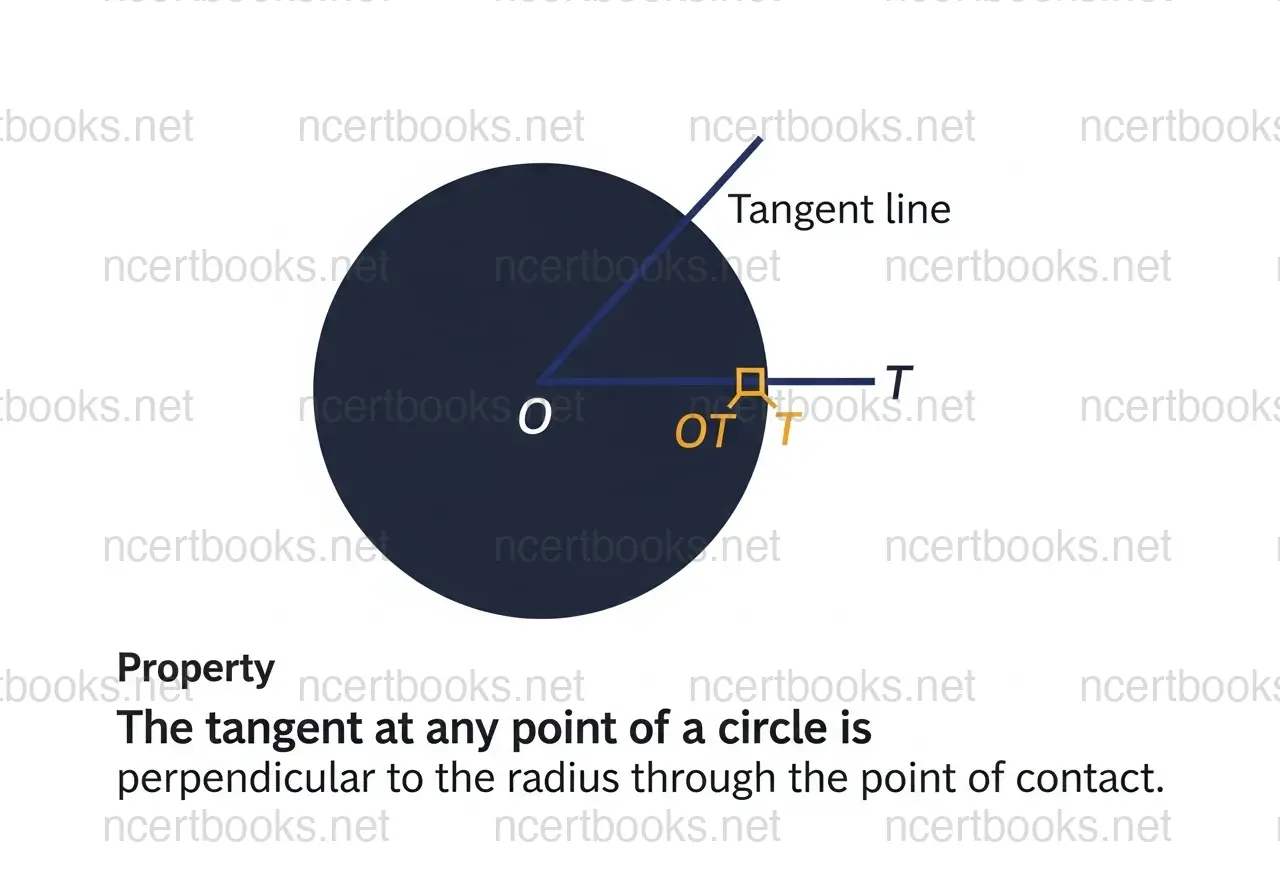
- Key Theorem 1: The tangent at any point of a circle is perpendicular to the radius at the point of contact.
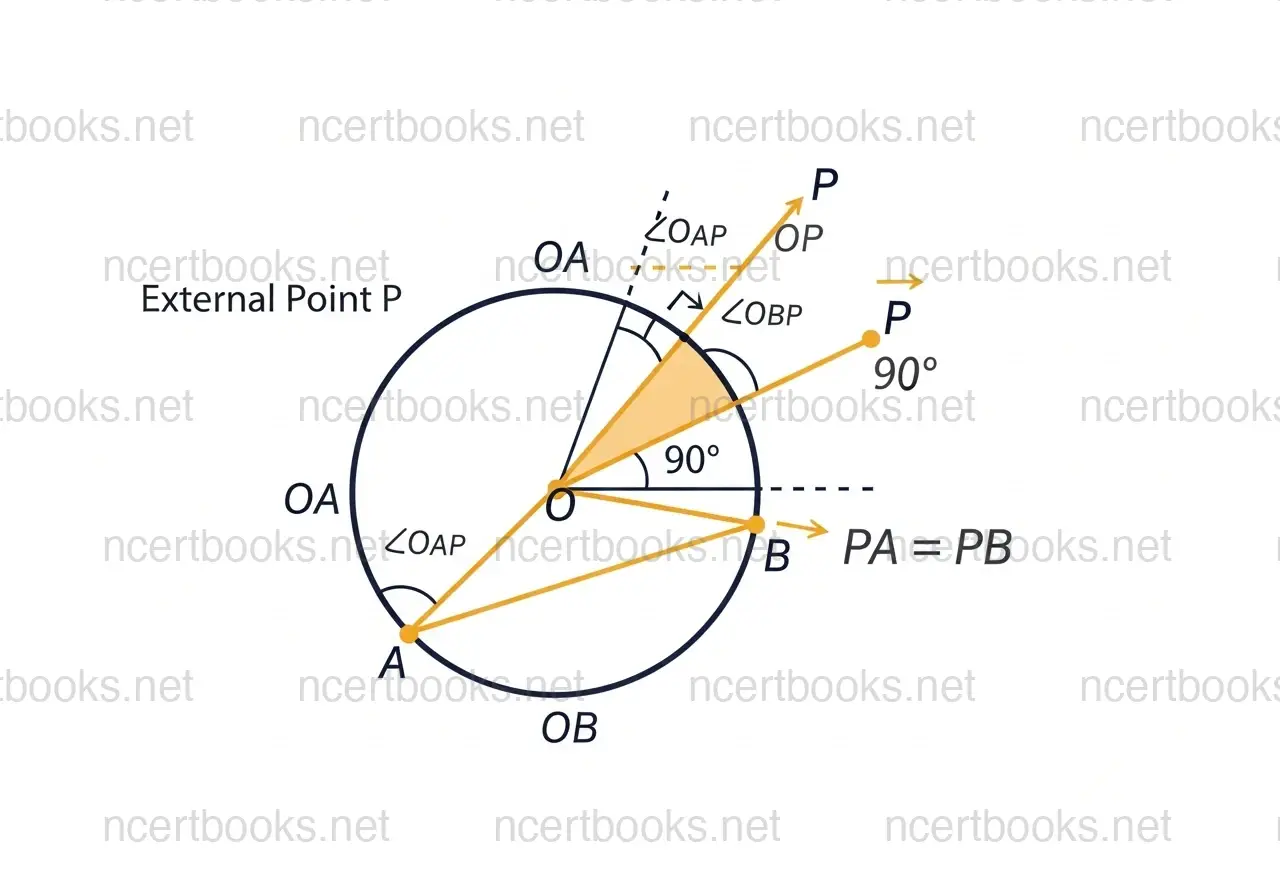
- Key Theorem 2: Tangents drawn from an external point to a circle are equal in length.
- Tangent length formula: If distance from external point to centre = \( d \), radius = \( r \), then tangent length \( = \sqrt{d^2 – r^2} \).
- Angle sum property: The angle between two tangents from an external point + angle subtended at centre by line joining contact points = 180°.
- Circumscribed quadrilateral: AB + CD = BC + AD (tangent equality property).
- Parallelogram circumscribing a circle: It must be a rhombus (all sides equal by tangent property).
- Exercise 10.2: 13 questions — 3 MCQs, 7 proofs, 3 numericals. All are important for CBSE 2026-27 board exams.
The NCERT Solutions for Class 10 Maths Chapter 10 Ex 10.2 on this page cover all 13 questions from the Circles chapter, fully updated for the 2026-27 CBSE board exam. Whether you need step-by-step proofs or numerical solutions, you will find complete, exam-ready answers here. These solutions are part of our comprehensive NCERT Solutions library. You can also refer to the NCERT official textbook for the original questions and diagrams.
This exercise is one of the most important sections in NCERT Solutions for Class 10. It tests your understanding of tangent properties, angle relationships, and your ability to write formal geometric proofs — all of which are high-value skills for the CBSE board exam.
Table of Contents
NCERT Solutions for Class 10 Maths Chapter 10 Ex 10.2 — Chapter Overview
Chapter 10 of the NCERT Class 10 Maths textbook is titled Circles. Exercise 10.2 focuses on tangents to a circle — their properties, the number of tangents from an external point, and their relationships with radii and angles. This chapter builds directly on your knowledge of geometry from earlier classes, especially properties of triangles and the Pythagoras theorem.
In the CBSE board exam, the Circles chapter typically carries 5–7 marks and questions appear across all formats — MCQ, short answer (2–3 marks), and long answer proofs (5 marks). Exercise 10.2 is heavier on proofs, making it critical to practise writing structured, step-by-step geometric arguments.
| Field | Details |
|---|---|
| Chapter | Chapter 10 — Circles |
| Exercise | Exercise 10.2 |
| Textbook | NCERT Mathematics (Class 10) |
| Class | Class 10 |
| Subject | Mathematics |
| Total Questions | 13 (3 MCQ + 7 Proofs + 3 Numericals) |
| Difficulty Level | Medium to Hard |
| Academic Year | 2026-27 |
Key Concepts and Theorems — Tangents to a Circle
Theorem 1: Tangent is Perpendicular to Radius
The tangent at any point of a circle is perpendicular to the radius drawn to the point of contact. In other words, if O is the centre and P is the point of contact, then \( OP \perp \) tangent at P. This is the foundation for almost every proof in Exercise 10.2.
Theorem 2: Tangents from an External Point Are Equal
If two tangents are drawn from an external point P to a circle with centre O, touching at points A and B, then \( PA = PB \). This is proved using congruent triangles (RHS congruence). This theorem is used in Questions 8, 11, and 12.
Number of Tangents from a Point
From a point inside the circle: 0 tangents. From a point on the circle: exactly 1 tangent. From a point outside the circle: exactly 2 tangents. Exercise 10.2 deals exclusively with external points.
Formula Reference Table — Circles Chapter 10
| Formula Name | Formula | Variables Defined |
|---|---|---|
| Tangent Length | \( PT = \sqrt{d^2 – r^2} \) | PT = tangent length, d = distance from external point to centre, r = radius |
| Angle Sum (Tangent–Radius) | \( \angle OPT = 90° \) | O = centre, P = point of contact, T = external point |
| Angle Between Two Tangents | \( \angle PTQ + \angle POQ = 180° \) | T = external point, P and Q = points of contact, O = centre |
| Circumscribed Quadrilateral | \( AB + CD = BC + AD \) | ABCD = quadrilateral circumscribing a circle |
| Pythagoras Theorem | \( h^2 = p^2 + b^2 \) | h = hypotenuse, p = perpendicular, b = base |
NCERT Solutions for Class 10 Maths Chapter 10 Ex 10.2 — All 13 Questions Solved
Below are complete, step-by-step solutions for all 13 questions in Exercise 10.2. These cbse class 10 maths ncert solutions are written to match the CBSE marking scheme for 2026-27.
Question 1 Easy
From a point Q, the length of the tangent to a circle is 24 cm and the distance of Q from the centre is 25 cm. The radius of the circle is (a) 7 cm (b) 12 cm (c) 15 cm (d) 24.5 cm
Key Concept: The tangent is perpendicular to the radius at the point of contact. So triangle OPQ is right-angled at P, where O is the centre, P is the point of contact, and Q is the external point.
Step 1: Identify the known values. Tangent length \( QP = 24 \) cm, distance from centre \( OQ = 25 \) cm, radius \( OP = r \) (unknown).
Step 2: Apply Pythagoras theorem in triangle OPQ:
\[ OQ^2 = OP^2 + QP^2 \]
\[ 25^2 = r^2 + 24^2 \]
\[ 625 = r^2 + 576 \]
\[ r^2 = 625 – 576 = 49 \]
\[ r = 7 \text{ cm} \]
\( \therefore \) The radius of the circle is 7 cm. Answer: (a)
Question 2 Medium
In figure, if TP and TQ are the two tangents to a circle with centre O so that ∠POQ = 110°, then ∠PTQ is equal to (a) 60° (b) 70° (c) 80° (d) 90°
Key Concept: Since TP and TQ are tangents, OP ⊥ TP and OQ ⊥ TQ. So \( \angle OPT = \angle OQT = 90° \).
Step 1: In quadrilateral OPTQ, the sum of all angles is 360°.
\[ \angle OPT + \angle PTQ + \angle TQO + \angle QOP = 360° \]
\[ 90° + \angle PTQ + 90° + 110° = 360° \]
\[ \angle PTQ + 290° = 360° \]
\[ \angle PTQ = 70° \]
\( \therefore \) ∠PTQ = 70°. Answer: (b)
Question 3 Medium
If tangents PA and PB from a point P to a circle with centre O are inclined to each other at angle of 80°, then ∠POA is equal to (a) 50° (b) 60° (c) 70° (d) 80°
Key Concept: OA ⊥ PA (radius ⊥ tangent), so \( \angle OAP = 90° \). Also, OP bisects \( \angle APB \) (by symmetry, since PA = PB).
Step 1: Since \( \angle APB = 80° \), and OP bisects this angle:
\[ \angle APO = \frac{80°}{2} = 40° \]
Step 2: In triangle OAP:
\[ \angle OAP + \angle APO + \angle POA = 180° \]
\[ 90° + 40° + \angle POA = 180° \]
\[ \angle POA = 50° \]
\( \therefore \) ∠POA = 50°. Answer: (a)
Question 4 Medium
Prove that the tangents drawn at the ends of a diameter of a circle are parallel.
Given: AB is a diameter of a circle with centre O. PQ is the tangent at A and RS is the tangent at B.
To Prove: PQ ∥ RS
Step 1: Since PQ is a tangent at A and OA is the radius, by Theorem 1:
\[ OA \perp PQ \implies \angle OAP = 90° \text{ and } \angle OAQ = 90° \]
Step 2: Since RS is a tangent at B and OB is the radius:
\[ OB \perp RS \implies \angle OBR = 90° \text{ and } \angle OBS = 90° \]
Step 3: Since AB is a diameter, O lies on AB, so OA and OB are in the same straight line.
Step 4: \( \angle OAQ = \angle OBR = 90° \). These are alternate interior angles formed by the transversal AB with lines PQ and RS.
Why does this work? When a transversal cuts two lines and the alternate interior angles are equal (both 90°), the two lines are parallel.
\( \therefore \) PQ ∥ RS. Hence proved.
Question 5 Hard
Prove that the perpendicular at the point of contact to the tangent to a circle passes through the centre.
Given: A tangent PQ to a circle at point A. A perpendicular drawn to PQ at A.
To Prove: This perpendicular passes through the centre O.
Step 1 (Proof by contradiction): Assume the perpendicular at A does NOT pass through the centre O. Let it pass through another point O’.
Step 2: Then O’A ⊥ PQ (by our assumption). But we also know that OA ⊥ PQ (radius is perpendicular to tangent at point of contact).
Step 3: This means both O’A and OA are perpendicular to PQ at the same point A. But through a given point, only one perpendicular can be drawn to a line.
Step 4: This is a contradiction. Therefore our assumption is wrong.
Why does this work? The uniqueness of the perpendicular from a point to a line ensures that O and O’ must be the same point.
\( \therefore \) The perpendicular at the point of contact to the tangent passes through the centre O. Hence proved.
Question 6 Easy
The length of a tangent from a point A at distance 5 cm from the centre of the circle is 4 cm. Find the radius of the circle.
Given: Distance from point A to centre O = 5 cm, tangent length AT = 4 cm, radius = OT = r.
Step 1: Since OT ⊥ AT, triangle OTA is right-angled at T. Apply Pythagoras theorem:
\[ OA^2 = OT^2 + AT^2 \]
\[ 5^2 = r^2 + 4^2 \]
\[ 25 = r^2 + 16 \]
\[ r^2 = 9 \]
\[ r = 3 \text{ cm} \]
\( \therefore \) The radius of the circle is 3 cm.
Question 7 Medium
Two concentric circles are of radii 5 cm and 3 cm. Find the length of the chord of the larger circle which touches the smaller circle.
Key Concept: A chord of the larger circle that is tangent to the smaller circle is bisected by the perpendicular from the common centre. The perpendicular from the centre to the chord equals the radius of the smaller circle.
Given: Radius of larger circle \( R = 5 \) cm, radius of smaller circle \( r = 3 \) cm. Let AB be the chord of the larger circle tangent to the smaller circle at point M.
Step 1: OM ⊥ AB (radius of smaller circle to point of tangency). So OM = 3 cm.
Step 2: In right triangle OMA, OA = 5 cm (radius of larger circle), OM = 3 cm:
\[ OA^2 = OM^2 + AM^2 \]
\[ 25 = 9 + AM^2 \]
\[ AM^2 = 16 \]
\[ AM = 4 \text{ cm} \]
Step 3: Since OM ⊥ AB, M is the midpoint of AB. Therefore:
\[ AB = 2 \times AM = 2 \times 4 = 8 \text{ cm} \]
\( \therefore \) The length of the chord is 8 cm.
Question 8 Hard
A quadrilateral ABCD is drawn to circumscribe a circle. Prove that AB + CD = AD + BC.
Given: Quadrilateral ABCD circumscribes a circle. The circle touches sides AB, BC, CD, and DA at points P, Q, R, and S respectively.
To Prove: \( AB + CD = AD + BC \)
Step 1: Apply the theorem — tangents from an external point to a circle are equal in length.
Step 2: From vertex A: \( AP = AS \) (tangents from A)
From vertex B: \( BP = BQ \) (tangents from B)
From vertex C: \( CQ = CR \) (tangents from C)
From vertex D: \( DR = DS \) (tangents from D)
Step 3: Now add the left-hand side:
\[ AB + CD = (AP + PB) + (CR + RD) = (AS + BQ) + (CQ + DS) \]
Step 4: Rearrange the right-hand side:
\[ AD + BC = (AS + SD) + (BQ + QC) = (AS + DS) + (BQ + CQ) \]
Step 5: Both expressions equal \( AS + BQ + CQ + DS \). Therefore:
\[ AB + CD = AD + BC \]
\( \therefore \) AB + CD = AD + BC. Hence proved.
Question 9 Hard
In figure, XY and X’Y’ are two parallel tangents to a circle with centre O and another tangent AB with point of contact C intersecting XY at A and X’Y’ at B. Prove that ∠AOB = 90°.
Given: XY and X’Y’ are parallel tangents touching the circle at P and Q respectively. AB is another tangent touching at C, meeting XY at A and X’Y’ at B.
To Prove: \( \angle AOB = 90° \)
Step 1: From point A, two tangents are drawn: AP (along XY) and AC. By equal tangent theorem: \( AP = AC \). So triangle OAP ≅ triangle OAC (SSS or RHS). Therefore \( \angle POA = \angle COA \), i.e., OA bisects \( \angle POC \).
Step 2: From point B, two tangents are drawn: BQ (along X’Y’) and BC. By equal tangent theorem: \( BQ = BC \). So OB bisects \( \angle QOC \), i.e., \( \angle QOB = \angle COB \).
Step 3: Since XY ∥ X’Y’, PQ is a diameter (the line joining the two points of tangency of parallel tangents passes through the centre). Therefore \( \angle POQ = 180° \).
Step 4:
\[ \angle POC + \angle QOC = 180° \]
\[ 2\angle AOC + 2\angle BOC = 180° \]
\[ \angle AOC + \angle BOC = 90° \]
\[ \angle AOB = 90° \]
\( \therefore \) ∠AOB = 90°. Hence proved.
Question 10 Hard
Prove that the angle between the two tangents drawn from an external point to a circle is supplementary to the angle subtended by the line segment joining the points of contact at the centre.
Given: PA and PB are tangents from external point P to a circle with centre O. A and B are the points of contact.
To Prove: \( \angle APB + \angle AOB = 180° \)
Step 1: Since OA ⊥ PA (radius ⊥ tangent): \( \angle OAP = 90° \)
Step 2: Since OB ⊥ PB (radius ⊥ tangent): \( \angle OBP = 90° \)
Step 3: In quadrilateral OAPB, the sum of all interior angles = 360°:
\[ \angle OAP + \angle APB + \angle PBO + \angle BOA = 360° \]
\[ 90° + \angle APB + 90° + \angle AOB = 360° \]
\[ \angle APB + \angle AOB = 180° \]
\( \therefore \) ∠APB + ∠AOB = 180°. The two angles are supplementary. Hence proved.
Question 11 Hard
Prove that the parallelogram circumscribing a circle is a rhombus.
Given: ABCD is a parallelogram that circumscribes a circle. The circle touches AB at P, BC at Q, CD at R, and DA at S.
To Prove: ABCD is a rhombus, i.e., AB = BC = CD = DA.
Step 1: From Question 8’s result (proved for any circumscribed quadrilateral):
\[ AB + CD = BC + DA \quad \ldots (1) \]
Step 2: Since ABCD is a parallelogram, opposite sides are equal:
\[ AB = CD \quad \text{and} \quad BC = DA \quad \ldots (2) \]
Step 3: Substitute (2) into (1):
\[ AB + AB = BC + BC \]
\[ 2AB = 2BC \]
\[ AB = BC \]
Step 4: Since \( AB = CD \) (from (2)) and \( AB = BC \), and \( BC = DA \) (from (2)):
\[ AB = BC = CD = DA \]
\( \therefore \) All four sides are equal, so ABCD is a rhombus. Hence proved.
Question 12 Hard
A triangle ABC is drawn to circumscribe a circle of radius 4 cm such that the segments BD and DC into which BC is divided by the point of contact D are of lengths 8 cm and 6 cm respectively. Find the sides AB and AC.
Given: Circle of radius 4 cm inscribed in triangle ABC. BC is divided by point of contact D into BD = 8 cm and DC = 6 cm. Let the circle touch AB at E and AC at F.
Step 1: Using equal tangent theorem from each vertex:
From B: \( BE = BD = 8 \) cm
From C: \( CF = CD = 6 \) cm
From A: \( AE = AF = x \) cm (unknown)
Step 2: Express the sides in terms of x:
\[ AB = AE + BE = x + 8 \]
\[ AC = AF + FC = x + 6 \]
\[ BC = BD + DC = 8 + 6 = 14 \text{ cm} \]
Step 3: Calculate the semi-perimeter \( s \):
\[ s = \frac{AB + BC + CA}{2} = \frac{(x+8) + 14 + (x+6)}{2} = \frac{2x + 28}{2} = x + 14 \]
Step 4: The area of triangle ABC can be expressed two ways. Using the inscribed circle (inradius r = 4 cm):
\[ \text{Area} = r \times s = 4(x + 14) \]
Step 5: Also use Heron’s formula. With \( s = x + 14 \), \( s – a = s – BC = x \), \( s – b = s – AC = 8 \), \( s – c = s – AB = 6 \):
\[ \text{Area} = \sqrt{s(s-a)(s-b)(s-c)} = \sqrt{(x+14)(x)(8)(6)} = \sqrt{48x(x+14)} \]
Step 6: Equate the two area expressions:
\[ 4(x+14) = \sqrt{48x(x+14)} \]
Square both sides:
\[ 16(x+14)^2 = 48x(x+14) \]
\[ 16(x+14) = 48x \]
\[ x + 14 = 3x \]
\[ 2x = 14 \]
\[ x = 7 \text{ cm} \]
Step 7: Find the sides:
\[ AB = x + 8 = 7 + 8 = 15 \text{ cm} \]
\[ AC = x + 6 = 7 + 6 = 13 \text{ cm} \]
\( \therefore \) AB = 15 cm and AC = 13 cm.
Question 13 Hard
Prove that opposite sides of a quadrilateral circumscribing a circle subtend supplementary angles at the centre of the circle.
Given: ABCD is a quadrilateral circumscribing a circle with centre O. The circle touches AB, BC, CD, and DA at P, Q, R, and S respectively.
To Prove: \( \angle AOB + \angle COD = 180° \) and \( \angle AOD + \angle BOC = 180° \)
Step 1: Join OP, OQ, OR, OS. In triangles OAP and OAS: OA = OA (common), AP = AS (equal tangents from A), OP = OS = r (radii). By SSS congruence: \( \triangle OAP \cong \triangle OAS \). Therefore \( \angle AOP = \angle AOS \).
Let \( \angle AOP = \angle AOS = \angle 1 \)
Step 2: Similarly, from vertex B: \( \angle BOP = \angle BOQ = \angle 2 \)
From vertex C: \( \angle COQ = \angle COR = \angle 3 \)
From vertex D: \( \angle DOR = \angle DOS = \angle 4 \)
Step 3: The angles around O sum to 360°:
\[ \angle 1 + \angle 2 + \angle 3 + \angle 4 + \angle 1 + \angle 2 + \angle 3 + \angle 4 = 360° \]
\[ 2(\angle 1 + \angle 2 + \angle 3 + \angle 4) = 360° \]
\[ \angle 1 + \angle 2 + \angle 3 + \angle 4 = 180° \]
Step 4: Now:
\[ \angle AOB = \angle 1 + \angle 2 \quad \text{and} \quad \angle COD = \angle 3 + \angle 4 \]
\[ \angle AOB + \angle COD = (\angle 1 + \angle 2) + (\angle 3 + \angle 4) = 180° \]
Step 5: Similarly:
\[ \angle BOC = \angle 2 + \angle 3 \quad \text{and} \quad \angle AOD = \angle 1 + \angle 4 \]
\[ \angle BOC + \angle AOD = 180° \]
\( \therefore \) Opposite sides of the quadrilateral subtend supplementary angles at the centre. Hence proved.
Solved Examples Beyond NCERT — Circles Chapter 10
Extra Example 1 — Tangent Length from External Point
Easy
A point P is 13 cm from the centre of a circle of radius 5 cm. Find the length of the tangent from P to the circle.
\( \therefore \) Length of tangent = 12 cm.
Extra Example 2 — Angle Between Tangents
Medium
Two tangents from an external point P make an angle of 60° with each other. Find the angle subtended by the chord joining the points of contact at the centre.
Using the supplementary angle property: \( \angle AOB + \angle APB = 180° \)
\[ \angle AOB = 180° – 60° = 120° \]
\( \therefore \) The angle at the centre = 120°.
Extra Example 3 — Circumscribed Triangle
Hard
A circle of radius 3 cm is inscribed in a right triangle. The hypotenuse is 15 cm. Find the other two sides.
Let the two legs be a and b. For a right triangle with inradius r: \( r = \frac{a + b – c}{2} \) where c is the hypotenuse.
\[ 3 = \frac{a + b – 15}{2} \implies a + b = 21 \]
Also, by Pythagoras: \( a^2 + b^2 = 225 \). Using \( (a+b)^2 = a^2 + 2ab + b^2 \):
\[ 441 = 225 + 2ab \implies ab = 108 \]
Solving: a and b are roots of \( t^2 – 21t + 108 = 0 \implies (t-12)(t-9) = 0 \)
\( \therefore \) The two sides are 9 cm and 12 cm.
Topic-Wise Important Questions for Board Exam — Class 10 Maths Circles
1-Mark Questions (Definition/Fill-in)
- How many tangents can be drawn to a circle from a point outside the circle? Answer: 2
- The tangent to a circle at any point is __________ to the radius at that point. Answer: Perpendicular
- Tangents drawn from an external point to a circle are __________ in length. Answer: Equal
3-Mark Questions
- From a point P, 10 cm away from the centre of a circle of radius 6 cm, find the length of the tangent. Answer: \( \sqrt{100 – 36} = 8 \) cm
- In a quadrilateral PQRS circumscribing a circle, PQ = 7 cm, QR = 9 cm, RS = 5 cm. Find SP. Answer: SP = PQ + RS − QR = 7 + 5 − 9 = 3 cm
5-Mark (Long Answer) Questions
- Prove that the tangents drawn from an external point are equal in length. (Full proof using RHS congruence of triangles OAP and OBP.) This is a standard CBSE board proof and must be memorised with all steps.
Common Mistakes Students Make in Chapter 10 Circles
Mistake 1: Students forget to state that the radius is perpendicular to the tangent before applying Pythagoras theorem.
Why it’s wrong: Examiners deduct marks if you jump to the Pythagoras step without justifying why the triangle is right-angled.
Correct approach: Always write “Since the tangent is perpendicular to the radius at the point of contact, ∠OTP = 90°” before using Pythagoras.
Mistake 2: In the circumscribed quadrilateral proof (Q8), students write AP = AS but forget to label the points of contact correctly.
Why it’s wrong: Using wrong labels means your proof is not logically valid and you lose marks.
Correct approach: Draw the figure first, label all four points of contact (P, Q, R, S), then write the tangent equalities.
Mistake 3: In Q12, students use Heron’s formula incorrectly by computing \( s – a \), \( s – b \), \( s – c \) with wrong values.
Why it’s wrong: \( s – a \) must equal the tangent length from the vertex opposite to side a, not the side itself.
Correct approach: Verify: \( s – BC = x \), \( s – AC = 8 \), \( s – AB = 6 \) and check these match the tangent segment lengths.
Mistake 4: In Q9, students forget to prove that PQ is a diameter when XY ∥ X’Y’.
Why it’s wrong: Without this step, the proof that ∠POQ = 180° is unjustified.
Correct approach: State explicitly: “Since XY and X’Y’ are parallel tangents, PQ must be a diameter, so ∠POQ = 180°.”
Mistake 5: Confusing “supplementary” (sum = 180°) with “complementary” (sum = 90°) in Q10 and Q13.
Why it’s wrong: These are standard terms — using them incorrectly signals poor conceptual understanding.
Correct approach: Supplementary = 180°. Write the conclusion clearly: “∠APB + ∠AOB = 180°, so they are supplementary.”
Exam Tips for 2026-27 CBSE Board — Class 10 Maths Chapter 10
- Proof questions from Exercise 10.2 (Q4, Q8, Q10, Q11, Q13) appear frequently in the long answer section of CBSE board papers. Practise writing them in a structured format with “Given”, “To Prove”, and numbered steps.
- Marks weightage: The Circles chapter typically contributes 5–7 marks in the CBSE Class 10 board exam. Exercise 10.2 is the heavier exercise with more proof-based questions.
- MCQ questions (Q1–Q3) test your ability to apply theorems quickly. For MCQs in 2026-27 board papers, always write the justification — it earns the method mark.
- Diagram rule: For every proof question, draw a neat, labelled diagram. CBSE examiners award ½ to 1 mark for diagrams in proof questions.
- Q12 strategy: This numerical question is the hardest in the exercise. Practise it at least 3 times. The Heron’s formula step is where most students lose marks.
- Last-minute checklist: Know the two main theorems (tangent ⊥ radius; equal tangents from external point), the angle sum in quadrilateral OAPB, and the circumscribed quadrilateral property.
Frequently Asked Questions — Circles Exercise 10.2 Class 10 Maths
How many questions are in NCERT Class 10 Maths Chapter 10 Exercise 10.2?
There are 13 questions in Exercise 10.2. Questions 1–3 are multiple-choice questions requiring justification. Questions 4, 5, 8, 9, 10, 11, and 13 are proof-based questions. Questions 6, 7, and 12 are numerical problems. All 13 questions are solved step by step on this page for the 2026-27 CBSE board exam.
How to prove that a parallelogram circumscribing a circle is a rhombus?
First, use the property that in any quadrilateral circumscribing a circle, AB + CD = BC + DA. Then use the parallelogram property that AB = CD and BC = DA. Substituting gives 2AB = 2BC, so AB = BC. Since all four sides are equal, the parallelogram is a rhombus. This is Question 11 in Exercise 10.2 and a popular CBSE board exam question.
What is the formula for the length of a tangent from an external point?
If a point P is at distance \( d \) from the centre O of a circle with radius \( r \), the tangent length is \( PT = \sqrt{d^2 – r^2} \). This comes from the Pythagoras theorem applied to the right triangle OTP, where OT ⊥ PT. This formula is used in Questions 1 and 6 of Exercise 10.2.
Is Exercise 10.2 of Class 10 Maths in the current CBSE syllabus for 2026-27?
Yes, Exercise 10.2 of Class 10 Maths Chapter 10 Circles is fully included in the CBSE syllabus for 2026-27. The chapter covers tangent properties and proofs, which are regularly tested in board exams. Students must practise all 13 questions. You can verify the current syllabus on the CBSE Academic website.
How to solve the two concentric circles problem in Exercise 10.2 Question 7?
Draw the perpendicular from the common centre O to the chord AB of the larger circle. This perpendicular is also the radius of the smaller circle (since AB is tangent to the smaller circle), so OM = 3 cm. In right triangle OMA, use Pythagoras: \( AM = \sqrt{5^2 – 3^2} = 4 \) cm. Since OM bisects AB, the full chord length = \( 2 \times 4 = 8 \) cm.
Where can I download the NCERT Solutions for Class 10 Maths Chapter 10 PDF?
You can download the complete ncert solutions for class 10 maths chapter 10 ex 10 2 PDF free of cost from this page using the download button above. The PDF is updated for the 2026-27 CBSE board exam and includes all 13 questions with step-by-step solutions. You can also access the original textbook from the NCERT official website.