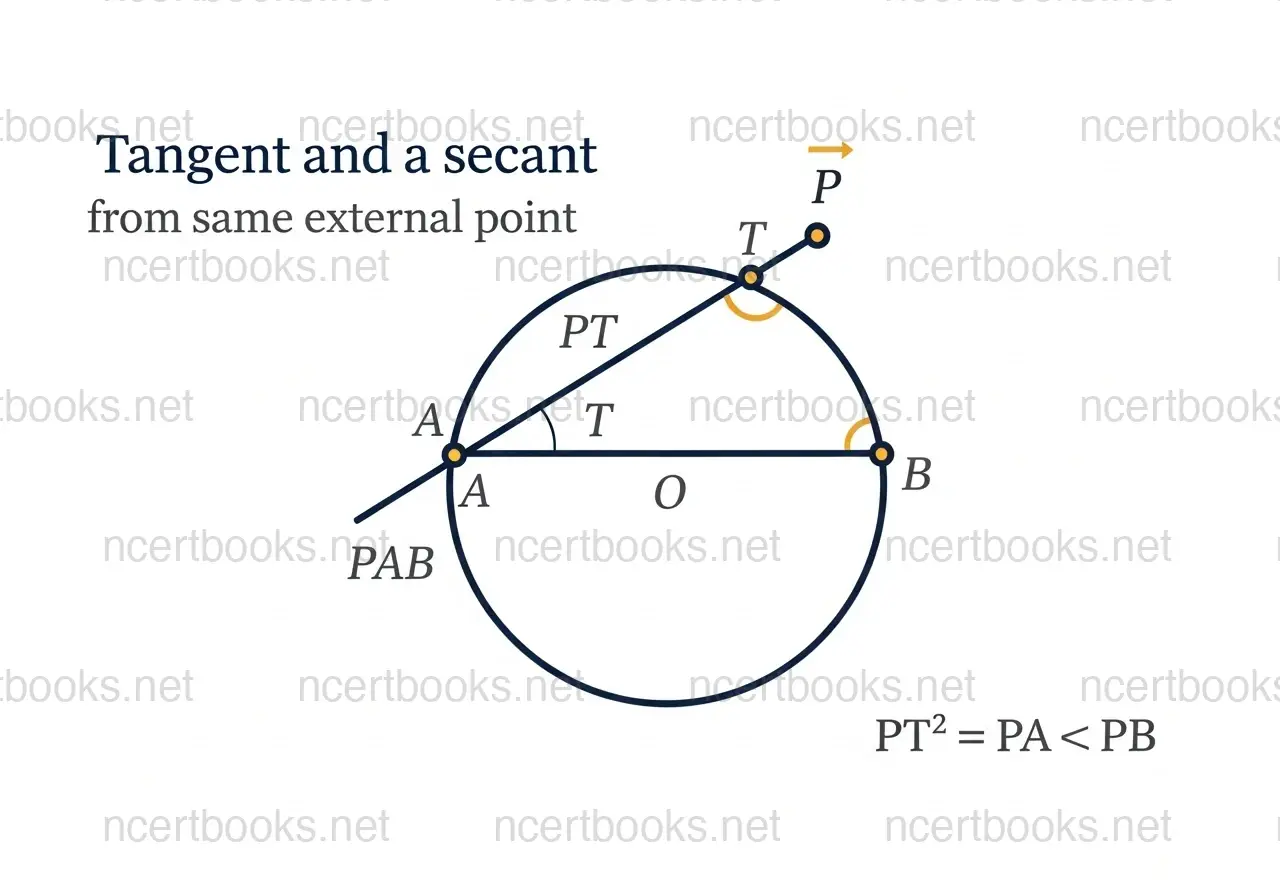
- Tangent definition (स्पर्श रेखा): A line that touches a circle at exactly one point — the point of contact.
- Secant definition (छेदक रेखा): A line that intersects a circle at two distinct points.
- Key Theorem: The tangent at any point on a circle is perpendicular to the radius at the point of contact.
- Tangents from external point: Exactly two tangents can be drawn from any point outside the circle, and they are equal in length.
- Parallel tangents: A circle can have at most two parallel tangents (at the ends of a diameter).
- Total tangents to a circle: Infinitely many (one at each point on the circumference).
- Tangent-length formula: If OP is radius and OQ is the distance from centre to external point, then tangent length \ ( PQ = \sqrt{OQ^2 – OP^2} \).
- Point inside circle: No tangent can be drawn from a point inside the circle.
The NCERT Solutions for Class 10 Maths Chapter 10 Circles on this page cover all questions from Exercise 10.1 with complete, step-by-step working — updated for the 2026-27 CBSE board exam. Whether you are revising tangents, secants, or circle theorems, these solutions from NCERT Solutions for Class 10 will help you understand every concept clearly and score full marks. You can also explore all subjects in our NCERT Solutions hub.
Table of Contents
- Quick Revision Box
- Chapter Overview — Class 10 Maths Chapter 10 Circles
- Key Concepts and Theorems
- NCERT Solutions Exercise 10.1 — All Questions
- Formula Reference Table
- Solved Examples Beyond NCERT
- Important Questions for Board Exam
- Common Mistakes Students Make
- Exam Tips for 2026-27
- Key Points to Remember
- Frequently Asked Questions
Chapter Overview — NCERT Solutions for Class 10 Maths Chapter 10 Circles
Chapter 10 of the NCERT Class 10 Maths textbook, Mathematics — Textbook for Class X, introduces you to the relationship between a circle and lines — specifically tangents and secants. You already studied basic properties of circles in Class 9; this chapter builds on that foundation by exploring how lines interact with circles and proving important theorems about tangent lengths and perpendicularity. You can download the official chapter from the NCERT official textbook portal.
For CBSE board exams, this chapter carries significant weight in the Geometry unit. Questions from Circles appear as 1-mark MCQs, 2-mark short answers, and 3-mark application problems. The most frequently tested topics are: the tangent-radius perpendicularity theorem, the equal-tangent-lengths theorem, and Pythagoras-based tangent-length calculations.
| Detail | Information |
|---|---|
| Chapter | Chapter 10 — Circles |
| Textbook | NCERT Mathematics Class X |
| Class | Class 10 |
| Subject | Mathematics |
| Exercises | Exercise 10.1 (4 Questions), Exercise 10.2 (13 Questions) |
| Difficulty Level | Easy to Medium |
| Academic Year | 2026-27 |
Key Concepts and Theorems — Circles Class 10
Tangent, Secant, and Non-Intersecting Lines
A line and a circle can relate to each other in three ways:
- Non-intersecting line: The line does not touch or cross the circle at any point.
- Secant (छेदक रेखा): The line intersects the circle at two distinct points. The chord formed between these two points is part of the secant.
- Tangent (स्पर्श रेखा): The line touches the circle at exactly one point. This point is called the point of contact (स्पर्श बिंदु).
A tangent is actually a special limiting case of a secant — when the two intersection points of a secant come closer and closer until they coincide, the secant becomes a tangent.
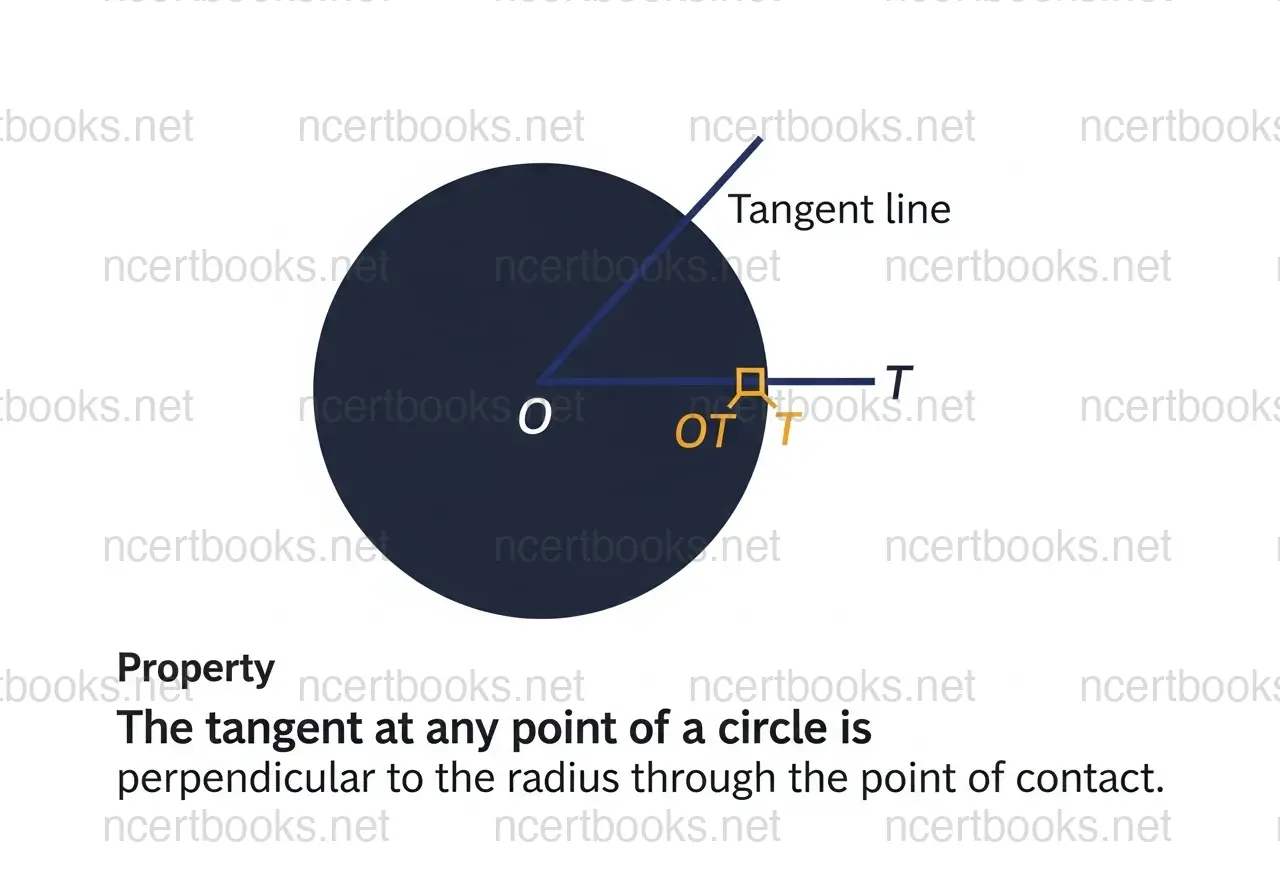
Theorem 1 — Tangent is Perpendicular to Radius at Point of Contact
Statement: The tangent at any point of a circle is perpendicular to the radius through the point of contact.
If O is the centre of a circle and P is the point of contact of a tangent, then:
\[ OP \perp \text{tangent at P} \]
Why does this matter? This theorem is the foundation for all tangent-length calculations. Whenever you see a tangent and a radius meeting, you immediately know the angle between them is 90°, which lets you apply the Pythagorean theorem.
Number of Tangents from a Point on a Circle
- Point inside the circle: No tangent can be drawn.
- Point on the circle: Exactly one tangent can be drawn.
- Point outside the circle: Exactly two tangents can be drawn, and their lengths are equal.
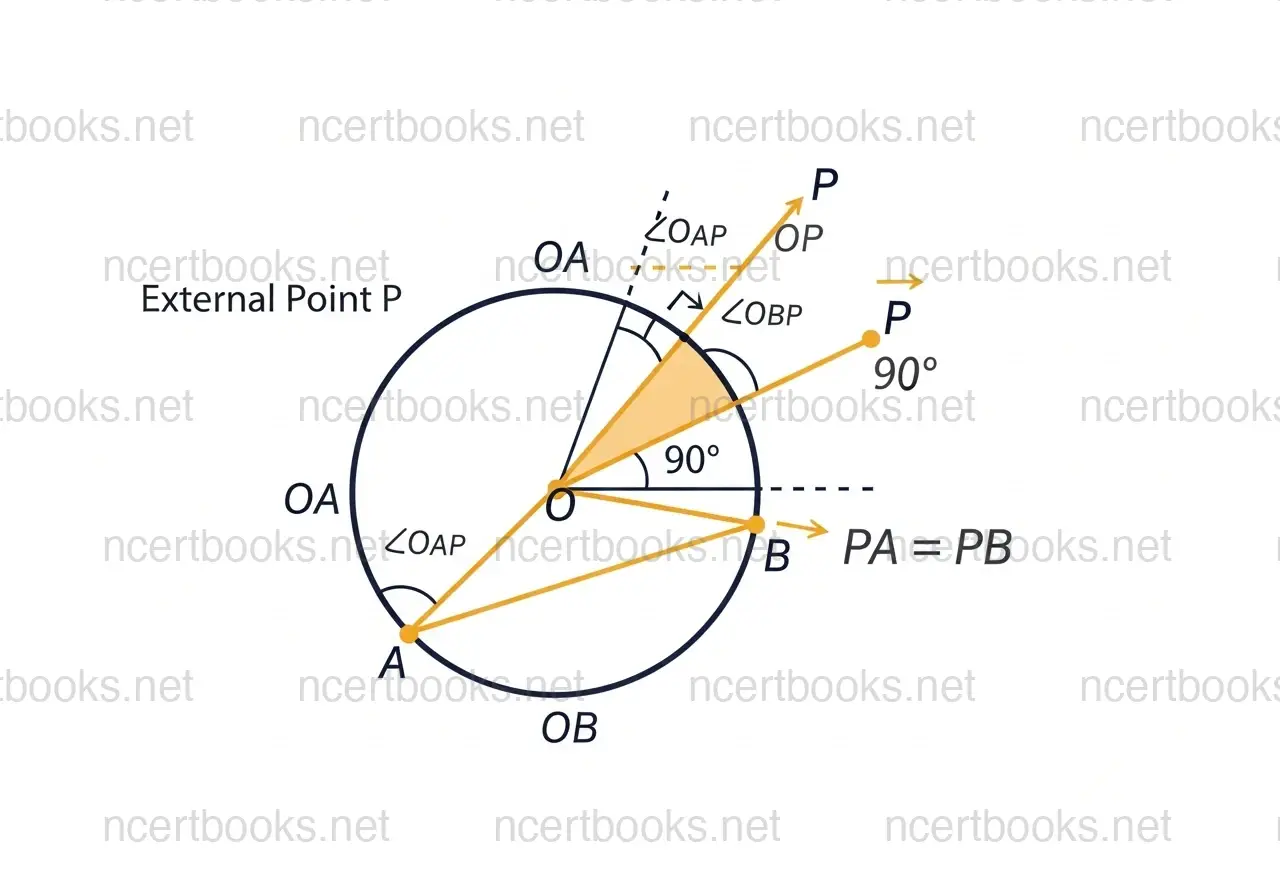
Theorem 2 — Equal Tangent Lengths from External Point
Statement: The lengths of the two tangents drawn from an external point to a circle are equal.
If PA and PB are two tangents from external point P to a circle with centre O, then:
\[ PA = PB \]
This is proved using the RHS congruence rule on triangles OAP and OBP (both right-angled at A and B respectively, sharing hypotenuse OP, with OA = OB = radius).
NCERT Solutions for Class 10 Maths Chapter 10 Circles — Exercise 10.1
Below are complete, step-by-step solutions for all 4 questions in Exercise 10.1 of the NCERT Solutions for Class 10 Maths Chapter 10 Circles. Every answer is written to match the CBSE marking scheme for 2026-27.
Question 1
Easy
How many tangents can a circle have?
Key Concept: A tangent is a line that touches a circle at exactly one point. Since a circle is a continuous curve made up of infinitely many points, a tangent can be drawn at each of those points.
Step 1: Recall the definition — a tangent to a circle touches it at one and only one point (the point of contact).
Step 2: A circle has infinitely many points on its circumference.
Step 3: At each point on the circumference, exactly one tangent can be drawn (perpendicular to the radius at that point).
Answer: A circle can have infinitely many tangents — one at each point on its circumference.
Question 2
Easy
Fill in the blanks:
(i) A tangent to a circle intersects it in ………… point(s).
(ii) A line intersecting a circle in two points is called a …………
(iii) A circle can have ………………. parallel tangents at the most.
(iv) The common point of a tangent to a circle and the circle is called ……….. .
Reasoning: By definition, a tangent touches the circle at exactly one point — it does not cross through the circle.
Answer: ONE
Reasoning: When a line cuts through a circle and meets it at two distinct points, that line is called a secant (छेदक रेखा). The chord formed between the two points lies inside the circle.
Answer: SECANT
Reasoning: Two parallel tangents can be drawn to a circle — one on each side, touching the circle at the two endpoints of a diameter. A third parallel tangent is impossible because it would either miss the circle entirely or intersect it at two points (making it a secant, not a tangent).
Answer: TWO
Reasoning: The single point where a tangent line meets the circle is specifically named the point of contact (स्पर्श बिंदु). At this point, the tangent is perpendicular to the radius of the circle.
Answer: POINT OF CONTACT (स्पर्श बिंदु)
Question 3
Medium
A tangent PQ at a point P of a circle of radius 5 cm meets a line through the centre O at a point Q so that OQ = 12 cm. Length PQ is:
(a) 12 cm (b) 13 cm (c) 8.5 cm (d) \( \sqrt{119} \) cm
Key Concept: The tangent at any point on a circle is perpendicular to the radius at the point of contact. So \( OP \perp PQ \), meaning triangle OPQ is right-angled at P.
Step 1: Identify the given values.
- Radius \( OP = 5 \) cm (given)
- Distance from centre to Q: \( OQ = 12 \) cm (given)
- Angle OPQ = 90° (tangent ⊥ radius at point of contact)
Step 2: Apply Pythagoras’ theorem to right-angled triangle OPQ (right angle at P):
\[ OQ^2 = OP^2 + PQ^2 \]
Step 3: Substitute the known values:
\[ 12^2 = 5^2 + PQ^2 \]
\[ 144 = 25 + PQ^2 \]
\[ PQ^2 = 144 – 25 = 119 \]
\[ PQ = \sqrt{119} \text{ cm} \]
Step 4: Verify — \( \sqrt{119} \approx 10.9 \) cm. Check: \( 5^2 + (\sqrt{119})^2 = 25 + 119 = 144 = 12^2 \). ✓
\( \therefore \) Answer: (d) \( \sqrt{119} \) cm
Question 4
Easy
Draw a circle and two lines parallel to a given line such that one is a tangent and the other, a secant to the circle.
Key Concept: This is a construction-based question. You need to draw a circle, choose a reference line, and then draw two parallel lines — one touching the circle (tangent) and one cutting through it (secant).
Step 1: Draw a circle with centre O and any convenient radius (say 3 cm).
Step 2: Draw a given line \( l \) (the reference line) — this line does not need to interact with the circle. Place it below or to the side of the circle.
Step 3: Draw line \( m \) parallel to \( l \) such that it touches the circle at exactly one point. This is the tangent to the circle. (To do this precisely: draw a radius OP perpendicular to \( l \), and draw \( m \) through P perpendicular to OP. Since \( l \) and \( m \) are both perpendicular to OP, they are parallel.)
Step 4: Draw line \( n \) parallel to \( l \) such that it cuts through the circle at two points A and B. This is the secant to the circle. Line \( n \) must pass through the interior of the circle.
Step 5: Verify: Lines \( l \), \( m \), and \( n \) are all parallel. Line \( m \) is the tangent (meets circle at one point P). Line \( n \) is the secant (meets circle at two points A and B).
Result: The construction shows three parallel lines — the given line \( l \), the tangent \( m \) (touching the circle at one point), and the secant \( n \) (intersecting the circle at two points). This confirms that through a circle, parallel lines can be both tangents and secants depending on their position relative to the circle.
[Diagram Description: A circle with centre O. Three horizontal parallel lines are shown — line l (below the circle, not touching it), line m (tangent, touching the bottom of the circle at point P), and line n (secant, passing through the interior of the circle and intersecting it at points A and B). The radius OP is drawn perpendicular to all three lines.]
Formula Reference Table — Circles Class 10
| Formula Name | Formula (LaTeX) | Variables Defined |
|---|---|---|
| Tangent length from external point | \( PT = \sqrt{OP^2 – r^2} \) | PT = tangent length, OP = distance from external point to centre, r = radius |
| Tangent perpendicular to radius | \( \angle OPT = 90^\circ \) | O = centre, P = point of contact, T = external point |
| Pythagoras in tangent triangle | \[ OT^2 = OP^2 + PT^2 \] | OT = hypotenuse (centre to external point), OP = radius, PT = tangent length |
| Equal tangents from external point | \( PA = PB \) | PA, PB = two tangents from external point P to circle |
| Angle between two tangents from external point | \( \angle APB + \angle AOB = 180^\circ \) | A, B = points of contact; O = centre; P = external point |
Solved Examples Beyond NCERT — Circles Chapter 10
Example 1 — Finding Tangent Length
Medium
From a point Q, the length of the tangent to a circle is 24 cm and the distance of Q from the centre is 25 cm. Find the radius of the circle.
Step 1: Let the radius = \( r \) cm, tangent length QT = 24 cm, OQ = 25 cm. Since tangent ⊥ radius at T:
\[ OQ^2 = OT^2 + QT^2 \]
Step 2: Substitute values:
\[ 25^2 = r^2 + 24^2 \]
\[ 625 = r^2 + 576 \]
\[ r^2 = 625 – 576 = 49 \]
\[ r = 7 \text{ cm} \]
\( \therefore \) Radius = 7 cm
Example 2 — Angle Between Tangents
Medium
Two tangents PA and PB are drawn from an external point P to a circle with centre O. If ∠APB = 60°, find ∠AOB.
Step 1: Use the property that \( \angle APB + \angle AOB = 180^\circ \) (since OAPB is a cyclic quadrilateral with two right angles at A and B).
Step 2: Substitute \( \angle APB = 60^\circ \):
\[ \angle AOB = 180^\circ – 60^\circ = 120^\circ \]
\( \therefore \) ∠AOB = 120°
Example 3 — Tangent from a Point on Concentric Circles
Hard
Two concentric circles have radii 5 cm and 13 cm. Find the length of the chord of the larger circle which is tangent to the smaller circle.
Step 1: Let O be the common centre. The chord AB of the larger circle is tangent to the smaller circle at point M. So OM ⊥ AB and OM = 5 cm (radius of smaller circle).
Step 2: OA = 13 cm (radius of larger circle). In right triangle OMA:
\[ AM^2 = OA^2 – OM^2 = 13^2 – 5^2 = 169 – 25 = 144 \]
\[ AM = 12 \text{ cm} \]
Step 3: Since OM ⊥ AB, M is the midpoint of AB. Therefore:
\[ AB = 2 \times AM = 2 \times 12 = 24 \text{ cm} \]
\( \therefore \) Length of chord AB = 24 cm
Topic-Wise Important Questions for Board Exam — NCERT Class 10 Maths Circles
1-Mark Questions (Definition / Fill-in)
- Q: What is a tangent to a circle?
A: A tangent to a circle is a line that touches the circle at exactly one point, called the point of contact (स्पर्श बिंदु). - Q: How many tangents can be drawn from a point inside a circle?
A: No tangent (zero tangents) can be drawn from a point inside the circle. - Q: What is the angle between the tangent and the radius at the point of contact?
A: The angle is always 90° (the tangent is perpendicular to the radius at the point of contact).
3-Mark Questions
- Q: Prove that the tangent at any point of a circle is perpendicular to the radius through the point of contact.
A: Let O be the centre and P the point of contact of tangent XY. For any other point Q on XY, Q lies outside the circle, so OQ > OP (radius is the shortest distance from centre to the tangent line). Since OP is the minimum distance from O to line XY, OP ⊥ XY. Hence the tangent is perpendicular to the radius at the point of contact. ∎ - Q: A point P is 13 cm from the centre of a circle of radius 5 cm. Find the length of the tangent from P to the circle.
A: Using Pythagoras: \( PT^2 = OP^2 – r^2 = 13^2 – 5^2 = 169 – 25 = 144 \), so \( PT = 12 \) cm.
5-Mark (Long Answer) Question
Q: Prove that the lengths of tangents drawn from an external point to a circle are equal.
A: Let O be the centre of the circle and P be an external point. Let PA and PB be the two tangents to the circle, touching at A and B respectively.
In triangles OAP and OBP:
- OA = OB (radii of the same circle)
- ∠OAP = ∠OBP = 90° (tangent ⊥ radius at point of contact)
- OP = OP (common hypotenuse)
By RHS congruence rule: △OAP ≅ △OBP
Therefore, PA = PB (by CPCT — Corresponding Parts of Congruent Triangles).
Hence, the lengths of the two tangents drawn from an external point to a circle are equal. ∎
Additional results from this congruence: ∠AOP = ∠BOP (OP bisects angle AOB) and ∠APO = ∠BPO (OP bisects angle APB).
Common Mistakes Students Make in Circles Chapter 10
Mistake 1: Students write that a circle has only 2 tangents.
Why it’s wrong: Two tangents can be drawn from a single external point. A circle itself has infinitely many tangents — one at every point on its circumference.
Correct approach: Always specify the context — “from an external point, 2 tangents; from the circle itself, infinitely many.”
Mistake 2: Students apply Pythagoras as \( OQ^2 = OP^2 – PQ^2 \) instead of \( OQ^2 = OP^2 + PQ^2 \).
Why it’s wrong: OQ is the hypotenuse (longest side) because it connects the centre to the external point, which is always farther than the radius.
Correct approach: Always identify OQ as the hypotenuse. Write \( PQ = \sqrt{OQ^2 – OP^2} \).
Mistake 3: In Q4 (construction), students draw the tangent and secant as non-parallel lines.
Why it’s wrong: The question specifically asks for both lines to be parallel to a given line.
Correct approach: Draw the radius perpendicular to the given line, then construct both the tangent and secant parallel to each other and to the given line.
Mistake 4: Students confuse “point of contact” with “centre” when describing where the tangent meets the circle.
Why it’s wrong: The centre is inside the circle; the point of contact is on the circumference.
Correct approach: The point of contact (स्पर्श बिंदु) is always on the circle’s boundary, not at the centre.
Mistake 5: Students forget to state “tangent ⊥ radius” as a reason when solving tangent-length problems, losing method marks.
Why it’s wrong: CBSE marking schemes award 1 mark specifically for stating this property.
Correct approach: Always write “Since PQ is a tangent and OP is the radius at the point of contact, ∠OPQ = 90°” before applying Pythagoras.
Exam Tips for 2026-27 — CBSE Class 10 Maths Circles
- Tip 1 — State the theorem first: In any tangent problem, write “tangent ⊥ radius at point of contact” as your first line. The CBSE 2026-27 marking scheme awards a step mark for this.
- Tip 2 — Identify the right-angle: In tangent-length problems, always mark the right angle in your diagram. Examiners check for correct labelling.
- Tip 3 — Proof questions: The proof of “tangents from external point are equal” (using RHS congruence) is a high-frequency 5-mark question. Memorise the three matching pairs: equal radii, 90° angles, common hypotenuse.
- Tip 4 — MCQ strategy: For Q3-type MCQs, eliminate options by checking whether the answer satisfies \( OQ^2 = OP^2 + PQ^2 \). Never guess without calculating.
- Tip 5 — Construction marks: For Q4-type construction questions, use a sharp pencil and ruler. Label every point (O, P, A, B). Write a brief description of what each line represents.
- Tip 6 — Revise Chapter 6 (Triangles): RHS and SAS congruence rules from Chapter 6 are used in Circle proofs. A quick revision of congruence criteria before your board exam will help.
For the 2026-27 CBSE board exam, Chapter 10 Circles is part of the Geometry unit, which typically contributes around 15 marks to the paper. Questions range from 1-mark definitions to 5-mark proofs. Practise both Exercise 10.1 and Exercise 10.2 thoroughly — Exercise 10.2 has more complex proof and application questions.
Key Points to Remember — Circles Class 10
- A tangent to a circle touches it at exactly one point — the point of contact (स्पर्श बिंदु).
- The tangent at any point is perpendicular to the radius at that point (∠ = 90°).
- From a point outside the circle: exactly two tangents, both equal in length.
- From a point on the circle: exactly one tangent.
- From a point inside the circle: no tangent possible.
- A circle has at most two parallel tangents, located at opposite ends of a diameter.
- A circle has infinitely many tangents in total (one per point on circumference).
For more practice on related topics, explore our solutions for NCERT Solutions for Class 10 Maths including Chapter 6 Triangles (congruence rules used in circle proofs) and Chapter 9 Some Applications of Trigonometry.
Frequently Asked Questions — Circles Class 10 Maths