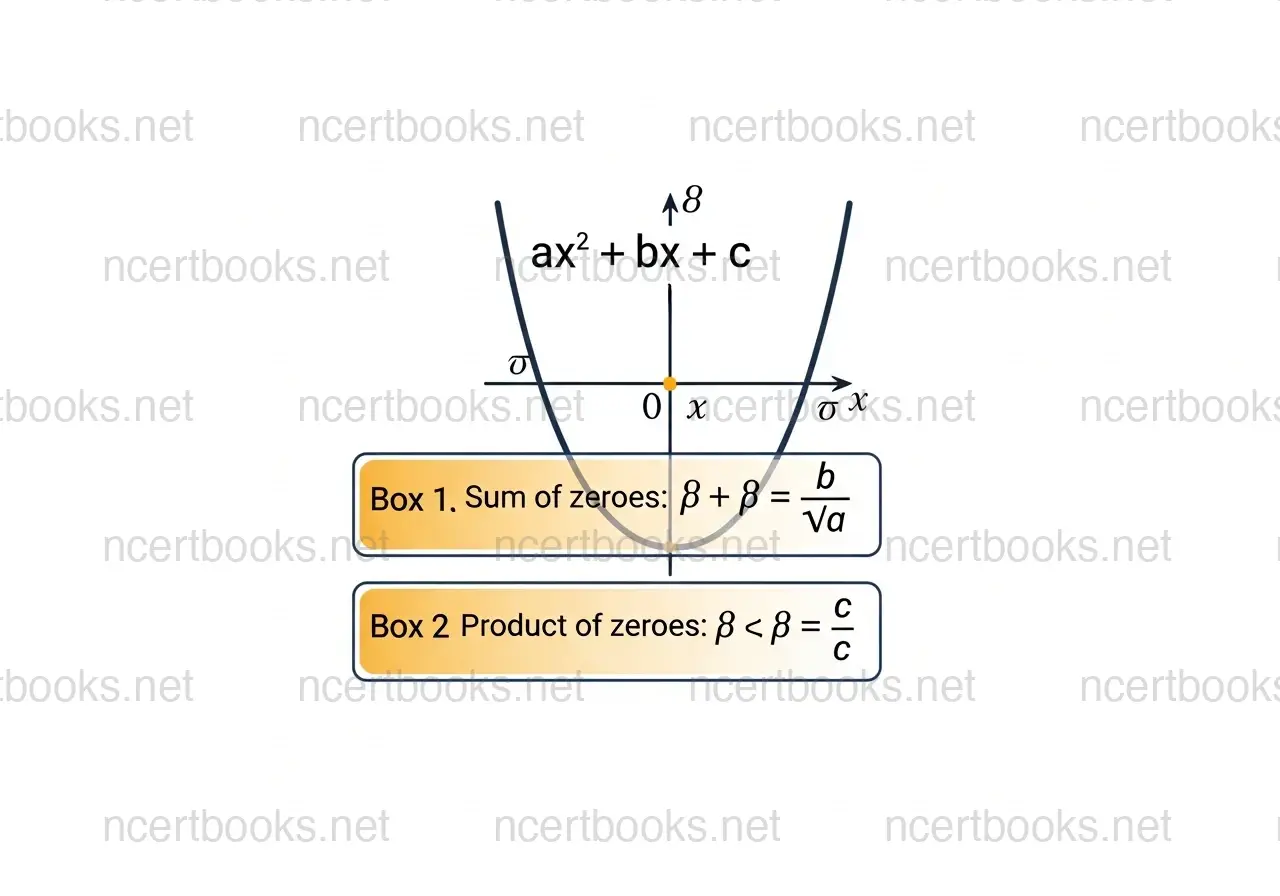
- Polynomial (बहुपद): An algebraic expression of the form \ ( a_0 + a_1x + a_2x^2 + \cdots + a_nx^n \) with real coefficients and non-negative integer exponents.
- Zero of a polynomial: A value \( x = r \) such that \( p(r) = 0 \). Geometrically, it is the x-coordinate where the graph crosses the x-axis.
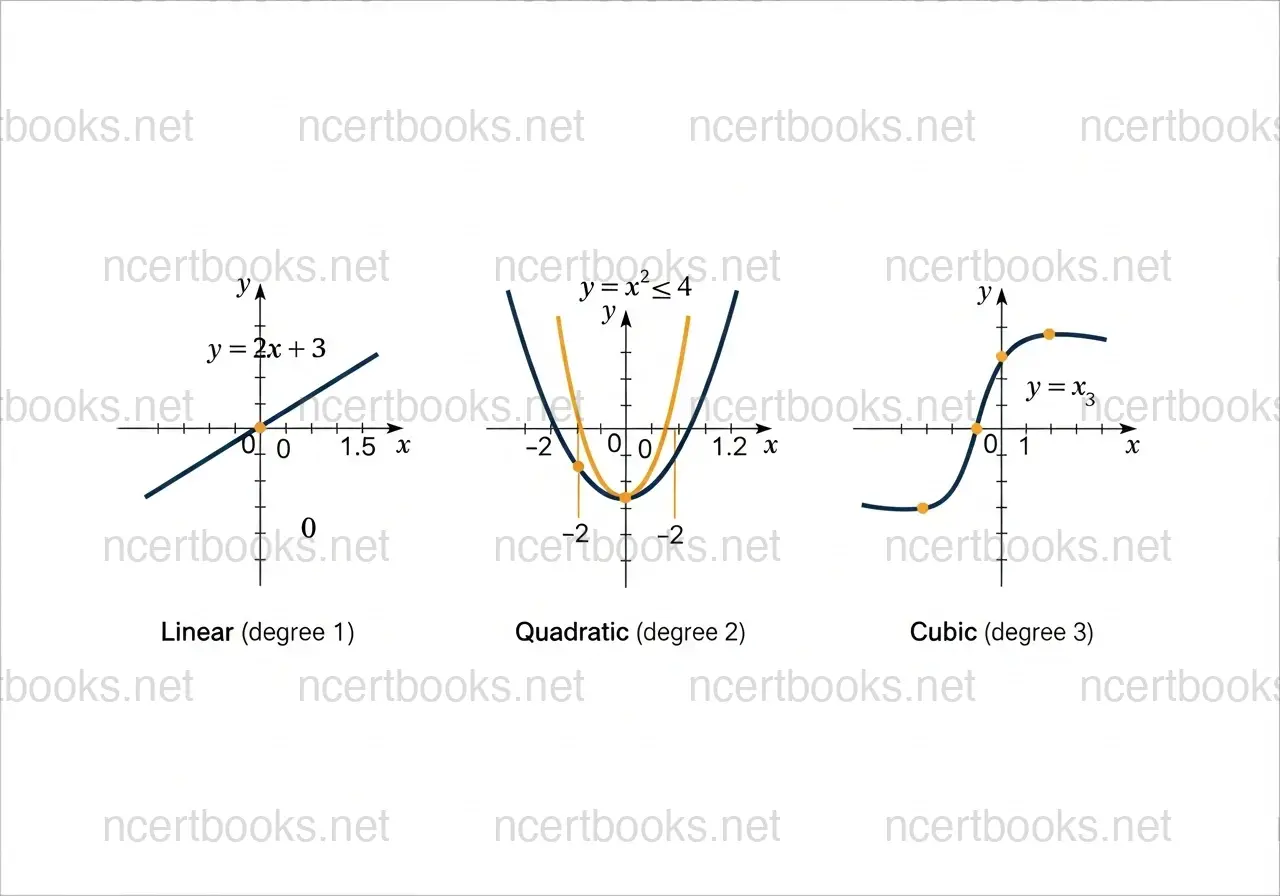
- Linear polynomial: At most 1 zero; graph is a straight line.
- Quadratic polynomial: At most 2 zeroes; graph is a parabola.
- Cubic polynomial: At most 3 zeroes.
- Sum of zeroes (quadratic): \( \alpha + \beta = -\frac{b}{a} \) | Product: \( \alpha\beta = \frac{c}{a} \)
- Division Algorithm: \( p(x) = g(x) \times q(x) + r(x) \), where \( r(x) = 0 \) or \( \deg r(x) < \deg g(x) \).
- Exercises covered: 2.1, 2.2, 2.3, 2.4 — all updated for 2026-27 CBSE syllabus.

These NCERT Solutions Class 10 Maths Chapter 2 Polynomials cover every question from Exercises 2.1 to 2.4 with complete step-by-step working, updated for the 2026-27 CBSE board exam. Whether you need help with finding zeroes of quadratic polynomials, verifying the relationship between zeroes and coefficients, or applying the division algorithm, this page has you covered. You can find all NCERT Solutions for Class 10 on our dedicated hub, and the full list of NCERT Solutions for all classes is also available. The official textbook is available on the NCERT official website.
Table of Contents
Chapter Overview — Polynomials Class 10 (CBSE 2026-27)
Chapter 2 of the NCERT Class 10 Mathematics textbook (Mathematics — Textbook for Class X, published by NCERT) introduces you to polynomials in depth. You will learn the geometrical meaning of zeroes, the algebraic relationship between zeroes and coefficients, and the division algorithm for polynomials — all essential for the 2026-27 CBSE board exam.
In board exams, questions from this chapter appear as 1-mark MCQs (identifying number of zeroes from a graph), 2–3 mark short-answer questions (finding zeroes and verifying coefficient relationships), and 4–5 mark long-answer questions (division algorithm and cubic polynomial problems). The chapter carries approximately 6–8 marks in the algebra unit.
| Detail | Information |
|---|---|
| Chapter | Chapter 2 — Polynomials |
| Textbook | NCERT Mathematics Class 10 |
| Class | Class 10 (Grade 10) |
| Subject | Mathematics |
| Unit | Unit II — Algebra |
| Difficulty Level | Medium |
| Academic Year | 2026-27 |
Key Concepts and Theorems — Chapter 2 Polynomials
What is a Polynomial? (बहुपद)
A polynomial in variable \( x \) is an expression of the form:
\[ f(x) = a_0 + a_1x + a_2x^2 + \cdots + a_nx^n \]
where \( a_0, a_1, \ldots, a_n \) are real numbers and all exponents are non-negative integers. The highest power of \( x \) is called the degree of the polynomial.
Standard Forms of Polynomials
- Linear Polynomial: \( ax + b \), where \( a \neq 0 \). Has exactly one zero: \( x = -\frac{b}{a} \).
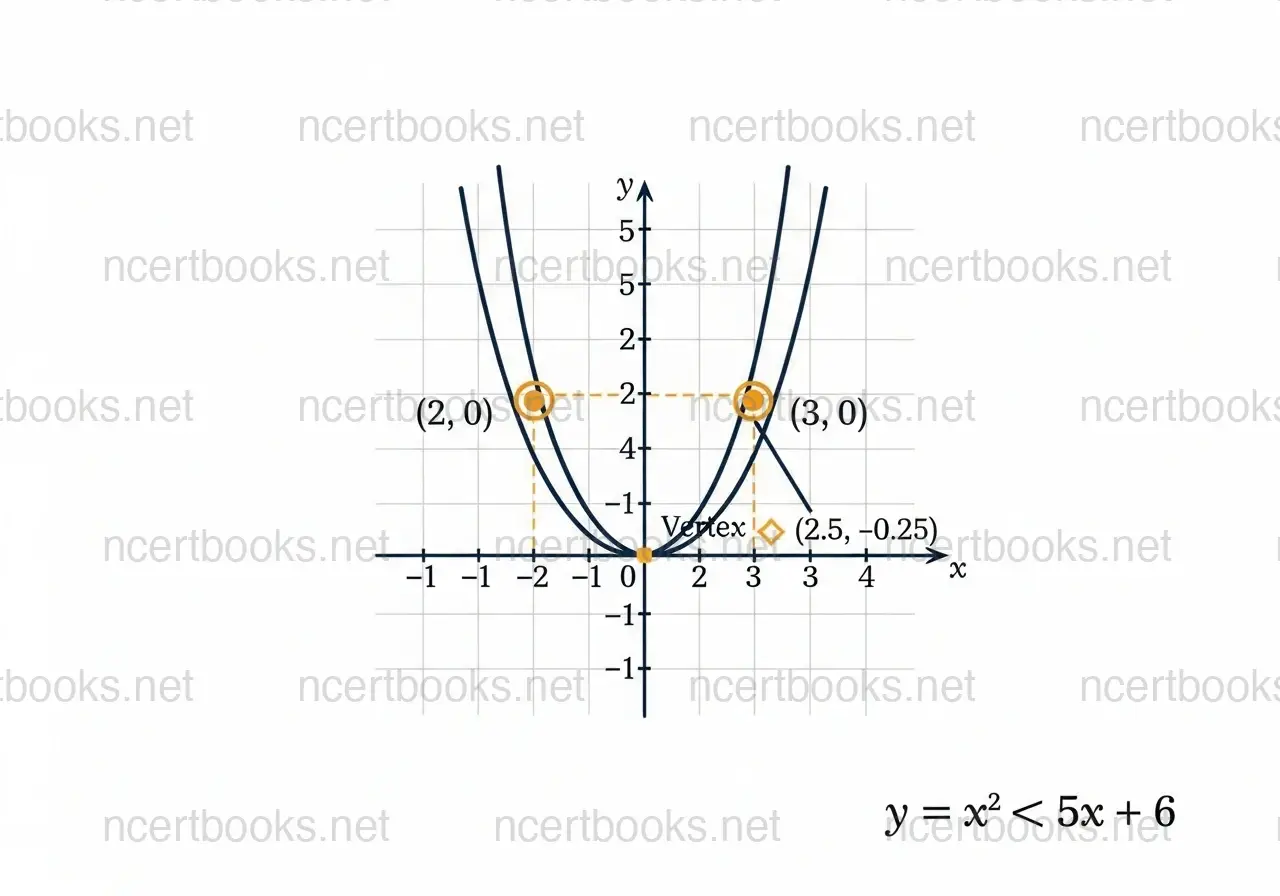
- Quadratic Polynomial: \( ax^2 + bx + c \), where \( a \neq 0 \). Has at most two zeroes. Graph is a parabola.
- Cubic Polynomial: \( ax^3 + bx^2 + cx + d \), where \( a \neq 0 \). Has at most three zeroes.
Zeroes of a Polynomial (बहुपद के शून्यक)
A real number \( r \) is called a zero of polynomial \( p(x) \) if \( p(r) = 0 \). Geometrically, the zeroes are the x-coordinates of the points where the graph \( y = p(x) \) intersects the x-axis. This is the key idea tested in Exercise 2.1.
Relationship Between Zeroes and Coefficients
For a quadratic polynomial \( ax^2 + bx + c \) with zeroes \( \alpha \) and \( \beta \):
\[ \alpha + \beta = -\frac{b}{a} \qquad \text{(Sum of zeroes)} \]
\[ \alpha \beta = \frac{c}{a} \qquad \text{(Product of zeroes)} \]
For a cubic polynomial \( ax^3 + bx^2 + cx + d \) with zeroes \( \alpha, \beta, \gamma \):
\[ \alpha + \beta + \gamma = -\frac{b}{a} \]
\[ \alpha\beta + \beta\gamma + \gamma\alpha = \frac{c}{a} \]
\[ \alpha\beta\gamma = -\frac{d}{a} \]
Division Algorithm for Polynomials
If \( p(x) \) and \( g(x) \) are polynomials with \( g(x) \neq 0 \), then there exist unique polynomials \( q(x) \) (quotient) and \( r(x) \) (remainder) such that:
\[ p(x) = g(x) \times q(x) + r(x) \]
where \( r(x) = 0 \) or \( \deg r(x) < \deg g(x) \). This mirrors the Euclid division lemma for integers.
NCERT Solutions Class 10 Maths Chapter 2 Polynomials — All Exercises (2026-27)
Exercise 2.1 — Geometrical Meaning of Zeroes of a Polynomial
Question 1
Easy
The graphs of \( y = p(x) \) are given below for some polynomials \( p(x) \). Find the number of zeroes of \( p(x) \) in each case.
Key Concept: The number of zeroes of \( p(x) \) equals the number of times the graph \( y = p(x) \) intersects the x-axis.
Observation: The graph does not intersect the x-axis at any point.
\( \therefore \) Number of zeroes = 0
Observation: The graph intersects the x-axis at exactly one point.
\( \therefore \) Number of zeroes = 1
Observation: The graph intersects the x-axis at exactly three points.
\( \therefore \) Number of zeroes = 3
Observation: The graph intersects the x-axis at exactly two points.
\( \therefore \) Number of zeroes = 2
Observation: The graph intersects the x-axis at exactly four points.
\( \therefore \) Number of zeroes = 4
\( \therefore \) Number of zeroes = 3
Exercise 2.2 — Relationship Between Zeroes and Coefficients
Question 1
Medium
Find the zeroes of the following quadratic polynomials and verify the relationship between the zeroes and their coefficients.
Step 1: Factorise \( x^2 – 2x – 8 \).
\[ x^2 – 2x – 8 = x^2 – 4x + 2x – 8 = x(x-4) + 2(x-4) = (x-4)(x+2) \]
Step 2: Set each factor to zero.
\[ x – 4 = 0 \Rightarrow x = 4 \qquad x + 2 = 0 \Rightarrow x = -2 \]
Verification: Here \( a=1, b=-2, c=-8 \).
Sum of zeroes: \( 4 + (-2) = 2 = -\frac{(-2)}{1} = -\frac{b}{a} \) ✓
Product of zeroes: \( 4 \times (-2) = -8 = \frac{-8}{1} = \frac{c}{a} \) ✓
\( \therefore \) Zeroes are 4 and −2.
Step 1: Factorise \( 4s^2 – 4s + 1 \).
\[ 4s^2 – 4s + 1 = (2s-1)^2 \]
Step 2: Set \( (2s-1)^2 = 0 \Rightarrow s = \frac{1}{2} \) (repeated zero).
Verification: \( a=4, b=-4, c=1 \).
Sum: \( \frac{1}{2} + \frac{1}{2} = 1 = -\frac{(-4)}{4} \) ✓ Product: \( \frac{1}{2} \times \frac{1}{2} = \frac{1}{4} = \frac{1}{4} \) ✓
\( \therefore \) Zero is \( \frac{1}{2} \) (repeated).
Step 1: Rewrite as \( 6x^2 – 7x – 3 \). Factorise by splitting the middle term.
\[ 6x^2 – 9x + 2x – 3 = 3x(2x-3) + 1(2x-3) = (3x+1)(2x-3) \]
Step 2: Zeroes: \( x = -\frac{1}{3} \) and \( x = \frac{3}{2} \).
Verification: \( a=6, b=-7, c=-3 \).
Sum: \( -\frac{1}{3} + \frac{3}{2} = \frac{-2+9}{6} = \frac{7}{6} = -\frac{(-7)}{6} \) ✓ Product: \( -\frac{1}{3} \times \frac{3}{2} = -\frac{1}{2} = \frac{-3}{6} \) ✓
\( \therefore \) Zeroes are \( -\frac{1}{3} \) and \( \frac{3}{2} \).
Step 1: Factorise: \( 4u^2 + 8u = 4u(u + 2) \).
Step 2: Zeroes: \( u = 0 \) and \( u = -2 \).
Verification: \( a=4, b=8, c=0 \).
Sum: \( 0 + (-2) = -2 = -\frac{8}{4} \) ✓ Product: \( 0 \times (-2) = 0 = \frac{0}{4} \) ✓
\( \therefore \) Zeroes are 0 and −2.
Step 1: \( t^2 – 15 = 0 \Rightarrow t^2 = 15 \Rightarrow t = \pm\sqrt{15} \).
Verification: \( a=1, b=0, c=-15 \).
Sum: \( \sqrt{15} + (-\sqrt{15}) = 0 = -\frac{0}{1} \) ✓ Product: \( \sqrt{15} \times (-\sqrt{15}) = -15 = \frac{-15}{1} \) ✓
\( \therefore \) Zeroes are \( \sqrt{15} \) and \( -\sqrt{15} \).
Step 1: Factorise: \( 3x^2 – 4x + 3x – 4 = x(3x-4) + 1(3x-4) = (x+1)(3x-4) \).
Step 2: Zeroes: \( x = -1 \) and \( x = \frac{4}{3} \).
Verification: \( a=3, b=-1, c=-4 \).
Sum: \( -1 + \frac{4}{3} = \frac{1}{3} = -\frac{(-1)}{3} \) ✓ Product: \( -1 \times \frac{4}{3} = -\frac{4}{3} = \frac{-4}{3} \) ✓
\( \therefore \) Zeroes are −1 and \( \frac{4}{3} \).
Question 2
Medium
Find a quadratic polynomial each with the given numbers as the sum and product of its zeroes respectively: (i) \( \frac{1}{4}, -1 \) (ii) \( \sqrt{2}, \frac{1}{3} \) (iii) \( 0, \sqrt{5} \) (iv) \( 1, 1 \) (v) \( -\frac{1}{4}, \frac{1}{4} \) (vi) \( 4, 1 \)
Key Concept: A quadratic polynomial with sum \( S \) and product \( P \) of zeroes is \( k(x^2 – Sx + P) \) for any non-zero constant \( k \). Take \( k = 1 \) for simplest form.
Polynomial: \( 4x^2 – x – 4 \)
Polynomial: \( 3x^2 – 3\sqrt{2}x + 1 \)
Polynomial: \( x^2 + \sqrt{5} \)
Polynomial: \( x^2 – x + 1 \)
Polynomial: \( 4x^2 + x + 1 \)
Polynomial: \( x^2 – 4x + 1 \)
Exercise 2.3 — Division Algorithm for Polynomials
Question 1
Medium
Divide the polynomial \( p(x) \) by the polynomial \( g(x) \) and find the quotient and remainder in each case.
Step 1: Divide the leading term \( x^3 \) by \( x^2 \) to get \( x \). Multiply: \( x(x^2 – 2) = x^3 – 2x \).
Step 2: Subtract: \( (x^3 – 3x^2 + 5x – 3) – (x^3 – 2x) = -3x^2 + 7x – 3 \).
Step 3: Divide \( -3x^2 \) by \( x^2 \) to get \( -3 \). Multiply: \( -3(x^2 – 2) = -3x^2 + 6 \).
Step 4: Subtract: \( (-3x^2 + 7x – 3) – (-3x^2 + 6) = 7x – 9 \).
Degree of \( 7x – 9 \) is 1, which is less than degree of \( g(x) = 2 \). Stop.
\( \therefore \) Quotient \( q(x) = x – 3 \), Remainder \( r(x) = 7x – 9 \)
Step 1: Rewrite \( g(x) = x^2 – x + 1 \).
Step 2: Divide \( x^4 \) by \( x^2 \) → \( x^2 \). Multiply: \( x^2(x^2 – x + 1) = x^4 – x^3 + x^2 \).
Step 3: Subtract: \( x^4 – 3x^2 + 4x + 5 – (x^4 – x^3 + x^2) = x^3 – 4x^2 + 4x + 5 \).
Step 4: Divide \( x^3 \) by \( x^2 \) → \( x \). Multiply: \( x(x^2 – x + 1) = x^3 – x^2 + x \).
Step 5: Subtract: \( x^3 – 4x^2 + 4x + 5 – (x^3 – x^2 + x) = -3x^2 + 3x + 5 \).
Step 6: Divide \( -3x^2 \) by \( x^2 \) → \( -3 \). Multiply: \( -3(x^2 – x + 1) = -3x^2 + 3x – 3 \).
Step 7: Subtract: \( -3x^2 + 3x + 5 – (-3x^2 + 3x – 3) = 8 \).
\( \therefore \) Quotient \( q(x) = x^2 + x – 3 \), Remainder \( r(x) = 8 \)
Step 1: Rewrite \( g(x) = -x^2 + 2 \). Divide \( x^4 \) by \( -x^2 \) → \( -x^2 \).
Step 2: Multiply: \( -x^2(-x^2 + 2) = x^4 – 2x^2 \). Subtract: \( x^4 – 5x + 6 – (x^4 – 2x^2) = 2x^2 – 5x + 6 \).
Step 3: Divide \( 2x^2 \) by \( -x^2 \) → \( -2 \). Multiply: \( -2(-x^2 + 2) = 2x^2 – 4 \).
Step 4: Subtract: \( 2x^2 – 5x + 6 – (2x^2 – 4) = -5x + 10 \).
\( \therefore \) Quotient \( q(x) = -x^2 – 2 \), Remainder \( r(x) = -5x + 10 \)
Question 2
Medium
Check whether the first polynomial is a factor of the second polynomial by dividing the second polynomial by the first polynomial.
Step 1: Divide \( 2t^4 + 3t^3 – 2t^2 – 9t – 12 \) by \( t^2 – 3 \).
Performing long division: Quotient \( = 2t^2 + 3t + 4 \), Remainder \( = 0 \).
Why does this work? Since remainder = 0, \( t^2 – 3 \) divides the second polynomial exactly.
\( \therefore \) Yes, \( t^2 – 3 \) is a factor.
Step 1: Divide \( 3x^4 + 5x^3 – 7x^2 + 2x + 2 \) by \( x^2 + 3x + 1 \).
Quotient \( = 3x^2 – 4x + 2 \), Remainder \( = 0 \).
\( \therefore \) Yes, \( x^2 + 3x + 1 \) is a factor.
Step 1: Divide \( x^5 – 4x^3 + x^2 + 3x + 1 \) by \( x^3 – 3x + 1 \).
Quotient \( = x^2 – 1 \), Remainder \( = 2 \neq 0 \).
\( \therefore \) No, \( x^3 – 3x + 1 \) is NOT a factor.
Question 3
Hard
Obtain all other zeroes of \( 3x^4 + 6x^3 – 2x^2 – 10x – 5 \), if two of its zeroes are \( \sqrt{\frac{5}{3}} \) and \( -\sqrt{\frac{5}{3}} \).
Step 1: Since \( \sqrt{\frac{5}{3}} \) and \( -\sqrt{\frac{5}{3}} \) are zeroes, \( \left(x – \sqrt{\frac{5}{3}}\right)\left(x + \sqrt{\frac{5}{3}}\right) = x^2 – \frac{5}{3} \) is a factor.
Multiply by 3: \( 3x^2 – 5 \) is a factor of \( 3x^4 + 6x^3 – 2x^2 – 10x – 5 \).
Step 2: Divide \( 3x^4 + 6x^3 – 2x^2 – 10x – 5 \) by \( 3x^2 – 5 \).
\[ 3x^4 + 6x^3 – 2x^2 – 10x – 5 = (3x^2 – 5)(x^2 + 2x + 1) \]
Step 3: Factorise \( x^2 + 2x + 1 = (x+1)^2 \). So the remaining zeroes are \( x = -1 \) (repeated).
\( \therefore \) All four zeroes: \( \sqrt{\frac{5}{3}},\ -\sqrt{\frac{5}{3}},\ -1,\ -1 \)
Question 4
Hard
On dividing \( x^3 – 3x^2 + x + 2 \) by a polynomial \( g(x) \), the quotient and remainder were \( x – 2 \) and \( -2x + 4 \) respectively. Find \( g(x) \).
Step 1: Use the division algorithm: \( p(x) = g(x) \times q(x) + r(x) \).
\[ x^3 – 3x^2 + x + 2 = g(x) \times (x-2) + (-2x+4) \]
Step 2: Rearrange:
\[ g(x) \times (x-2) = x^3 – 3x^2 + x + 2 – (-2x + 4) = x^3 – 3x^2 + 3x – 2 \]
Step 3: Divide \( x^3 – 3x^2 + 3x – 2 \) by \( x – 2 \).
\[ x^3 – 3x^2 + 3x – 2 = (x-2)(x^2 – x + 1) \]
\( \therefore \) \( g(x) = x^2 – x + 1 \)
Question 5
Medium
Give examples of polynomials \( p(x) \), \( g(x) \), \( q(x) \) and \( r(x) \) which satisfy the division algorithm and: (i) deg \( p(x) \) = deg \( q(x) \) (ii) deg \( q(x) \) = deg \( r(x) \) (iii) deg \( r(x) \) = 0
This happens when \( g(x) \) is a constant. Let \( p(x) = 2x^2 + 2x + 2 \), \( g(x) = 2 \), \( q(x) = x^2 + x + 1 \), \( r(x) = 0 \).
Check: \( 2(x^2+x+1) + 0 = 2x^2+2x+2 \) ✓ Both \( p(x) \) and \( q(x) \) have degree 2.
Example valid.
Let \( p(x) = x^3 + x \), \( g(x) = x^2 – 1 \), \( q(x) = x \), \( r(x) = 2x \).
Check: \( (x^2-1)(x) + 2x = x^3 – x + 2x = x^3 + x \) ✓ Both \( q(x) \) and \( r(x) \) have degree 1.
Example valid.
Let \( p(x) = x^3 + 1 \), \( g(x) = x^2 \), \( q(x) = x \), \( r(x) = 1 \).
Check: \( x^2 \cdot x + 1 = x^3 + 1 \) ✓ Remainder is a non-zero constant, so degree = 0.
Example valid.
Exercise 2.4 — Cubic Polynomial Zeroes and Coefficients
Question 1
Medium
Verify that the numbers given alongside the cubic polynomials below are their zeroes. Also verify the relationship between zeroes and coefficients.
Step 1: Verify zeroes by substitution.
\( p\left(\frac{1}{2}\right) = 2\cdot\frac{1}{8} + \frac{1}{4} – \frac{5}{2} + 2 = \frac{1}{4} + \frac{1}{4} – \frac{5}{2} + 2 = 0 \) ✓
\( p(1) = 2 + 1 – 5 + 2 = 0 \) ✓ \( p(-2) = 2(-8) + 4 – 5(-2) + 2 = -16 + 4 + 10 + 2 = 0 \) ✓
Step 2: Verify relationships. \( a=2, b=1, c=-5, d=2 \).
Sum: \( \frac{1}{2} + 1 + (-2) = -\frac{1}{2} = -\frac{b}{a} \) ✓
Sum of products of pairs: \( \frac{1}{2}(1) + 1(-2) + \frac{1}{2}(-2) = \frac{1}{2} – 2 – 1 = -\frac{5}{2} = \frac{c}{a} \) ✓
Product: \( \frac{1}{2} \times 1 \times (-2) = -1 = -\frac{2}{2} = -\frac{d}{a} \) ✓
\( \therefore \) All verified.
\( p(2) = 8 – 16 + 10 – 2 = 0 \) ✓ \( p(1) = 1 – 4 + 5 – 2 = 0 \) ✓
\( a=1, b=-4, c=5, d=-2 \).
Sum: \( 2+1+1 = 4 = -\frac{(-4)}{1} \) ✓ Sum of pairs: \( 2(1)+1(1)+2(1) = 2+1+2 = 5 = \frac{5}{1} \) ✓ Product: \( 2 \times 1 \times 1 = 2 = -\frac{(-2)}{1} \) ✓
\( \therefore \) All verified.
Question 2
Medium
Find a cubic polynomial with the sum, sum of product of its zeroes taken two at a time, and the product of its zeroes as \( 2, -7, -14 \) respectively.
Key Concept: A cubic polynomial with zeroes \( \alpha, \beta, \gamma \) is:
\[ k\left[x^3 – (\alpha+\beta+\gamma)x^2 + (\alpha\beta+\beta\gamma+\gamma\alpha)x – \alpha\beta\gamma\right] \]
Step 1: Substitute: sum \( = 2 \), sum of pairs \( = -7 \), product \( = -14 \). Take \( k = 1 \).
\[ p(x) = x^3 – 2x^2 + (-7)x – (-14) = x^3 – 2x^2 – 7x + 14 \]
\( \therefore \) Cubic polynomial: \( x^3 – 2x^2 – 7x + 14 \)
Question 3
Hard
If the zeroes of the polynomial \( x^3 – 3x^2 + x + 1 \) are \( a-b,\ a,\ a+b \), find \( a \) and \( b \).
Step 1: Sum of zeroes: \( (a-b) + a + (a+b) = 3a = -\frac{(-3)}{1} = 3 \Rightarrow a = 1 \).
Step 2: Product of zeroes: \( (a-b) \cdot a \cdot (a+b) = a(a^2 – b^2) = -\frac{1}{1} = -1 \).
Substitute \( a = 1 \): \( 1(1 – b^2) = -1 \Rightarrow 1 – b^2 = -1 \Rightarrow b^2 = 2 \Rightarrow b = \pm\sqrt{2} \).
\( \therefore \) \( a = 1 \) and \( b = \pm\sqrt{2} \)
Question 4
Hard
If two zeroes of the polynomial \( x^4 – 6x^3 – 26x^2 + 138x – 35 \) are \( 2 \pm \sqrt{3} \), find the other zeroes.
Step 1: Since \( 2 + \sqrt{3} \) and \( 2 – \sqrt{3} \) are zeroes, \( (x – 2 – \sqrt{3})(x – 2 + \sqrt{3}) = (x-2)^2 – 3 = x^2 – 4x + 1 \) is a factor.
Step 2: Divide \( x^4 – 6x^3 – 26x^2 + 138x – 35 \) by \( x^2 – 4x + 1 \).
\[ x^4 – 6x^3 – 26x^2 + 138x – 35 = (x^2 – 4x + 1)(x^2 – 2x – 35) \]
Step 3: Factorise \( x^2 – 2x – 35 = (x-7)(x+5) \).
Remaining zeroes: \( x = 7 \) and \( x = -5 \).
\( \therefore \) Other zeroes are 7 and −5.
Question 5
Hard
If the polynomial \( x^4 – 6x^3 + 16x^2 – 25x + 10 \) is divided by another polynomial \( x^2 – 2x + k \), the remainder comes out to be \( x + a \). Find \( k \) and \( a \).
Step 1: Perform the division of \( x^4 – 6x^3 + 16x^2 – 25x + 10 \) by \( x^2 – 2x + k \).
Quotient: \( x^2 – 4x + (8-k) \).
Remainder: \( (2k-9)x + (10 – 8k + k^2) \).
Step 2: Compare with \( x + a \):
Coefficient of \( x \): \( 2k – 9 = 1 \Rightarrow k = 5 \).
Constant: \( a = 10 – 8(5) + 25 = 10 – 40 + 25 = -5 \).
\( \therefore \) \( k = 5 \) and \( a = -5 \)
Formula Reference Table — Class 10 Maths Chapter 2 Polynomials
| Formula Name | Formula | Variables Defined |
|---|---|---|
| Zero of linear polynomial | \( x = -\frac{b}{a} \) | \( ax + b \), \( a \neq 0 \) |
| Sum of zeroes (quadratic) | \( \alpha + \beta = -\frac{b}{a} \) | \( ax^2 + bx + c \) |
| Product of zeroes (quadratic) | \( \alpha\beta = \frac{c}{a} \) | \( ax^2 + bx + c \) |
| Sum of zeroes (cubic) | \( \alpha+\beta+\gamma = -\frac{b}{a} \) | \( ax^3+bx^2+cx+d \) |
| Sum of products of pairs (cubic) | \( \alpha\beta+\beta\gamma+\gamma\alpha = \frac{c}{a} \) | \( ax^3+bx^2+cx+d \) |
| Product of zeroes (cubic) | \( \alpha\beta\gamma = -\frac{d}{a} \) | \( ax^3+bx^2+cx+d \) |
| Division Algorithm | \( p(x) = g(x) \cdot q(x) + r(x) \) | \( r(x)=0 \) or \( \deg r < \deg g \) |
| Quadratic from zeroes | \( k(x^2 – Sx + P) \) | \( S \) = sum, \( P \) = product |
Important Questions for Board Exam 2026-27 — Polynomials Class 10
1-Mark Questions
Q1. What is the maximum number of zeroes a cubic polynomial can have?
Answer: A cubic polynomial can have at most 3 zeroes.
Q2. If \( \alpha \) and \( \beta \) are zeroes of \( 2x^2 – 5x + 3 \), find \( \alpha + \beta \).
Answer: \( \alpha + \beta = -\frac{b}{a} = -\frac{(-5)}{2} = \frac{5}{2} \).
Q3. The graph of \( y = p(x) \) is a straight line parallel to the x-axis. How many zeroes does \( p(x) \) have?
Answer: 0 zeroes (the line never crosses the x-axis).
3-Mark Questions
Q4. Find a quadratic polynomial whose zeroes are \( 3 + \sqrt{2} \) and \( 3 – \sqrt{2} \).
Answer: Sum \( = 6 \), Product \( = 9 – 2 = 7 \). Polynomial: \( x^2 – 6x + 7 \).
Q5. If one zero of \( 2x^2 + 3x + k \) is \( \frac{1}{2} \), find \( k \) and the other zero.
Answer: \( p\left(\frac{1}{2}\right) = 2 \cdot \frac{1}{4} + \frac{3}{2} + k = 0 \Rightarrow \frac{1}{2} + \frac{3}{2} + k = 0 \Rightarrow k = -2 \). Product of zeroes \( = \frac{k}{2} = -1 \). Other zero \( = -1 \div \frac{1}{2} = -2 \).
5-Mark Questions
Q6. Divide \( 3x^3 + x^2 + 2x + 5 \) by \( 1 + 2x + x^2 \). Verify using the division algorithm.
Answer: Rewrite divisor as \( x^2 + 2x + 1 \). Performing long division: Quotient \( = 3x – 5 \), Remainder \( = 9x + 10 \). Verification: \( (x^2+2x+1)(3x-5) + (9x+10) = 3x^3+x^2+2x+5 \) ✓.
Common Mistakes Students Make — Polynomials Class 10
Mistake 1: Confusing the number of x-axis intersections with the degree of the polynomial.
Why it’s wrong: A degree-3 polynomial can have 1, 2, or 3 real zeroes — the degree gives the maximum, not the actual count.
Correct approach: Count only the actual intersection points on the graph to find the number of zeroes.
Mistake 2: Writing sum of zeroes as \( +\frac{b}{a} \) instead of \( -\frac{b}{a} \).
Why it’s wrong: The negative sign comes from Vieta’s formulas and is non-negotiable.
Correct approach: Always write \( \alpha + \beta = -\frac{b}{a} \). Memorise the sign carefully.
Mistake 3: Forgetting to subtract the entire term (including sign) during polynomial long division.
Why it’s wrong: A sign error in one step cascades through all subsequent steps, giving a wrong remainder.
Correct approach: Change signs of every term in the product before subtracting, just like in numerical long division.
Mistake 4: Not verifying the division algorithm answer using \( p(x) = g(x) \cdot q(x) + r(x) \).
Why it’s wrong: The verification step is explicitly required in CBSE marking schemes and carries marks.
Correct approach: Always multiply back and confirm the result matches \( p(x) \).
Mistake 5: Using \( \alpha\beta\gamma = +\frac{d}{a} \) for cubic polynomials instead of \( -\frac{d}{a} \).
Why it’s wrong: The product of zeroes of a cubic polynomial is \( -\frac{d}{a} \), not \( +\frac{d}{a} \).
Correct approach: Learn all three cubic formulas together as a set to avoid sign confusion.
Exam Tips for 2026-27 — NCERT Solutions Class 10 Maths Chapter 2 Polynomials
- Graph-based questions (Ex 2.1) are almost always 1-mark MCQs. Just count x-axis crossings — no formula needed.
- Verification of zeroes-coefficients relationship (Ex 2.2 Q1) is a guaranteed 3-mark question every year. Always write all three steps: find zeroes, then verify sum, then verify product.
- Division algorithm questions (Ex 2.3) carry 3–4 marks. Show every long-division step. Do not skip intermediate rows.
- Cubic polynomial questions (Ex 2.4) are high-value 4–5 mark questions. Learn all three Vieta’s formulas for cubic polynomials by heart.
- CBSE marking scheme 2026-27: Partial marks are awarded for correct steps even if the final answer is wrong. Never leave a step blank.
- Last-minute revision checklist: (1) Zeroes = x-axis intersections; (2) Sum formula has negative sign; (3) Division algorithm formula; (4) Cubic product formula has negative sign; (5) Always verify your answer.
You can also explore all NCERT Solutions for Class 10 and the complete NCERT Solutions library for other subjects and classes.
For the official syllabus and textbook reference, visit CBSE Academic website.